Fibonacci and the Liber abaci
1202 Pisa, Tuscany
In short
Leonardo of Pisa, known as Fibonacci, followed his merchant father to Bugia, in Algeria, as a boy, and there he learnt Hindu-Arabic numerals. In 1202 he wrote the Liber abaci, a book that taught how to calculate with the nine digits and zero. It explained the sums merchants needed: changing money, weights and interest. Among the book's problems is one about a pair of rabbits that multiply, which gives rise to the famous ‘Fibonacci sequence’.
Why it matters Thanks to him, the digits we use today spread among merchants and then across all of Europe.
Source: Encyclopaedia Britannica, “Fibonacci”
Study card about 4 minutes of reading
The story
Doing sums with Roman numerals
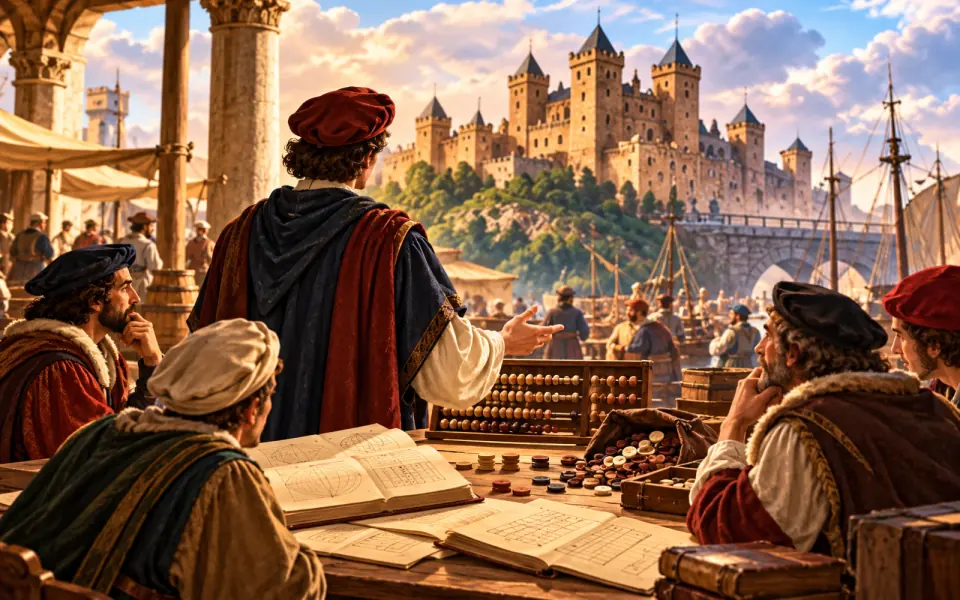
Try doing a multiplication, for example 24 times 13, with Roman numerals: XXIV times XIII. It is almost impossible without tricks, because Roman numerals have no value that depends on position and have no zero. To do calculations, in the Middle Ages, merchants used the abacus, a board with pebbles or counters on which the numbers were moved, and they had to write the results in Roman numerals. Calculating was a job for specialists.
Meanwhile, in India, for some centuries, a much more convenient system had been in use, which the Arabs had taken up and spread in their world: ten digits, from 0 to 9, in which each digit is worth more or less according to the place where it stands. The number 222 written this way contains the same symbol three times, but each is worth something different: two hundred, twenty and two. In Europe almost nobody knew it.
A boy from Pisa in Africa
Leonardo was born at Pisa around 1170. His father, Guglielmo Bonacci, was an official who worked for the Pisan merchants at Bougie, in Algeria, a busy port where traders from many countries met. As a boy Leonardo was sent there and learned calculation with the Indian digits from Arab teachers. He was struck by how convenient and precise that method was, compared with the European one.
He then travelled to Egypt, Syria, Greece, Sicily and Provence, for business and for study, and compared the various methods of calculation he came across. When he returned to Pisa he decided to write a book to explain all this to Europeans.
The Liber abaci
The book came out in 1202. It is called “Liber abaci”, that is, “Book of Calculation” (the word “abacus” here does not mean the instrument, but the art of calculating). It is an enormous treatise in Latin, divided into fifteen chapters. At the beginning it explains the nine Indian digits and the sign “0”, which he calls “zephirum”, from the Arabic, from which our words “zero” and “cipher” come. Then it teaches how to do addition, subtraction, multiplication and division with that system, how to work with fractions and how to solve practical problems: how to divide profits among partners, how to change coins, how to calculate interest, how to mix metals.
The book also contains curious problems, such as the one about rabbits: a pair of rabbits becomes adult after a month, and every following month produces a new pair; how many pairs are there after a year? The answer forms a sequence of numbers, 1, 1, 2, 3, 5, 8, 13, 21, in which each number is the sum of the two before. Today it is called the “Fibonacci sequence”, a name given much later, in the 19th century (Fibonacci is a shortening of “filius Bonacci”, son of Bonaccio).
A respected mathematician
The book did not change the world at once: the new digits were looked on with suspicion, because zero seemed easy to falsify, and in Florence, in 1299, the Arte del Cambio, the guild of the money-changers, even banned them from its own account books. But merchants grasped their advantages, and in the “abacus schools” of the Italian towns boys learned practical calculation.
Leonardo was also known at the court of the Emperor Frederick II, who around 1225 tested him with some problems, which he solved. In 1241 the commune of Pisa granted him an annual payment for his work as an adviser on the public accounts. We do not know exactly when he died: perhaps after 1240. In Pisa there is a statue dedicated to him in the Camposanto, near the square of the famous leaning tower.
Why it happened
Trade across the Mediterranean needed a quick, convenient and precise way of doing sums, above all to change coins, calculate interest and divide profits. The Pisan merchants had dealings with the Arab world.
Leonardo had the chance, as a boy, to come into contact with Arab and Indian mathematics, and the talent to explain it in an orderly and understandable way to merchants.
What changed
The Indo-Arabic number system spread in Europe over the following centuries, helped by printing, and is used all over the world today. It made modern bookkeeping and banking possible and, many centuries later, science and computing.
The Fibonacci sequence became famous. The ratio between one number and the one before gets close to 1.618, the “golden ratio”, and the sequence appears in many natural phenomena, such as the spirals of sunflower seeds and pine cones. It does not explain everything, as is often said, but it is an example of how mathematics can be found in nature.
The book started the study of algebra and calculation in Europe, and prepared the ground for mathematicians such as Cardano and Tartaglia in the 1500s.
Key people and places
People
- Leonardo Fibonacci (Leonardo of Pisa)
- Mathematician from Pisa (about 1170 - after 1240): he wrote the Liber abaci.
- Guglielmo Bonacci
- Leonardo's father, an official of the Pisan merchants at Bougie.
- Frederick II
- Emperor (1194-1250): he tested Leonardo with problems.
- Al-Khwarizmi
- Persian mathematician (about 780-850): the word “algorithm” comes from his name; his works were a source for Leonardo.
Places
- Pisa
- Leonardo's home town, an important trading port.
- Bougie (Bejaia, Algeria)
- North African port where Leonardo learned the Hindu-Arabic numerals.
Good to know
- The words “zero” and “cipher” both come from Arabic.
- The name “Fibonacci” is a shortening of “filius Bonacci”.
- In Florence, in 1299, money-changers were forbidden to use Arabic numerals in their account books.
- The Fibonacci sequence was already known in India centuries earlier.
- Leonardo learned the Hindu-Arabic numbers in Algeria, as a boy.
Find out more
- Wikipedia, “Fibonacci” en.wikipedia.org
- Wikipedia, “Liber Abaci” en.wikipedia.org
- Wikipedia, “Fibonacci sequence” en.wikipedia.org
- Wikipedia, “Hindu–Arabic numeral system” en.wikipedia.org
Related events
- Paper arrives in Europeabout 1150 · Late Middle AgesPaper made it easier to write accounts and books.
- The gold florin1252 · Late Middle AgesThe gold florin was a coin that required precise calculations.
- Marco Polo sets off for Asia1271 · Late Middle AgesMarco Polo travelled to Asia as a merchant.
- The University of Bolognaabout 1088 · Late Middle AgesThe universities also taught the arts of calculation.
Before and after, in the era “Late Middle Ages”
Event 14 of 25
 BeforeThe growth of medieval townsabout 1050
 BeforeThe East–West Schism1054
 BeforeThe Bayeux Tapestryabout 1070
 BeforeThe University of Bolognaabout 1088
 BeforeThe First Crusade1096–1099
 BeforeThe Italian communesabout 1100
 BeforeRomanesque cathedralsabout 1100
 BeforeWatermills and windmillsabout 1100
 BeforeGothic style at Saint-Denis1144
 BeforeHildegard of Bingenabout 1150
 BeforePaper arrives in Europeabout 1150
 BeforeFrederick Barbarossa1155
 BeforeFrancis of Assisiabout 1182
- You are hereFibonacci and the Liber abaci1202
 AfterMagna Carta1215
 AfterThe gold florin1252
 AfterMarco Polo sets off for Asia1271
 AfterSpectaclesabout 1286
 AfterThe Hanseatic League and northern tradeabout 1300
 AfterGiotto paints in Paduaabout 1305
 AfterDante begins the Divine Comedyabout 1307
 AfterThe Hundred Years' War1337–1453
 AfterThe Black Death1347–1352
 AfterPublic mechanical clocksabout 1350
 AfterJoan of Arc1429
Listen / Read next
- Music to read by: Cinematic JourneyEpic film-style music, no lyrics, by Ciro Simone IrmiciSpotifyYouTube Music
Meanwhile, elsewhere in the world
Other events of the era “Late Middle Ages”
- The growth of medieval towns
- The East–West Schism
- The Bayeux Tapestry
- The University of Bologna
- The First Crusade
- The Italian communes
- Romanesque cathedrals
- Watermills and windmills
- Gothic style at Saint-Denis
- Hildegard of Bingen
- Paper arrives in Europe
- Frederick Barbarossa
- Francis of Assisi
- Magna Carta
- The gold florin
- Marco Polo sets off for Asia
- Spectacles
- The Hanseatic League and northern trade
- Giotto paints in Padua
- Dante begins the Divine Comedy
- The Hundred Years' War
- The Black Death
- Public mechanical clocks
- Joan of Arc
