Dante begins the Divine Comedy
about 1307 In exile, between Lunigiana, Verona and Ravenna
In short
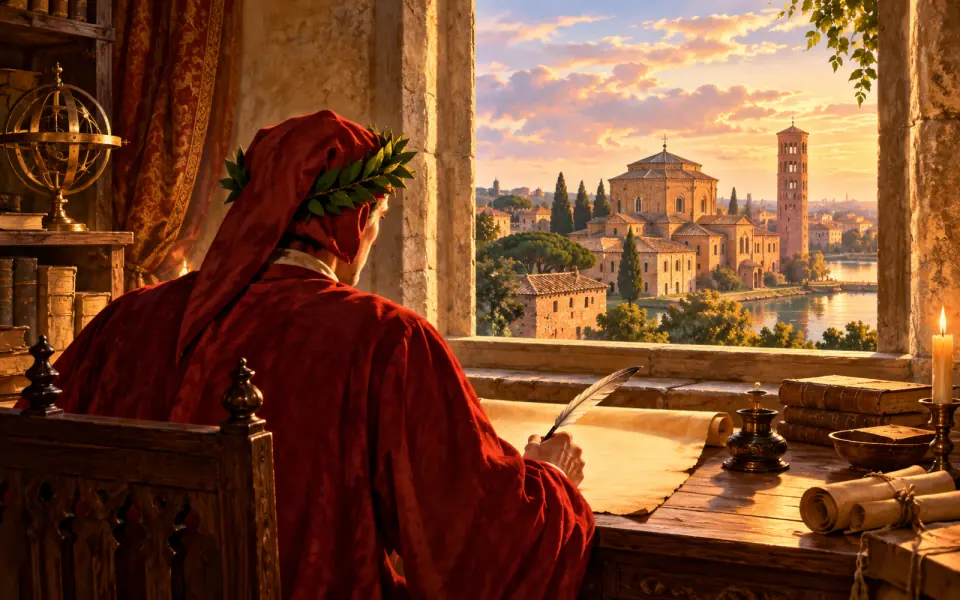
Dante Alighieri was a Florentine poet and politician, driven into exile from his city in 1302. Far from Florence he began writing the Comedy, a long poem in verse. It tells of an imaginary journey through Hell, Purgatory and Paradise: in the first two realms his guide is the poet Virgil. He chose to write it in the everyday Florentine language rather than in Latin, so that even people who had not studied could understand it. It was Boccaccio who called it ‘divine’.
Why it matters The Divine Comedy lies at the root of the Italian language: many words and expressions Italians use come from it.
Source: Treccani, entry “Dante Alighieri”
Study card about 5 minutes of reading
The story
A Florentine in Florence
Dante Alighieri was born in Florence in 1265, into a family of minor nobility. As a boy he studied, read a great deal and became a friend of poets such as Guido Cavalcanti. At the age of nine, according to his own account, he met a little girl named Beatrice, and fell in love with her for ever. Beatrice died very young, in 1290, and Dante dedicated to her a small book of verse and prose, the “Vita nova” (“New Life”).
Dante was also a man involved in politics. Florence was a republic torn by fierce struggles between two parties: the White Guelphs and the Black Guelphs, divided over how much the pope should count in the government of the city. In 1300 Dante became one of the six priors, that is, the heads of the city government, for two months. He was on the side of the Whites, who wanted to protect Florence's independence.
Exile
In 1301 Dante was sent to Rome as ambassador to Pope Boniface VIII. While he was away, the Blacks took power with the help of Charles of Valois, brother of the King of France. Dante was accused of corruption, without proof, and in 1302 he was sentenced in his absence to a fine and then to be burned at the stake if he returned to the city. He never saw Florence again.
A long exile began, lasting almost twenty years. He lived as a guest of lords and princes at various courts: in Lunigiana with the Malaspina, in Verona with the Scaligeri, and finally in Ravenna with Guido da Polenta. In the Paradiso he wrote that he knew “how salt is the taste of another man's bread, and how hard the way up and down another man's stairs”.
In exile he wrote many works: the “Convivio” (“The Banquet”), the treatise “De vulgari eloquentia” (“On Eloquence in the Vernacular”), in Latin, in which he defended the dignity of the spoken language, and “De monarchia” (“On Monarchy”). But above all he began his masterpiece. Scholars think he began the “Commedia” around 1306-1308.
A journey into the afterlife
The poem tells of a journey that Dante, the main character, makes through the afterlife, during Holy Week of 1300, at the age of thirty-five, “in the middle of the journey of our life”. He loses himself in a dark wood, and the Roman poet Virgil, a symbol of reason, guides him through Hell, an enormous funnel of nine circles where sinners are punished, then up the mountain of Purgatory, where souls are purified. At the top, Beatrice accompanies him into Paradise, through the nine heavens, up to God.
Dante meets popes, emperors, poets, friends, enemies, historical and mythological figures. Each has a punishment or a reward that suits his character. The poem is divided into three parts, or canticles, of 33 cantos each, plus an introductory one: one hundred cantos in all. It is written in tercets, stanzas of three linked lines in which the rhyme repeats in a regular pattern, and the number three, a symbol of the Trinity, appears everywhere.
A language for everyone
Dante wrote the Commedia in the vernacular, the Florentine spoken in the street, and not in Latin, the language of scholars. It was a bold choice: he wanted to be read by everyone, not only by scholars. He called it simply “Comedìa”; the adjective “Divine” was added later, by Boccaccio and then by the editors of the 1500s.
Dante died at Ravenna in the night between 13 and 14 September 1321, on his way back from a diplomatic journey to Venice, perhaps of a fever caught in the marshes. He is buried at Ravenna; Florence, which for centuries asked to have his bones back, has only an empty monument, in Santa Croce.
Why it happened
Political defeat and exile gave Dante time, distance and sorrow in which to write. He lived at many courts and came to know different men and customs, and this enriched his ideas.
Before him there were poets in the vernacular, but nobody had dared to write so great a work in a spoken language; Dante was convinced that the vernacular could express even the highest thoughts.
What changed
The Commedia was read and commented on at once, and helped to make Florentine the model of the Italian language. For this reason Dante is called “the father of the Italian language”. Many expressions used today, such as “without infamy and without praise” or “it does not touch me”, come from the poem.
The picture of the afterlife described by Dante has influenced literature, painting (from Botticelli to Doré) and cinema. The poem has been translated into all the great languages of the world.
Since 2020, 25 March, the day that many scholars give as the start of the journey, has been celebrated in Italy as “Dantedì” (Dante Day).
Key people and places
People
- Dante Alighieri
- Florentine poet (1265-1321): author of the Divine Comedy.
- Beatrice Portinari
- Woman loved by Dante (1266-1290): the poet's guide in Paradise.
- Virgil
- Roman poet (70-19 BC): Dante's guide through Hell and Purgatory.
- Boniface VIII
- Pope from 1294 to 1303: Dante's political enemy.
- Cangrande della Scala
- Lord of Verona (1291-1329): he gave Dante hospitality.
Places
- Florence
- Dante's home town, from which he was exiled in 1302.
- Verona
- City of the Scaligeri where Dante found hospitality.
- Ravenna
- City where he died in 1321 and where he is buried.
Good to know
- The Commedia has one hundred cantos: one introductory and 33 for each of the three canticles.
- The adjective “Divine” was added later by Boccaccio.
- Dante was condemned to death in his absence and never returned to Florence.
- Each canticle ends with the word “stars”.
- Since 2020, 25 March has been “Dantedì”.
Find out more
- Wikipedia, “Dante Alighieri” en.wikipedia.org
- Wikipedia, “Divine Comedy” en.wikipedia.org
- Wikipedia, “Terza rima” en.wikipedia.org
- Wikipedia, “Cangrande della Scala” en.wikipedia.org
Related events
- Giotto paints in Paduaabout 1305 · Late Middle AgesGiotto, Dante's contemporary, was painting frescoes in Padua.
- Francis of Assisiabout 1182 · Late Middle AgesDante speaks of Saint Francis in the Paradiso.
- The gold florin1252 · Late Middle AgesDante criticised the florin in the Paradiso.
- The Hundred Years' War1337–1453 · Late Middle AgesThe Hundred Years' War began a few years after Dante's death.
Before and after, in the era “Late Middle Ages”
Event 21 of 25
 BeforeThe growth of medieval townsabout 1050
 BeforeThe East–West Schism1054
 BeforeThe Bayeux Tapestryabout 1070
 BeforeThe University of Bolognaabout 1088
 BeforeThe First Crusade1096–1099
 BeforeThe Italian communesabout 1100
 BeforeRomanesque cathedralsabout 1100
 BeforeWatermills and windmillsabout 1100
 BeforeGothic style at Saint-Denis1144
 BeforeHildegard of Bingenabout 1150
 BeforePaper arrives in Europeabout 1150
 BeforeFrederick Barbarossa1155
 BeforeFrancis of Assisiabout 1182
 BeforeFibonacci and the Liber abaci1202
 BeforeMagna Carta1215
 BeforeThe gold florin1252
 BeforeMarco Polo sets off for Asia1271
 BeforeSpectaclesabout 1286
 BeforeThe Hanseatic League and northern tradeabout 1300
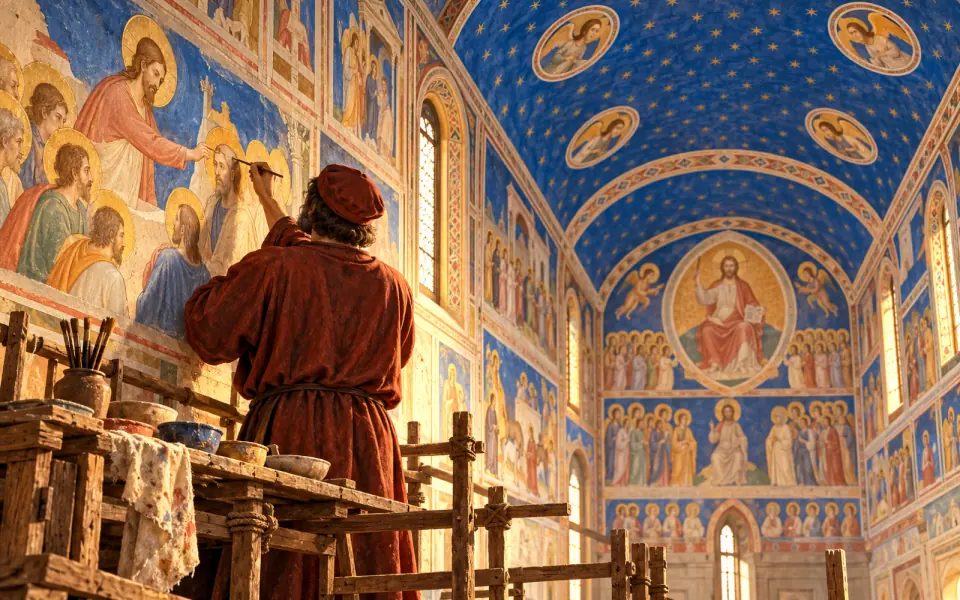 BeforeGiotto paints in Paduaabout 1305
- You are hereDante begins the Divine Comedyabout 1307
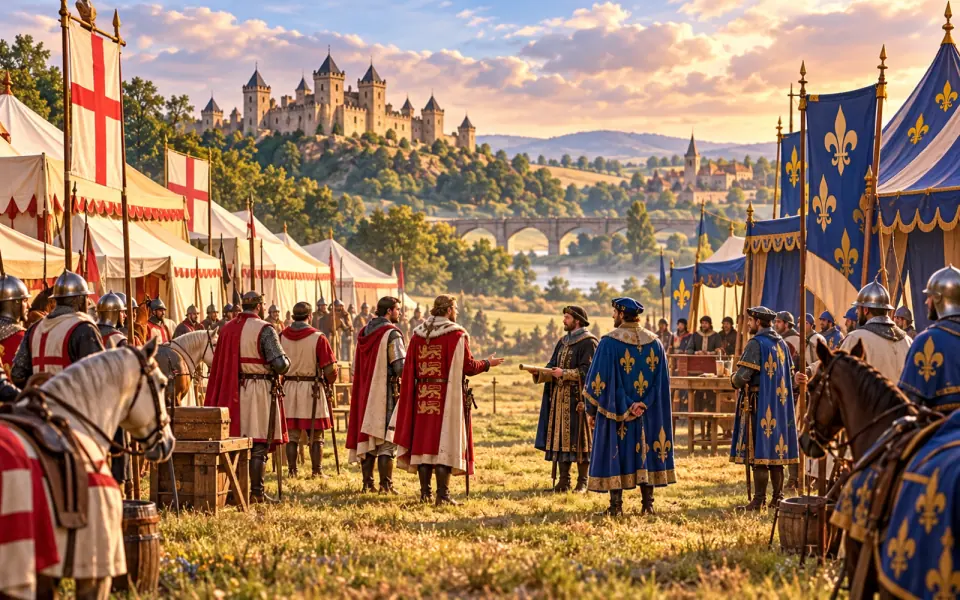 AfterThe Hundred Years' War1337–1453
 AfterThe Black Death1347–1352
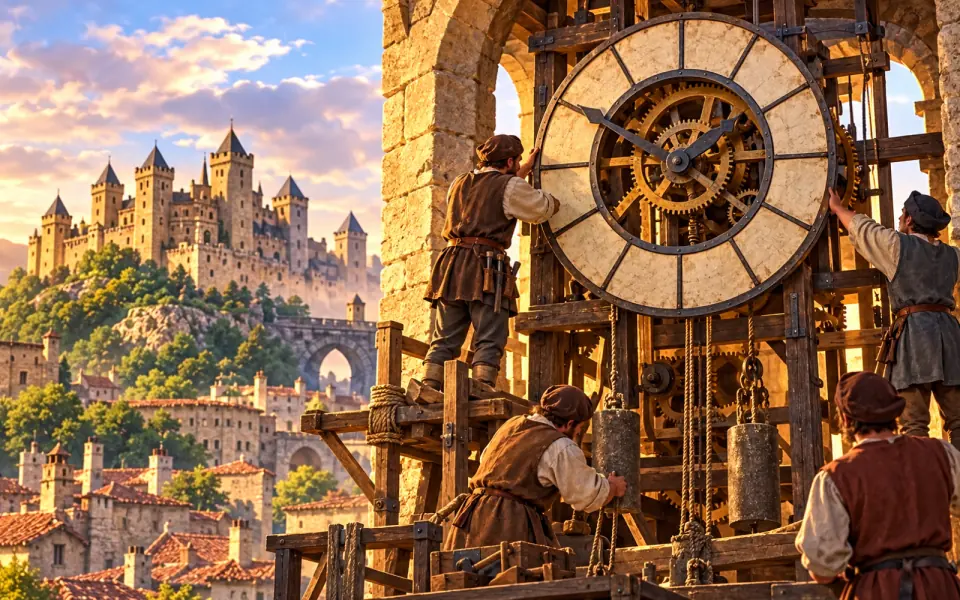 AfterPublic mechanical clocksabout 1350
 AfterJoan of Arc1429
In legend
Listen / Read next
- Music to read by: Cinematic JourneyEpic film-style music, no lyrics, by Ciro Simone IrmiciSpotifyYouTube Music
- How Italians spoke: the dialectsNonnese, the dictionary of Italian dialects
Meanwhile, elsewhere in the world
Other events of the era “Late Middle Ages”
- The growth of medieval towns
- The East–West Schism
- The Bayeux Tapestry
- The University of Bologna
- The First Crusade
- The Italian communes
- Romanesque cathedrals
- Watermills and windmills
- Gothic style at Saint-Denis
- Hildegard of Bingen
- Paper arrives in Europe
- Frederick Barbarossa
- Francis of Assisi
- Fibonacci and the Liber abaci
- Magna Carta
- The gold florin
- Marco Polo sets off for Asia
- Spectacles
- The Hanseatic League and northern trade
- Giotto paints in Padua
- The Hundred Years' War
- The Black Death
- Public mechanical clocks
- Joan of Arc
