Giotto paints in Padua
about 1305 Scrovegni Chapel, Padua
In short
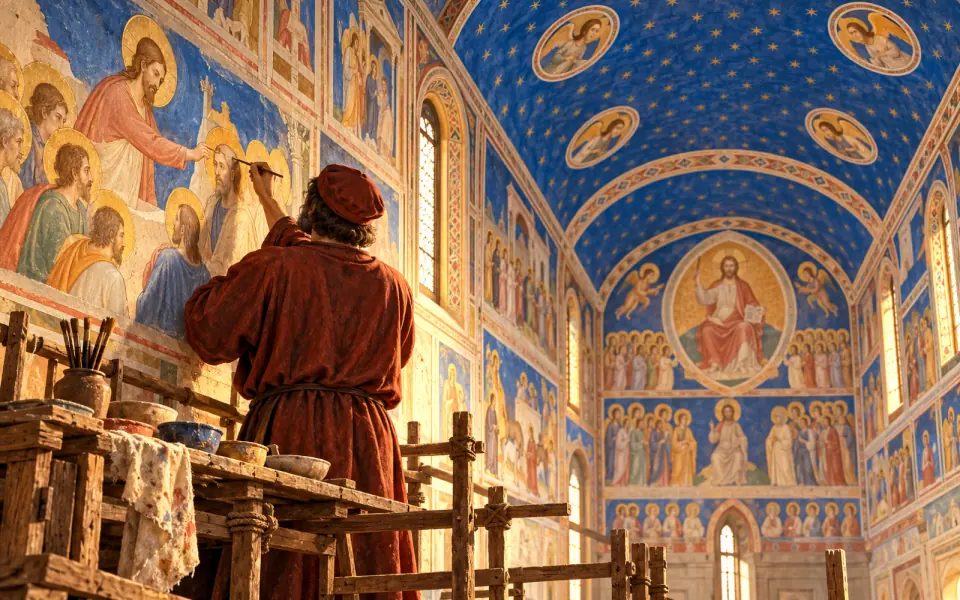
The rich Paduan banker Enrico Scrovegni called on Giotto to decorate his chapel. Between about 1303 and 1305 the Florentine painter covered the walls with frescoes telling the stories of Mary and Jesus. His figures have solid bodies, natural gestures and faces that express sorrow, joy or wonder. The ceiling is a deep blue sky full of golden stars.
Why it matters Giotto opened the way to a more lifelike, human kind of painting that would lead to the Renaissance.
Source: UNESCO, “Padua's fourteenth-century fresco cycles”
Study card about 4 minutes of reading
The story
A banker who wanted to be forgiven
In Padua, at the beginning of the 1300s, there lived a very rich man, Enrico Scrovegni. His father, Reginaldo, was a banker who lent money at very high interest, an activity the Church considered a grave sin, usury. Dante, in the Divine Comedy, puts Reginaldo in Hell, among the usurers. Enrico wanted to restore the family's good name, and decided to have a chapel built.
He bought a plot of land inside the remains of an ancient Roman amphitheatre, the Arena, and built a small church dedicated to Santa Maria della Carità, which was inaugurated on 25 March 1303, the day of the Annunciation, and definitively consecrated on the same day in 1305. To decorate it he called the most famous painter of the time: Giotto.
The painter of sheep
Giotto di Bondone was born around 1267, according to tradition at Vespignano, in Tuscany, near Florence. A legend, told by the painter and biographer Giorgio Vasari, says that as a boy he was a little shepherd and drew his sheep on a stone; the painter Cimabue, passing by, saw the drawing, was impressed and took him into his workshop. We do not know whether it is true, but certainly Giotto learned the trade and soon surpassed his teachers.
Medieval painting before him was usually very solemn: stiff figures, gold backgrounds, faces similar to one another, little movement, like icons. Giotto changed everything. He painted figures with volume, as if they had a real body, heavy and three-dimensional, wrapped in clothes that fall in natural folds. His scenes have deep space, with buildings and landscapes in which the figures move believably.
The chapel
Between 1303 and 1305 Giotto and his assistants covered all the walls with frescoes, that is, with paintings done on plaster that is still damp, so that the colour sinks into the wall. They worked in “days”: each day only as much plaster was laid as could be painted before it dried. The edges of the days can still be made out if you look at the frescoes close up.
The cycle tells, in three bands from top to bottom, the stories of Joachim and Anne, Mary's parents, then the life of Mary and finally the life and passion of Jesus. On the entrance wall is the Last Judgement, in which Enrico Scrovegni can be seen offering the Virgin a small model of the chapel. Below, in monochrome, are the allegories of the Virtues and the Vices. The ceiling is a deep blue like a night sky, dotted with golden stars.
The scenes are famous for their emotions. In the “Flight into Egypt” the donkeys and people are realistic. In the “Nativity” there are shepherds and sheep. In the “Lamentation over the Dead Christ” the angels fly in the sky weeping and twisting, while at the foot of the cross the family show all their despair. For the first time in Western art the sacred figures seem like real people who suffer and who are moved.
A chapel to protect
After Padua, Giotto worked at Assisi, Florence, Rome and Naples. In 1334 he became master builder of Florence Cathedral and designed the bell tower, which was later called “Giotto's Campanile”. He died in 1337. Dante remembered him in the Purgatorio, writing that Giotto had overshadowed the fame of Cimabue.
The Scrovegni Chapel is today one of the most precious places in Italian painting. To protect the frescoes from damp and from the breath of visitors, people enter in small groups, first passing through a chamber where they wait for about fifteen minutes. In 2021 the chapel was added, together with other fresco cycles of Padua, to UNESCO's World Heritage List.
Why it happened
Giotto came after centuries in which painting had remained very stylised, but the towns of the 1200s and 1300s were ready for a vision closer to reality. The teachings of Saint Francis and the sermons of the mendicant orders had drawn attention to human feelings.
Enrico Scrovegni had money and the wish to be recognised as a good Christian and an important man: he entrusted the work to the best and allowed him to work at length.
What changed
Giotto is considered the start of a new road in Italian painting, which led to the Renaissance: volume, perspective and attention to emotions. It is said that with Giotto “painting is reborn”. His style was followed by many artists, such as Masaccio a century later.
The frescoes of the chapel have remained in good condition for seven hundred years and are studied by historians, restorers and scientists. They were carefully restored between 2001 and 2002.
Giotto's name has also remained in an Italian saying, “Giotto's O”, which recalls an anecdote about the perfect circle the painter is said to have drawn freehand.
Key people and places
People
- Giotto di Bondone
- Tuscan painter and architect (about 1267-1337): he painted the frescoes of the chapel.
- Enrico Scrovegni
- Banker from Padua (about 1270-1336): he commissioned the chapel.
- Cimabue
- Florentine painter (about 1240-1302): according to tradition, Giotto's teacher.
- Reginaldo Scrovegni
- Banker, Enrico's father: Dante puts him among the usurers.
Places
- Padua
- City in the Veneto where the Scrovegni Chapel is found.
- Roman Arena of Padua
- The remains of the amphitheatre where the chapel stands.
Good to know
- Giotto's frescoes in Padua are more than seven hundred years old.
- To visit the Chapel you wait about fifteen minutes in a special chamber.
- Dante put Enrico Scrovegni's father in Hell, among the usurers.
- The ceiling is painted deep blue with golden stars.
- Giotto designed the bell tower of Florence Cathedral.
Find out more
- Wikipedia, “Scrovegni Chapel” en.wikipedia.org
- Wikipedia, “Giotto” en.wikipedia.org
- Wikipedia, “Enrico Scrovegni” en.wikipedia.org
Related events
- Dante begins the Divine Comedyabout 1307 · Late Middle AgesDante knew Giotto and mentioned him in the Purgatorio.
- Francis of Assisiabout 1182 · Late Middle AgesGiotto also painted the stories of Saint Francis.
- Gothic style at Saint-Denis1144 · Late Middle AgesGiotto worked in the age of the great Gothic cathedrals.
- The gold florin1252 · Late Middle AgesThe wealth of bankers also paid for art.
Before and after, in the era “Late Middle Ages”
Event 20 of 25
 BeforeThe growth of medieval townsabout 1050
 BeforeThe East–West Schism1054
 BeforeThe Bayeux Tapestryabout 1070
 BeforeThe University of Bolognaabout 1088
 BeforeThe First Crusade1096–1099
 BeforeThe Italian communesabout 1100
 BeforeRomanesque cathedralsabout 1100
 BeforeWatermills and windmillsabout 1100
 BeforeGothic style at Saint-Denis1144
 BeforeHildegard of Bingenabout 1150
 BeforePaper arrives in Europeabout 1150
 BeforeFrederick Barbarossa1155
 BeforeFrancis of Assisiabout 1182
 BeforeFibonacci and the Liber abaci1202
 BeforeMagna Carta1215
 BeforeThe gold florin1252
 BeforeMarco Polo sets off for Asia1271
 BeforeSpectaclesabout 1286
 BeforeThe Hanseatic League and northern tradeabout 1300
- You are hereGiotto paints in Paduaabout 1305
 AfterDante begins the Divine Comedyabout 1307
 AfterThe Hundred Years' War1337–1453
 AfterThe Black Death1347–1352
 AfterPublic mechanical clocksabout 1350
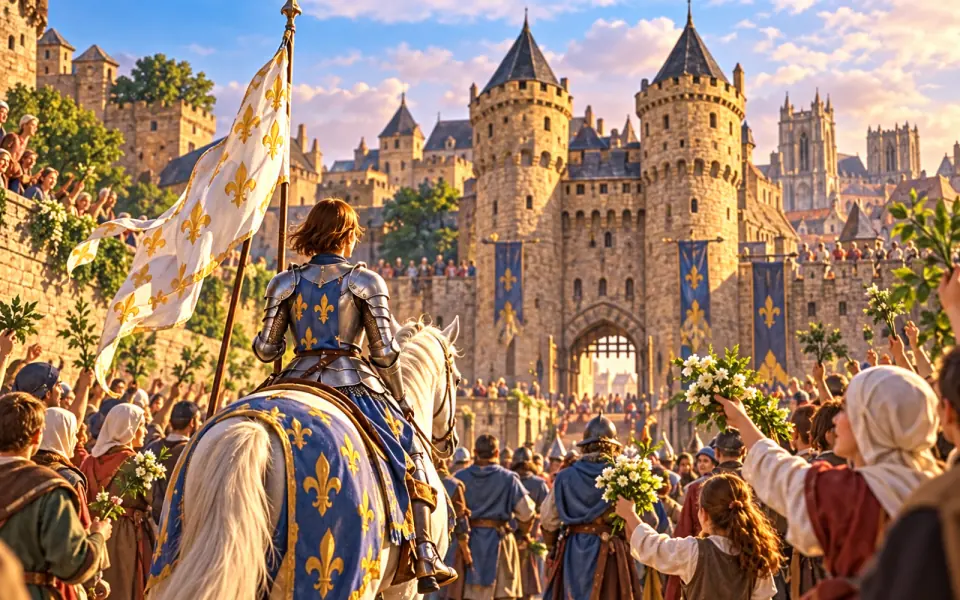 AfterJoan of Arc1429
Listen / Read next
- Music to read by: Cinematic JourneyEpic film-style music, no lyrics, by Ciro Simone IrmiciSpotifyYouTube Music
Meanwhile, elsewhere in the world
Other events of the era “Late Middle Ages”
- The growth of medieval towns
- The East–West Schism
- The Bayeux Tapestry
- The University of Bologna
- The First Crusade
- The Italian communes
- Romanesque cathedrals
- Watermills and windmills
- Gothic style at Saint-Denis
- Hildegard of Bingen
- Paper arrives in Europe
- Frederick Barbarossa
- Francis of Assisi
- Fibonacci and the Liber abaci
- Magna Carta
- The gold florin
- Marco Polo sets off for Asia
- Spectacles
- The Hanseatic League and northern trade
- Dante begins the Divine Comedy
- The Hundred Years' War
- The Black Death
- Public mechanical clocks
- Joan of Arc
