The Hanseatic League and northern trade
about 1300 Lübeck and the ports of the North Sea and the Baltic
In short
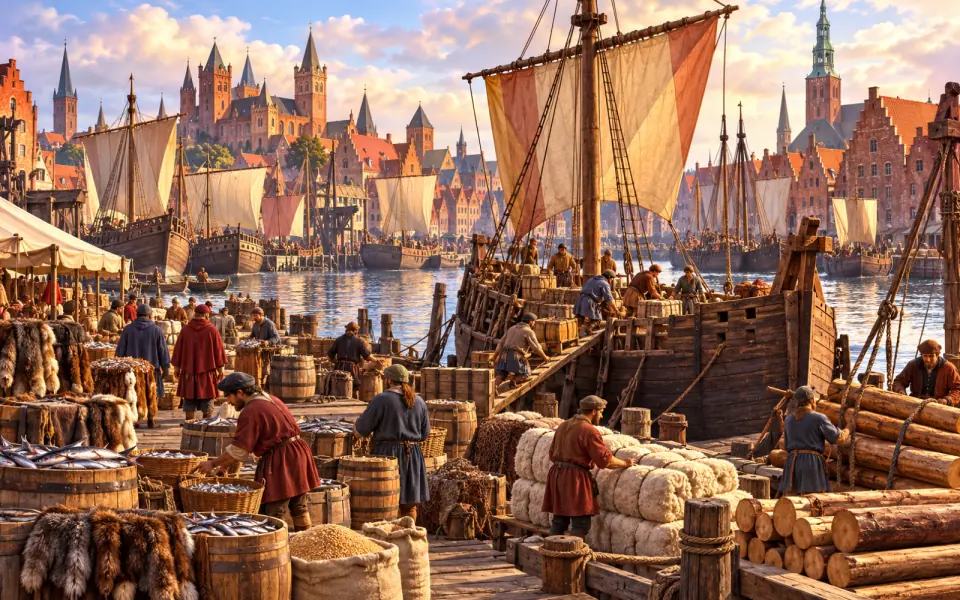
The Hanseatic League, or Hansa, was an alliance of merchant towns in northern Europe led by Lübeck. Dozens of German and Baltic towns belonged to it, and it had trading bases in London, Bruges, Bergen and Novgorod. Its ships, called cogs, carried salted fish, timber, furs, grain and wool. The towns helped each other to protect trade from pirates and to win privileges from kings.
Why it matters The Hansa shows how trade could unite towns from different countries with different languages.
Source: Encyclopaedia Britannica, “Hanseatic League”
Study card about 4 minutes of reading
The story
Merchants united against dangers
While Italian merchants traded in the Mediterranean, in northern Europe other merchants did business in the Baltic and the North Sea. They sold grain, fish, timber, furs, wax, amber, salt, beer and wool cloth. But travelling was dangerous: the seas were full of pirates, the roads full of bandits, and every lord wanted to charge tolls. A merchant on his own was in difficulty.
For this reason the German merchants of the northern towns began to join in groups, called “Hansa”, an old word meaning “company” or “group”. They helped one another, travelled in convoy, agreed prices and together asked rulers for privileges and protection. Soon it was not only the merchants who joined together, but also the towns they came from.
Lübeck, queen of the Baltic
The capital of the League was Lübeck, a town founded on the river Trave, near the Baltic. It had a perfect position: it was linked by land to Lüneburg, and so to Hamburg and the North Sea, by the “salt road”, and from its port one could sail into the Baltic towards the east. After being refounded in 1159 by the Duke of Saxony, Henry the Lion, it became the centre of trade.
Around 1300 the towns that made up the Hansa numbered dozens: Lübeck, Hamburg, Bremen, Rostock, Gdańsk, Riga, Cologne and many others; at the time of greatest growth, in the 1300s and 1400s, there were quite a few dozen, with perhaps two hundred places connected. From about 1356 they had a regular assembly, the “Hansetag”, which met at Lübeck to take common decisions. There was no king of the League and no real army, but a pact of alliance between free towns.
Ships, warehouses and factories abroad
The typical means of transport was the cog (in German Kogge), a broad sailing ship with a single mast, a flat bottom and high sides, able to carry a heavy load with a small crew. One of these ships, built in 1380 and found in the mud of the river Weser in 1962, can be seen today in a museum at Bremerhaven, in the state of Bremen.
The League also had permanent bases in foreign towns, called “Kontore”: large walled quarters, with warehouses, houses, offices and sometimes even a church, where the German merchants lived. The main ones were in London (the Steelyard), in Bruges, in Bergen, in Norway, where you can still visit the historic district of wooden warehouses called Bryggen, and in Novgorod, in Russia. There the merchants lived by strict rules: in Bergen, for example, young apprentices could not marry and had to follow a very harsh discipline.
War, when needed
The League was not made for war, but sometimes it fought. In 1361 the King of Denmark Valdemar IV conquered the island of Gotland and plundered the town of Visby, with no regard for the merchants' privileges. The towns of the Hansa allied, defeated him and with the Peace of Stralsund of 1370 obtained great trading privileges in the Baltic. For a time the League had a political weight equal to that of the neighbouring kingdoms.
Famous too are the pirates of the northern seas, such as Klaus Störtebeker, who was captured in 1401 and executed in Hamburg. There are many legends about him, and historians still argue about them.
The decline
From the 1500s the League weakened. Dutch and English merchants became stronger, the voyages of discovery shifted trade towards the Atlantic, and national kingdoms, such as Sweden and Russia, wanted to trade on their own. The last assembly was held in 1669. Today Hamburg, Bremen and Lübeck are still called “free and Hanseatic cities”, and the old town of Lübeck has been a UNESCO World Heritage Site since 1987.
Why it happened
The merchants of the north needed to protect themselves from pirates, bandits and tolls, and to obtain privileges from foreign rulers. By uniting they were stronger.
The trade in heavy, cheap goods, such as grain, timber and fish, required large ships and large quantities, and keeping prices under control. A company of towns could do this better than a single one.
What changed
For almost three centuries the Hanseatic League united the towns of the Baltic and the North Sea in a network of trade, which brought wealth and exchange: banks, warehouses and brick churches in the Gothic style were born, which can still be seen at Lübeck, Gdańsk and Tallinn.
It spread common rules on trade, on maritime law and on the honesty of merchants. The use of Low German as a language of trade from the Baltic to the North Sea is also due to them.
The memory of the Hansa has remained: the German airline Lufthansa carries its name, and many northern towns preserve their old warehouses.
Key people and places
People
- Henry the Lion
- Duke of Saxony and Bavaria (1129-1195): he refounded Lübeck in 1159.
- Valdemar IV of Denmark
- King from 1340 to 1375: defeated by the League in 1370.
- Klaus Störtebeker
- Baltic pirate (died 1401): executed in Hamburg.
- The Hanseatic merchants
- German traders of the northern towns gathered in the League.
Places
- Lübeck
- Capital of the League on the Baltic, rich in medieval churches and warehouses.
- Bergen (Norway)
- Home of a great Kontor, with the Bryggen district.
- Visby (Gotland)
- Swedish town on the island of Gotland, an old port of the League.
Good to know
- The word “Hansa” means “company”.
- A cog built in 1380 and found in 1962 can be seen at Bremerhaven.
- The name Lufthansa means “air Hansa”.
- Hamburg, Bremen and Lübeck are still called free and Hanseatic cities.
- The Bryggen district of Bergen is a World Heritage Site.
Find out more
- Wikipedia, “Hanseatic League” en.wikipedia.org
- Wikipedia, “Lübeck” en.wikipedia.org
- Wikipedia, “Bryggen” en.wikipedia.org
- Wikipedia, “Klaus Störtebeker” en.wikipedia.org
Related events
- The growth of medieval townsabout 1050 · Late Middle AgesGrowing towns were the base of the League.
- Marco Polo sets off for Asia1271 · Late Middle AgesAt the same time, in the Mediterranean, Italian merchants travelled as far as China.
- The gold florin1252 · Late Middle AgesItalian bankers too lent money all over Europe.
- The Black Death1347–1352 · Late Middle AgesThe Black Death hit the northern ports hard.
Before and after, in the era “Late Middle Ages”
Event 19 of 25
 BeforeThe growth of medieval townsabout 1050
 BeforeThe East–West Schism1054
 BeforeThe Bayeux Tapestryabout 1070
 BeforeThe University of Bolognaabout 1088
 BeforeThe First Crusade1096–1099
 BeforeThe Italian communesabout 1100
 BeforeRomanesque cathedralsabout 1100
 BeforeWatermills and windmillsabout 1100
 BeforeGothic style at Saint-Denis1144
 BeforeHildegard of Bingenabout 1150
 BeforePaper arrives in Europeabout 1150
 BeforeFrederick Barbarossa1155
 BeforeFrancis of Assisiabout 1182
 BeforeFibonacci and the Liber abaci1202
 BeforeMagna Carta1215
 BeforeThe gold florin1252
 BeforeMarco Polo sets off for Asia1271
 BeforeSpectaclesabout 1286
- You are hereThe Hanseatic League and northern tradeabout 1300
 AfterGiotto paints in Paduaabout 1305
 AfterDante begins the Divine Comedyabout 1307
 AfterThe Hundred Years' War1337–1453
 AfterThe Black Death1347–1352
 AfterPublic mechanical clocksabout 1350
 AfterJoan of Arc1429
Listen / Read next
- Music to read by: Cinematic JourneyEpic film-style music, no lyrics, by Ciro Simone IrmiciSpotifyYouTube Music
Meanwhile, elsewhere in the world
Other events of the era “Late Middle Ages”
- The growth of medieval towns
- The East–West Schism
- The Bayeux Tapestry
- The University of Bologna
- The First Crusade
- The Italian communes
- Romanesque cathedrals
- Watermills and windmills
- Gothic style at Saint-Denis
- Hildegard of Bingen
- Paper arrives in Europe
- Frederick Barbarossa
- Francis of Assisi
- Fibonacci and the Liber abaci
- Magna Carta
- The gold florin
- Marco Polo sets off for Asia
- Spectacles
- Giotto paints in Padua
- Dante begins the Divine Comedy
- The Hundred Years' War
- The Black Death
- Public mechanical clocks
- Joan of Arc
