Spectacles
about 1286 Tuscany (perhaps Pisa)
In short
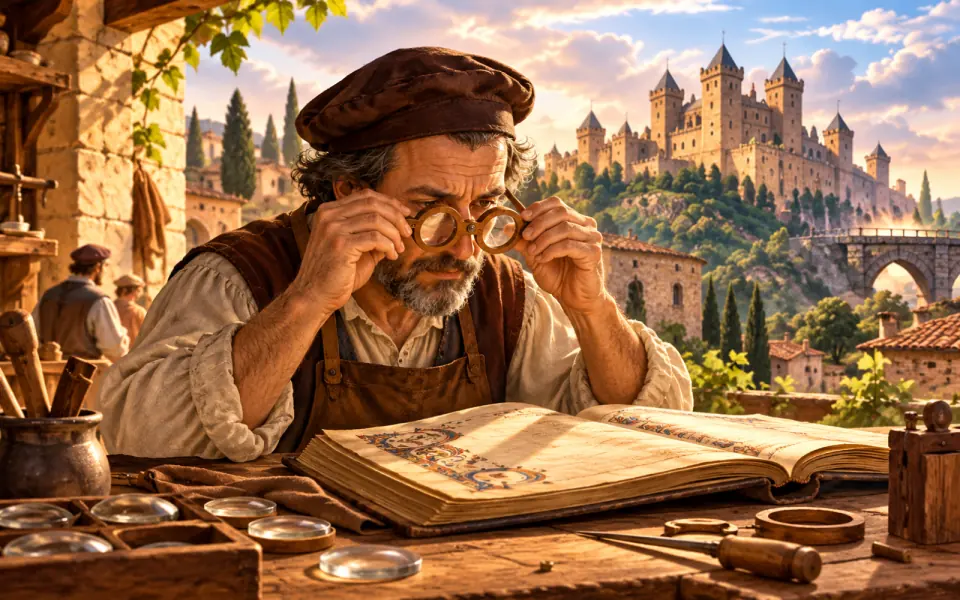
In a sermon given in Florence in 1306, the friar Giordano of Pisa said that the art of making spectacles had been invented less than twenty years earlier. So it is thought that the first spectacles were made in Tuscany, perhaps in Pisa, in the 1280s. They were two glass lenses set in small wooden or bone rings and joined by a pin, to be balanced on the nose. We do not know the inventor's name for certain.
Why it matters Spectacles allowed people with poor close-up sight to keep reading and working even in old age.
Source: University of Oxford, Cabinet, “Spectacles: technology unknown to the ancients, c. 1290”
Study card about 5 minutes of reading
The story
When letters go blurry
Anyone over forty knows it: at a certain point reading becomes tiring. The letters in books go blurry and you have to hold the page further away to see them. The condition is called presbyopia: with age the lens, the eye's natural lens, loses its elasticity and finds it harder to focus on things that are close. Today it is solved with a pair of glasses, but for thousands of years there was no remedy.
For a monk, a copyist, a notary or a merchant who needed to read and write for a living, presbyopia often meant the end of a career at about forty. The work of the monasteries and of the writing workshops depended on healthy eyes.
Lenses already known
Lenses had been known for a long time. People knew that a piece of rock crystal or glass, cut into the shape of a drop, makes things look bigger. Arab scholars, such as Ibn al-Haytham (Alhazen), had written treatises on optics. In Europe, in the 1200s, the English friar Roger Bacon spoke of lenses that help people with weak sight. In monasteries, crystal stones were used, called “reading stones”, to be laid on the pages to magnify the letters.
One decisive step was missing: putting two lenses in a frame to wear in front of the eyes, and freeing the hands.
Friar Giordano's testimony
On 23 February 1306, in Florence, in a church, a Dominican friar from Pisa, Giordano da Pisa, gave a sermon. At one point he said that not even twenty years had passed since the art of making spectacles had been found, “one of the best and most necessary arts that the world has”, and that he had personally known the man who first made them. His words are one of the oldest documents that mention spectacles: they tell us that they were invented around 1286-1290, probably in Tuscany.
We do not know who the inventor was, and perhaps we never shall. A chronicle of the Dominican convent of Santa Caterina, in Pisa, tells that another friar, Alessandro della Spina, who died in 1313, happened to see a pair of spectacles made by a person who did not want to reveal the secret; Alessandro copied them and taught everyone how to make them, “with a cheerful and willing heart”. That is why, in the 1300s, spectacles spread quickly.
Spectacles were liked at once, but not by everyone: people who wore them were sometimes teased, and for a while they were thought of as an object for elderly and learned people. In the 1400s, with printed books, they became normal; scholars wore them habitually, and in many paintings scholarly saints, such as Saint Jerome, have spectacles on the table.
What the first spectacles were like
The first spectacles did not have the arms that rest on the ears. They were two convex lenses, that is, curved outward, in frames of bone, wood, horn or metal, joined by a rivet above the nose. They were held in the hand in front of the eyes or rested on the nose, and served only for reading close up. The lenses, of rock crystal or glass, were very expensive and made by hand.
The oldest picture of spectacles is a fresco of 1352 by Tommaso da Modena, at Treviso, in which Cardinal Hugh of Saint-Cher, busy writing in his study, has a pair of spectacles on his nose. Soon afterwards they multiplied in paintings. In Venice, at Murano and elsewhere, workshops of spectacle-makers (“occhialai”) arose, with rules for the quality of their products.
Spectacles for the short-sighted, with concave lenses, appeared later, in the 1400s. A famous example is Raphael's portrait of Pope Leo X, of about 1518, in which the pope holds in his hand a lens for the short-sighted. The arms that rest on the ears were introduced only in the 1700s.
Why it happened
Medieval towns had more and more people who worked by reading and writing: notaries, merchants, copyists, students. For them sight was a tool of the trade, and losing it meant losing their work.
The Italian glassmakers, in Pisa, Venice and elsewhere, knew how to work glass and crystal well, and knew the properties of lenses. When someone had the idea of mounting them in front of the eyes, all the necessary knowledge was already there.
What changed
Spectacles prolonged the working lives of many scholars, scribes and craftsmen. With printing, in the 1400s, demand grew further, because books were more widespread and more people learned to read.
The study of lenses led, centuries later, to the microscope and the telescope, instruments that changed science: the Dutch telescope of 1608 used two lenses, and Galileo, in 1609, built a better one.
Spectacles are still one of the most useful inventions: today millions of people in the world wear a pair, and they are used alongside contact lenses and eye surgery.
Key people and places
People
- Giordano da Pisa
- Dominican friar (about 1260-1311): in 1306 he mentioned the invention of spectacles.
- Alessandro della Spina
- Friar of Pisa (died 1313): according to the chronicle he copied spectacles and spread the technique.
- Tommaso da Modena
- Painter (about 1325-1379): in 1352 he painted the oldest portrait with spectacles.
- Roger Bacon
- English friar and scholar (about 1214-1292): he wrote of lenses to help sight.
Places
- Pisa
- Tuscan city where the friars mentioned in the documents lived.
- Murano (Venice)
- Island of the glassmakers, where crystal was worked for lenses.
Good to know
- One of the oldest documents about spectacles is a sermon of 1306.
- The inventor of spectacles is unknown.
- The first spectacles had no arms: they were held on the nose.
- The oldest painting with spectacles dates from 1352 and is in Treviso.
- Lenses for the short-sighted spread in the 1400s.
Find out more
- Wikipedia, “Glasses” en.wikipedia.org
- Wikipedia, “Alessandro della Spina” en.wikipedia.org
- Wikipedia, “Jordan of Pisa” en.wikipedia.org
- Wikipedia, “Presbyopia” en.wikipedia.org
Related events
- Paper arrives in Europeabout 1150 · Late Middle AgesPaper and books made it necessary to read more.
- Public mechanical clocksabout 1350 · Late Middle AgesMechanical clocks were also born in the same century.
- Fibonacci and the Liber abaci1202 · Late Middle AgesFibonacci, a century earlier, had taught calculation that needed careful eyes.
- The University of Bolognaabout 1088 · Late Middle AgesStudents and professors at the universities read a great deal.
Before and after, in the era “Late Middle Ages”
Event 18 of 25
 BeforeThe growth of medieval townsabout 1050
 BeforeThe East–West Schism1054
 BeforeThe Bayeux Tapestryabout 1070
 BeforeThe University of Bolognaabout 1088
 BeforeThe First Crusade1096–1099
 BeforeThe Italian communesabout 1100
 BeforeRomanesque cathedralsabout 1100
 BeforeWatermills and windmillsabout 1100
 BeforeGothic style at Saint-Denis1144
 BeforeHildegard of Bingenabout 1150
 BeforePaper arrives in Europeabout 1150
 BeforeFrederick Barbarossa1155
 BeforeFrancis of Assisiabout 1182
 BeforeFibonacci and the Liber abaci1202
 BeforeMagna Carta1215
 BeforeThe gold florin1252
 BeforeMarco Polo sets off for Asia1271
- You are hereSpectaclesabout 1286
 AfterThe Hanseatic League and northern tradeabout 1300
 AfterGiotto paints in Paduaabout 1305
 AfterDante begins the Divine Comedyabout 1307
 AfterThe Hundred Years' War1337–1453
 AfterThe Black Death1347–1352
 AfterPublic mechanical clocksabout 1350
 AfterJoan of Arc1429
Listen / Read next
- Music to read by: Cinematic JourneyEpic film-style music, no lyrics, by Ciro Simone IrmiciSpotifyYouTube Music
Meanwhile, elsewhere in the world
Other events of the era “Late Middle Ages”
- The growth of medieval towns
- The East–West Schism
- The Bayeux Tapestry
- The University of Bologna
- The First Crusade
- The Italian communes
- Romanesque cathedrals
- Watermills and windmills
- Gothic style at Saint-Denis
- Hildegard of Bingen
- Paper arrives in Europe
- Frederick Barbarossa
- Francis of Assisi
- Fibonacci and the Liber abaci
- Magna Carta
- The gold florin
- Marco Polo sets off for Asia
- The Hanseatic League and northern trade
- Giotto paints in Padua
- Dante begins the Divine Comedy
- The Hundred Years' War
- The Black Death
- Public mechanical clocks
- Joan of Arc
