Watermills and windmills
about 1100 Europe (England, France, Italy)
In short
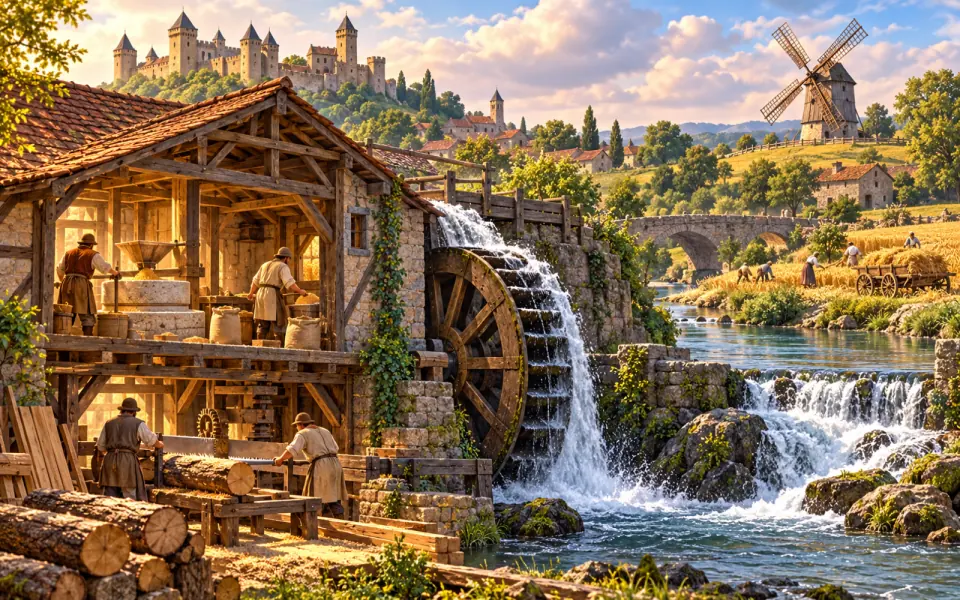
Watermills were already known to the Romans, but in the Middle Ages a great many were built along rivers and canals. In England a great survey of 1086, the Domesday Book, counted more than five thousand of them. Towards the end of the 12th century windmills appeared too, useful where there were no streams or rivers. They were used to grind grain, but also to pound cloth, saw wood and work iron.
Why it matters Using the power of water and wind instead of human muscle was a first step towards modern machines.
Source: Encyclopaedia Britannica, “Mill”
Study card about 4 minutes of reading
The story
Grinding by hand was hard work
To make bread you need flour, and to make flour you have to grind grain. For thousands of years, at home, this was done by hand: the grain was crushed between two stones, one fixed and one that was turned. It was long, tiring work, often done by women and slaves, and after hours of effort it produced little flour. A family might spend many hours every day grinding, just to have bread for the next day.
The ancient Romans already knew the watermill: a wheel that turns, pushed by the current of a river, and that, through a series of gears, moves the millstone. But it was in the Middle Ages that this machine really spread, across the whole of Europe. Around the year 1000, every village near a stream wanted its own mill.
A thousand mills in England
An extraordinary document lets us see how widespread they were: the Domesday Book, the great register that King William the Conqueror had compiled in England in 1086 to count the lands and goods of the kingdom. It lists about five thousand six hundred watermills, in a country that perhaps had a couple of million inhabitants: roughly one mill for every fifty families.
The mill usually belonged to the local lord or to a monastery. The peasants were obliged to use it and to pay part of their flour for the service, a charge called “multure”; they could not grind at home. It was not unusual for quarrels to arise between the miller, who had a reputation for cheating, and his customers.
From water to wind
Where there were no fast rivers, for example on plains, on coasts, in the Low Countries or in eastern England, another force was found: the wind. Windmills appeared in Europe in the second half of the 12th century; the first certain evidence, in England and north-western Europe, dates from around 1180-1190. They were built of wood, with sails that turned on their axle. The whole mill rested on a big post and could be turned by hand, to put the sails into the wind.
Later, tide mills also spread, in which the sea, as it rose and fell, filled and emptied a basin that drove the wheel. They were used in Venice, in England and in Spain. On the great rivers, such as the Po and the Tiber, floating mills appeared, built on top of moored boats.
The miller's work was not simple. He had to choose the right stone, adjust the distance between the two millstones so that the flour was neither too coarse nor too fine, and keep the wheel in good condition. The noise of the mill, wheels, gears and millstones, could be heard from far away, and the mill was also a place where people met and exchanged news.
Not just flour
The great discovery was that the water wheel could also drive other machines. With a camshaft, that is, an axle with teeth that lift and let fall a hammer, people made trip-hammers for beating iron, fulling mills for beating and felting wool cloth, saws for cutting logs, bellows for forges, machines for working paper and leather, and presses for oil. In Europe whole towns, such as Fabriano for paper, grew rich thanks to the energy of water.
In the Low Countries, from the 1400s, windmills were also used to pump water off the low-lying land, winning new fields from the sea, the polders.
Why it happened
The growth of the population required more flour, and work by hand was no longer enough. The lords' lands had rivers and canals, and the lords saw in mills a good source of profit.
There was a shortage of labour for heavy work, and machines driven by water and wind saved human effort. In addition, lords and monasteries had the means to build dams and canals, and could earn money from the payment for grinding.
What changed
The mill was the first machine to be truly widespread and used by the whole of society. For the first time the energy of a river or of the wind replaced the work of human arms on a large scale, with effects similar, though smaller, to those the steam engine would have many centuries later.
Trades and activities linked to water multiplied: millers, carpenters, makers of gears, joiners. The technique of turning circular motion into back-and-forth motion, with cams and cranks, was born; it lies behind many later machines.
Mills have left their mark on language and landscapes too: street names, surnames such as Molinari and Mulder, canals, and ruined mills scattered along the rivers.
Key people and places
People
- The miller
- He ran the mill and received part of the flour as payment.
- William the Conqueror
- King of England (about 1028-1087): he had the Domesday Book compiled, which counts thousands of mills.
- Vitruvius
- Roman architect of the 1st century BC: he described the watermill in his treatise.
Places
- England
- Country with thousands of watermills, counted in 1086, and with the first windmills.
- The Netherlands
- Land of windmills also used to drain the land.
- Fabriano (Marche)
- Town famous from the 1200s for its water-powered paper mills.
Good to know
- The Domesday Book of 1086 lists more than 5,000 watermills in England.
- The first European windmills are documented around 1180-1190.
- Peasants had to pay the lord part of their flour to use the mill.
- Fulling mills beat wool cloth with hammers driven by water.
- In Holland windmills were used to drain low-lying land.
Find out more
- Wikipedia, “Watermill” en.wikipedia.org
- Wikipedia, “Windmill” en.wikipedia.org
- Wikipedia, “Domesday Book” en.wikipedia.org
- Wikipedia, “Fulling” en.wikipedia.org
Related events
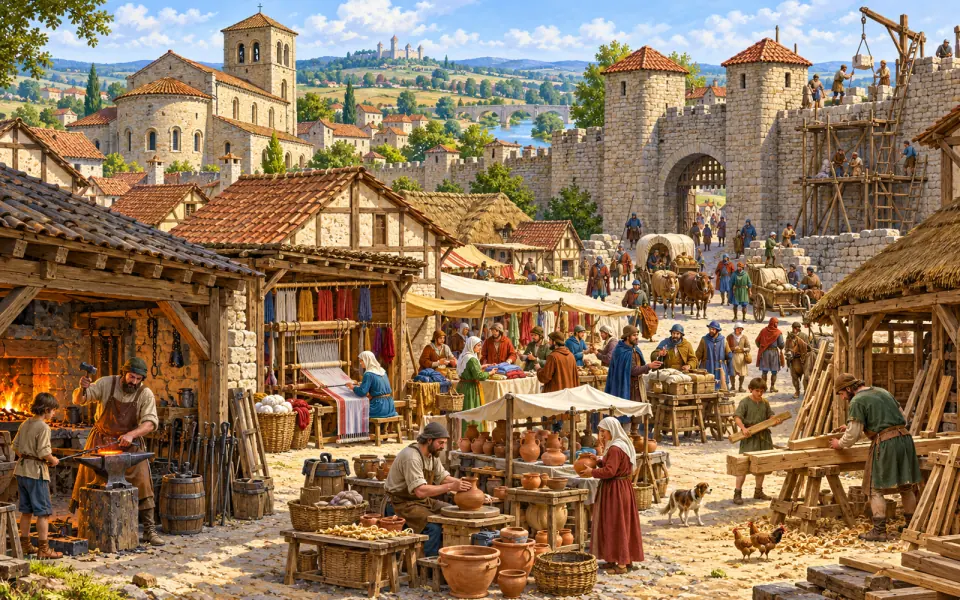
- The growth of medieval townsabout 1050 · Late Middle AgesThe growth of towns and population required more flour and more energy.
- Paper arrives in Europeabout 1150 · Late Middle AgesPaper in Europe was made in water-powered paper mills.
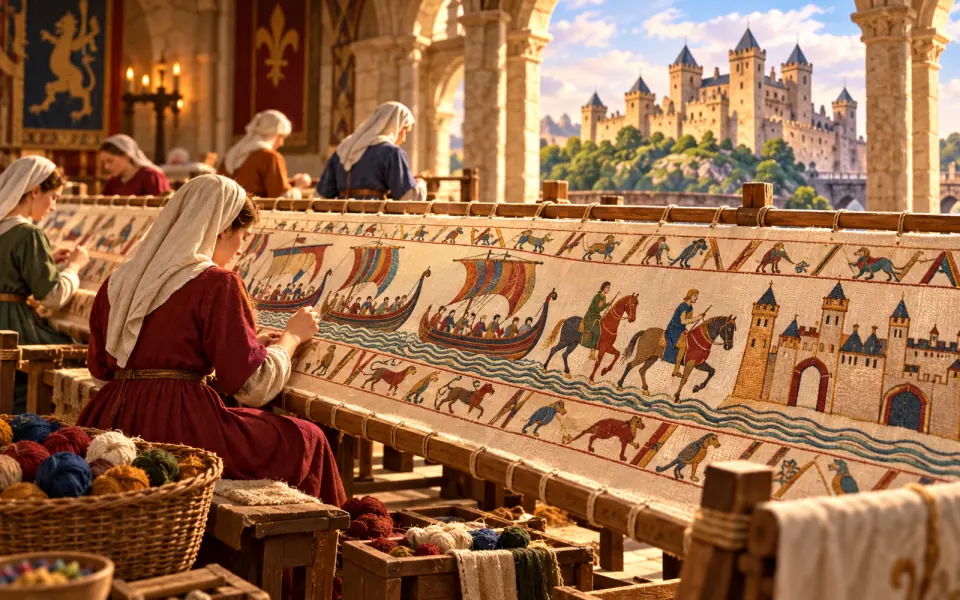
- The Bayeux Tapestryabout 1070 · Late Middle AgesAfter the Norman Conquest, William had the mills counted in the Domesday Book.
- Public mechanical clocksabout 1350 · Late Middle AgesMechanical clocks also used gears similar to those of mills.
Before and after, in the era “Late Middle Ages”
Event 8 of 25
 BeforeThe growth of medieval townsabout 1050
 BeforeThe East–West Schism1054
 BeforeThe Bayeux Tapestryabout 1070
 BeforeThe University of Bolognaabout 1088
 BeforeThe First Crusade1096–1099
 BeforeThe Italian communesabout 1100
 BeforeRomanesque cathedralsabout 1100
- You are hereWatermills and windmillsabout 1100
 AfterGothic style at Saint-Denis1144
 AfterHildegard of Bingenabout 1150
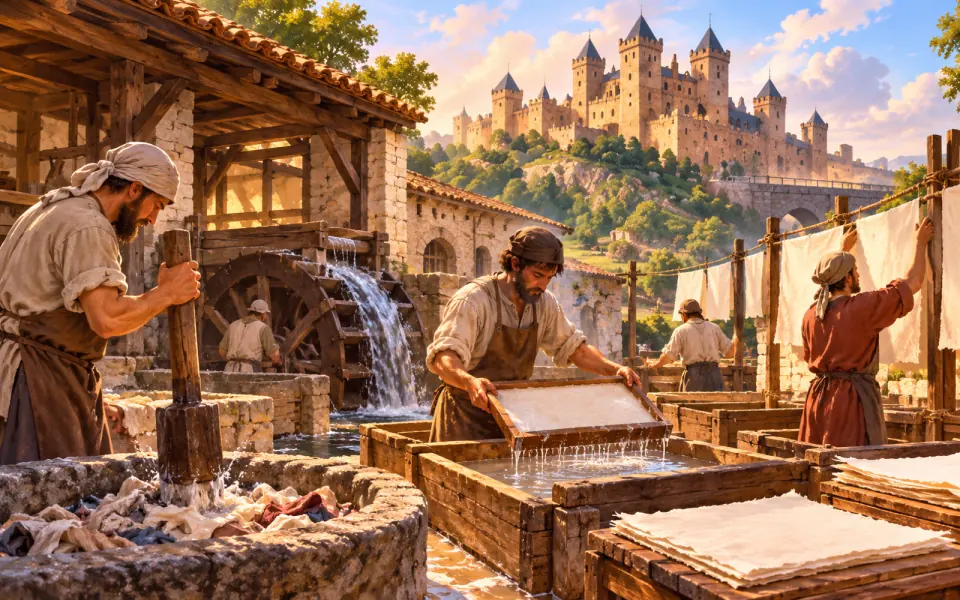 AfterPaper arrives in Europeabout 1150
 AfterFrederick Barbarossa1155
 AfterFrancis of Assisiabout 1182
 AfterFibonacci and the Liber abaci1202
 AfterMagna Carta1215
 AfterThe gold florin1252
 AfterMarco Polo sets off for Asia1271
 AfterSpectaclesabout 1286
 AfterThe Hanseatic League and northern tradeabout 1300
 AfterGiotto paints in Paduaabout 1305
 AfterDante begins the Divine Comedyabout 1307
 AfterThe Hundred Years' War1337–1453
 AfterThe Black Death1347–1352
 AfterPublic mechanical clocksabout 1350
 AfterJoan of Arc1429
Listen / Read next
- Music to read by: Cinematic JourneyEpic film-style music, no lyrics, by Ciro Simone IrmiciSpotifyYouTube Music
Meanwhile, elsewhere in the world
Other events of the era “Late Middle Ages”
- The growth of medieval towns
- The East–West Schism
- The Bayeux Tapestry
- The University of Bologna
- The First Crusade
- The Italian communes
- Romanesque cathedrals
- Gothic style at Saint-Denis
- Hildegard of Bingen
- Paper arrives in Europe
- Frederick Barbarossa
- Francis of Assisi
- Fibonacci and the Liber abaci
- Magna Carta
- The gold florin
- Marco Polo sets off for Asia
- Spectacles
- The Hanseatic League and northern trade
- Giotto paints in Padua
- Dante begins the Divine Comedy
- The Hundred Years' War
- The Black Death
- Public mechanical clocks
- Joan of Arc
