Romanesque cathedrals
about 1100 Europe; in Italy, for example, Modena
In short
Around 1100 a great many churches were built all over Europe in a style we now call Romanesque. They had thick walls, small windows and round arches, shaped like a half-circle, like those of the ancient Romans. Inside they were often dark and intimate, while on the fronts sculptors told Bible stories for people who could not read. Famous examples in Italy are Modena Cathedral, begun in 1099, and the Cathedral Square in Pisa.
Why it matters The Romanesque style gave a huge number of European towns and villages the churches we still see today.
Source: UNESCO, “Cathedral, Torre Civica and Piazza Grande, Modena”
Study card about 4 minutes of reading
The story
Churches like fortresses of stone
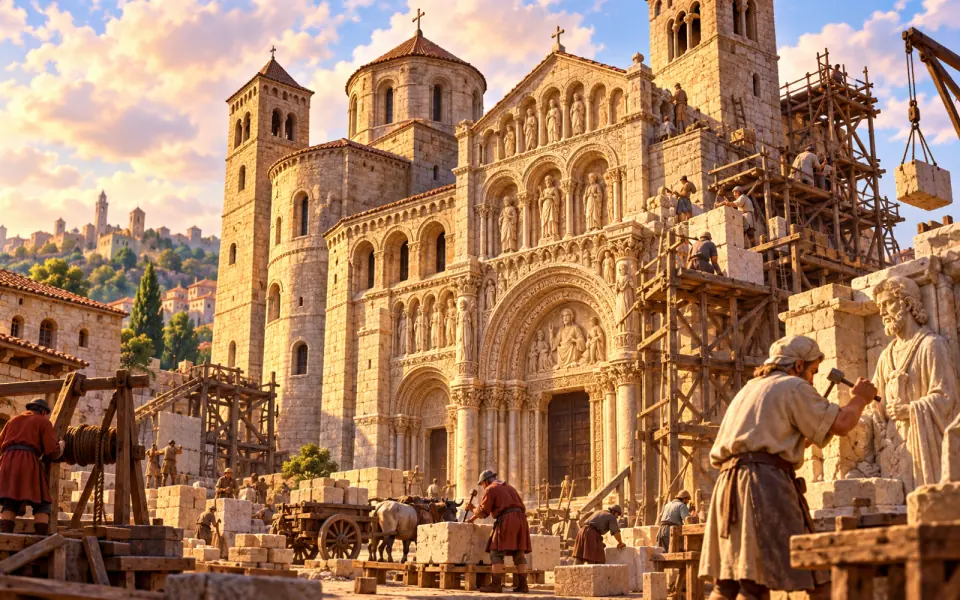
After the year 1000 a flowering of religious building began across Europe: in a few decades more churches were built than in the previous centuries. A chronicler of the time, Rodulfus Glaber, wrote that the world was “clothing itself in a white mantle of churches”. The style in which they were built is today called Romanesque, because it partly recalls the architecture of the Romans: round arches, that is, semicircular ones, stone vaults and massive columns.
The name is modern: it was coined in the 19th century by French scholars. The people who built then did not call it that, nor did they think they were creating a “style”. They wanted to build churches that were solid, that would last and be beautiful, to honour God and to show the wealth of the town or the monastery.
What a Romanesque church is like
A Romanesque church usually has very thick walls and small windows. There are two reasons: the stone used for the roof was extremely heavy, and the walls had to hold it up without collapsing; and large windows would have weakened the wall. Inside, therefore, there is little light, and the space is quiet and solemn. The aisles are held up by great pillars and round arches, and inside the church you feel a sense of strength and calm.
Outside, the façade is often plain, with a large doorway, sometimes with a carved semicircle above it (the “tympanum”) and a small round window, called a rose window. The bell tower is often a separate building, next to the church. The capitals, that is, the tops of the columns, are decorated with figures of animals, monsters, saints and men, sometimes with curious scenes.
Modena and its masters
Modena Cathedral is considered one of the masterpieces of Italian Romanesque. It was begun in 1099, on the spot where the tomb of Saint Geminianus, patron saint of the city, was venerated. The architect was called Lanfranco; the sculptor, Wiligelmo, one of the first artists of the Middle Ages whose name we know. His name is carved on the façade, in an inscription praising him. Wiligelmo carved on the façade some slabs with stories from Genesis, the first book of the Bible: Adam and Eve, Cain and Abel, Noah. The figures are stocky and lively, almost comic strips in stone.
The church was consecrated in 1184. Next to it rises the bell tower, the Ghirlandina, about 86-88 metres high, which became the symbol of the city. In 1997 the cathedral, the tower and the neighbouring square were placed by UNESCO on the World Heritage List.
There was not one Romanesque but many. At Pisa, where the cathedral was begun in 1064, the façades are covered with little arches and slender columns in white and dark marble, with an elegant effect. In France, at Cluny, the monks built one of the largest churches in Christendom. In Germany, at Speyer, the imperial cathedrals are very tall and severe. In England, at Durham, the columns are carved with zigzags.
Inside, artists painted on the walls scenes of saints, of the Last Judgement and of stories from the Bible, in bright colours. Unfortunately many frescoes have been damaged by time, but those that remain show large, stern figures, with wide-open eyes, meant to be seen from far away in the half-light.
Pilgrims and pictures
Many Romanesque churches stood along the roads of the pilgrims, who went to Rome, to Jerusalem or to Santiago de Compostela in Spain, where the tomb of the apostle James was kept. The largest churches had wide spaces for crowds of worshippers to walk through and chapels for relics. Sculptures and paintings served to tell the sacred stories to people who could not read. It was indeed said that pictures were the “Bible of the poor”.
Why it happened
The growth of the population, the return of some security after the invasions, and the wealth of towns and monasteries made it possible to build bigger churches. Pilgrimages brought money and people.
The builders had rediscovered stone-working and the Roman arch, and they used vaults and pillars to cover ever wider spaces, instead of the wooden roofs that often burned.
What changed
Romanesque was the first style to spread across the whole of Europe, from Spain to Germany, from England to Italy, with local variations. The churches built by the masters, who often travelled, show that ideas and techniques were circulating.
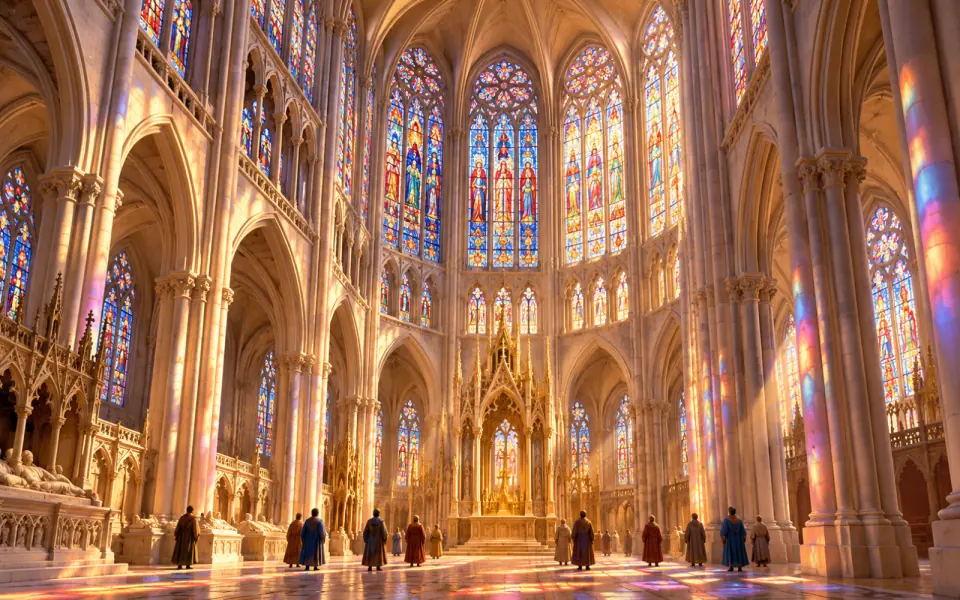
Its problems, such as the lack of light, pushed people to look for new solutions: from the experience of Romanesque the Gothic style, with its great stained-glass windows, was born in the following century.
Many Romanesque churches are still standing and in use: they are among the oldest medieval monuments that can be visited.
Key people and places
People
- Lanfranco
- Architect of Modena Cathedral (12th century): he directed the start of the work.
- Wiligelmo
- Sculptor (active between about 1099 and 1120): author of the slabs on the façade of Modena Cathedral.
- Saint Geminianus
- Bishop of Modena in the 4th century: the cathedral holds his tomb.
- Rodulfus Glaber
- Burgundian monk and chronicler (about 985-1047): he described the “white mantle of churches”.
Places
- Modena
- City in Emilia with the Romanesque cathedral and the Ghirlandina tower.
- Santiago de Compostela
- Spanish city, destination of the pilgrimage, with a great Romanesque cathedral.
- Pisa
- Tuscan city with the Piazza del Duomo, in the Pisan Romanesque style.
Good to know
- The word “Romanesque” was invented in the 19th century.
- Wiligelmo is one of the first sculptors of the Middle Ages whose name we know.
- Modena Cathedral has been a UNESCO World Heritage Site since 1997.
- Romanesque churches have small windows because the walls had to hold up the stone roof.
- The pictures in churches were called the “Bible of the poor”.
Find out more
- Wikipedia, “Romanesque architecture” en.wikipedia.org
- Wikipedia, “Modena Cathedral” en.wikipedia.org
- Wikipedia, “Wiligelmo” en.wikipedia.org
- Wikipedia, “Camino de Santiago” en.wikipedia.org
Related events
- Gothic style at Saint-Denis1144 · Late Middle AgesGothic was born from Romanesque at Saint-Denis.
- The growth of medieval townsabout 1050 · Late Middle AgesThe growth of towns made it possible to build great churches.
- The First Crusade1096–1099 · Late Middle AgesPilgrimages and crusades moved crowds of people.
- Giotto paints in Paduaabout 1305 · Late Middle AgesGiotto painted a few centuries later, in a chapel in Padua.
Before and after, in the era “Late Middle Ages”
Event 7 of 25
 BeforeThe growth of medieval townsabout 1050
 BeforeThe East–West Schism1054
 BeforeThe Bayeux Tapestryabout 1070
 BeforeThe University of Bolognaabout 1088
 BeforeThe First Crusade1096–1099
 BeforeThe Italian communesabout 1100
- You are hereRomanesque cathedralsabout 1100
 AfterWatermills and windmillsabout 1100
 AfterGothic style at Saint-Denis1144
 AfterHildegard of Bingenabout 1150
 AfterPaper arrives in Europeabout 1150
 AfterFrederick Barbarossa1155
 AfterFrancis of Assisiabout 1182
 AfterFibonacci and the Liber abaci1202
 AfterMagna Carta1215
 AfterThe gold florin1252
 AfterMarco Polo sets off for Asia1271
 AfterSpectaclesabout 1286
 AfterThe Hanseatic League and northern tradeabout 1300
 AfterGiotto paints in Paduaabout 1305
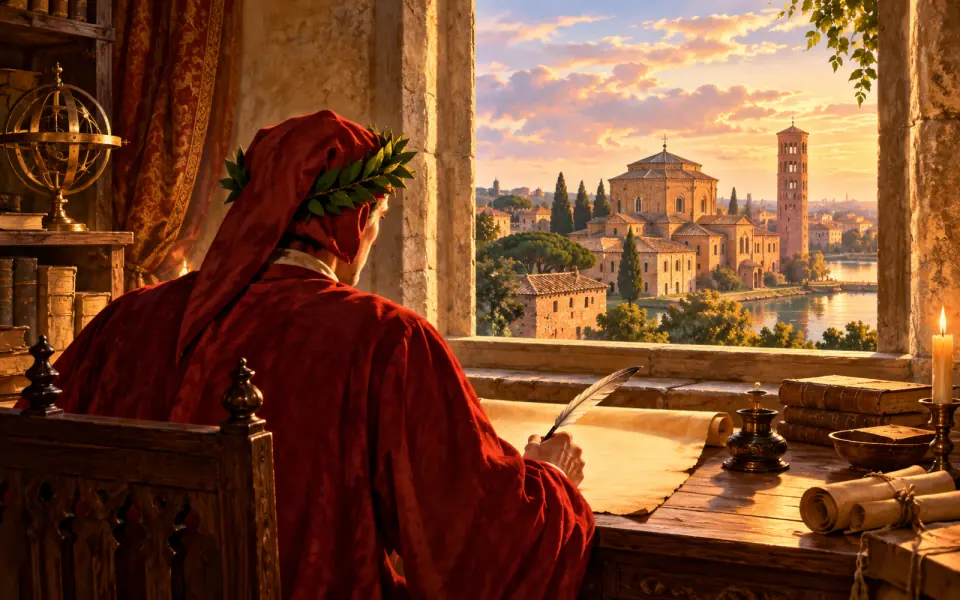 AfterDante begins the Divine Comedyabout 1307
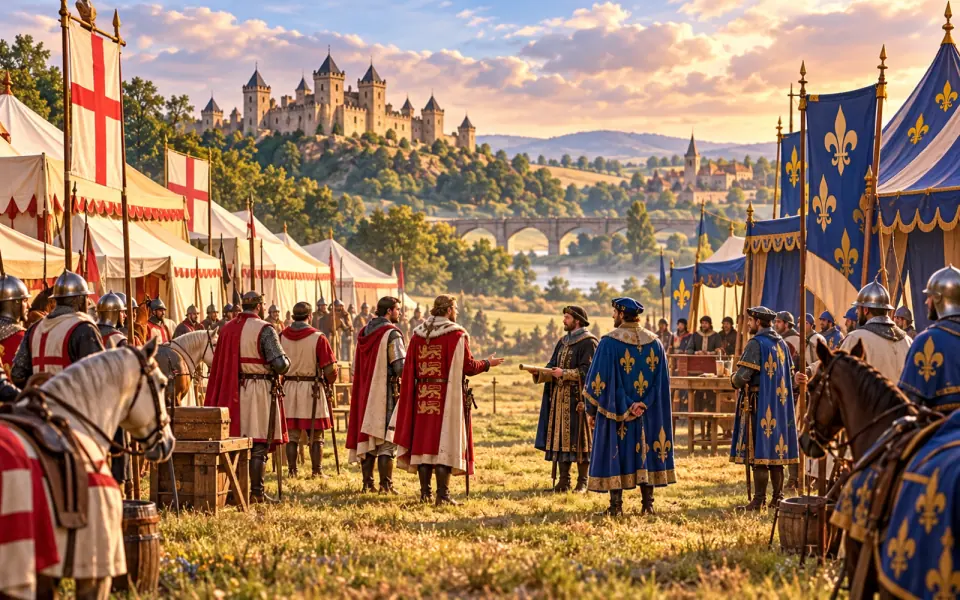 AfterThe Hundred Years' War1337–1453
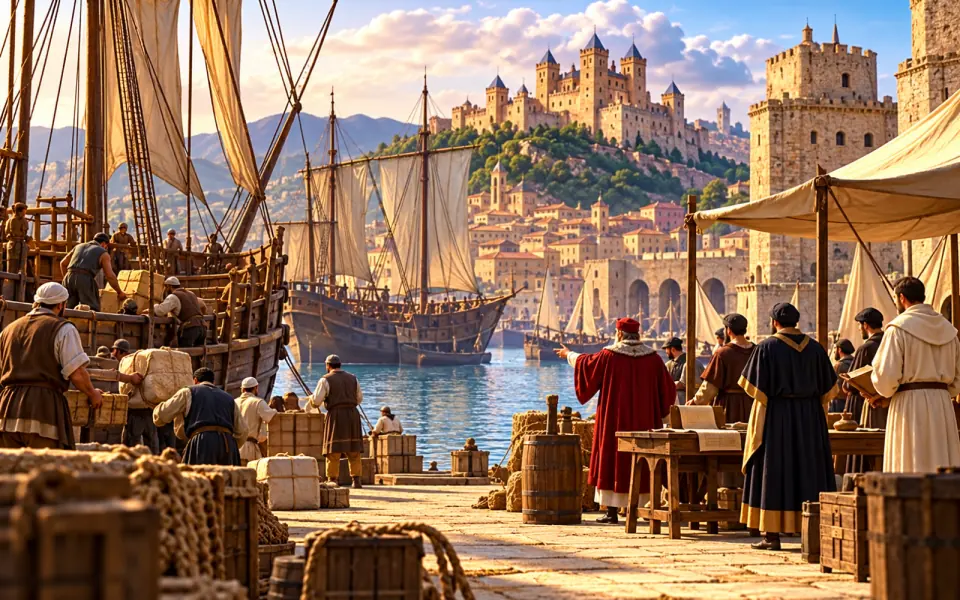 AfterThe Black Death1347–1352
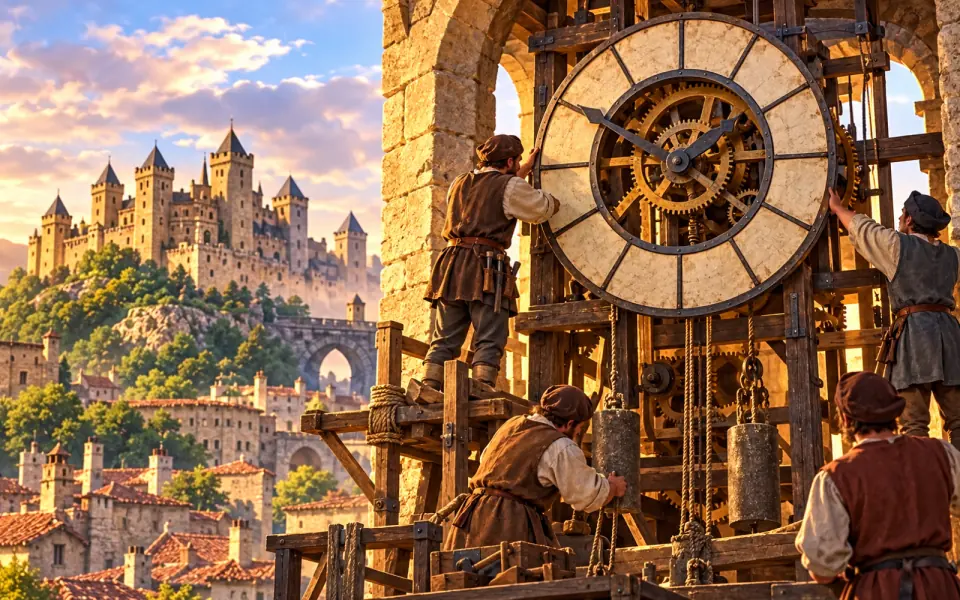 AfterPublic mechanical clocksabout 1350
 AfterJoan of Arc1429
Listen / Read next
- Music to read by: Cinematic JourneyEpic film-style music, no lyrics, by Ciro Simone IrmiciSpotifyYouTube Music
Meanwhile, elsewhere in the world
Other events of the era “Late Middle Ages”
- The growth of medieval towns
- The East–West Schism
- The Bayeux Tapestry
- The University of Bologna
- The First Crusade
- The Italian communes
- Watermills and windmills
- Gothic style at Saint-Denis
- Hildegard of Bingen
- Paper arrives in Europe
- Frederick Barbarossa
- Francis of Assisi
- Fibonacci and the Liber abaci
- Magna Carta
- The gold florin
- Marco Polo sets off for Asia
- Spectacles
- The Hanseatic League and northern trade
- Giotto paints in Padua
- Dante begins the Divine Comedy
- The Hundred Years' War
- The Black Death
- Public mechanical clocks
- Joan of Arc
