Paper arrives in Europe
about 1150 Xàtiva, near Valencia (Spain)
In short
The Arabs brought the craft of papermaking to Spain, which was then partly under their rule. Around 1150 the geographer al-Idrisi described Xàtiva, near Valencia, as a place where excellent paper was made. In Italy production grew from the 13th century, especially in Fabriano, in the Marche, where the watermark was born, a design you can see when you hold the paper up to the light. Paper was made from linen and hemp rags pulped into a mush.
Why it matters Without paper, much cheaper than parchment, Gutenberg's printing would not have succeeded.
Source: Encyclopaedia Britannica, “Papermaking”
Study card about 4 minutes of reading
The story
Books written on animal skins
In medieval Europe books were usually written on parchment, that is, on the skin of sheep, goats or calves, washed, scraped and stretched. Parchment was tough and beautiful, but expensive: a whole Bible needed the skins of hundreds of animals. For this reason books were rare, and very precious. Anyone writing a letter, a contract or an account had to think twice, because material could not be wasted.
Meanwhile, in the East, a much cheaper material had been used for centuries: paper. According to Chinese tradition it was an official named Cai Lun who, in AD 105, presented to the emperor a new way of making it, with rags, bark and fishing nets, reduced to a pulp and then spread out to dry on a frame. In fact archaeologists have found older fragments of paper, but Cai Lun improved the technique.
The long journey westward
For centuries China kept the secret. Paper reached the Islamic world, according to tradition, after the battle of Talas (751), in Central Asia, where some Chinese prisoners are said to have taught the craft at Samarkand; historians are cautious about this story, but they know that paper was made at Samarkand in the 8th century. In 794 a paper factory was set up at Baghdad, and the craft spread to Syria, Egypt and the Maghreb.
From the Arab world paper reached Europe through Muslim Spain. The town of Xàtiva, near Valencia, became famous for its paper mills: around 1150 the Arab geographer al-Idrisi wrote that paper was made there of a quality second to none, and exported to East and West. The memory of that centre has remained: the name of Xàtiva is linked to one of the oldest paper productions in Europe.
Fabriano and European innovations
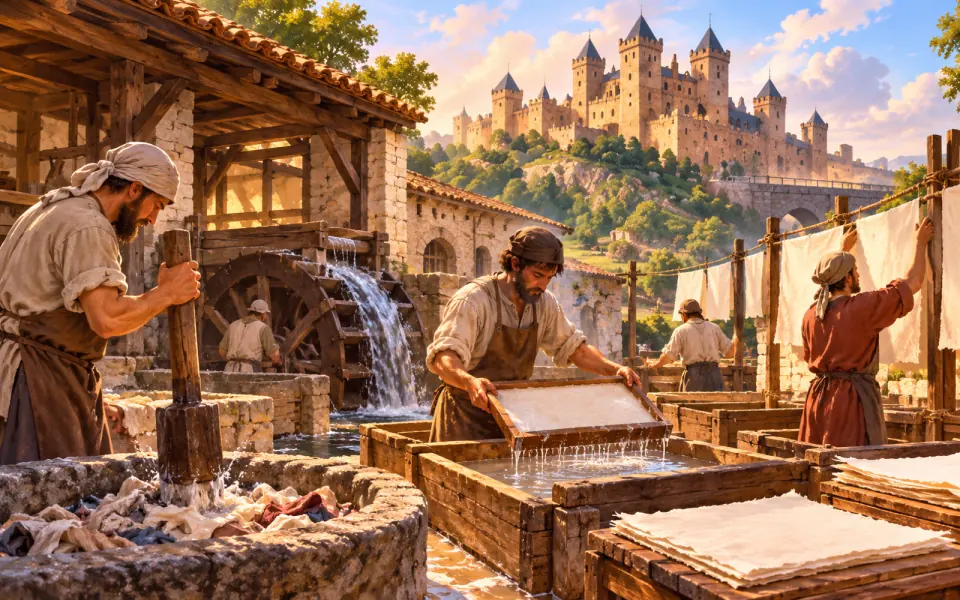
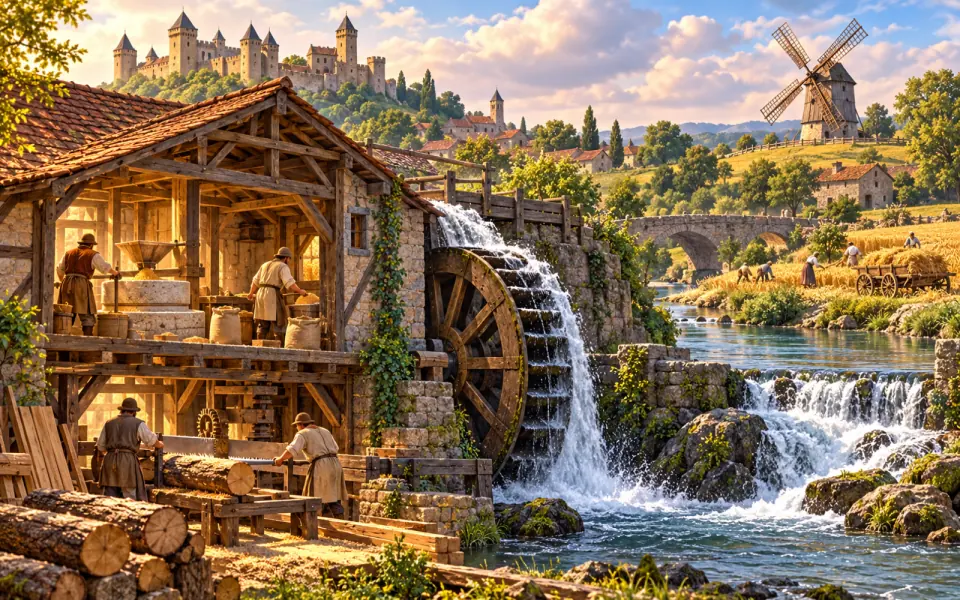
In Italy paper arrived at a few ports, such as Amalfi and Genoa, but the most important centre was Fabriano, in the Marche, where from the second half of the 1200s paper mills became numerous. The Italian papermakers improved the process with several inventions. They used water wheels to drive hammers that shredded linen and hemp rags; they replaced starch glue with gelatine made from animal skins, which made the paper more resistant to ink; and they created watermarks.
A watermark is a design, or a mark, that appears as a transparency when you hold the sheet up to the light. It is made with a metal wire bent into a shape and sewn onto the frame in which the pulp is collected. The first watermarks appeared at Fabriano in 1282. They helped the makers to recognise their own sheets, and today they help historians to date documents.
At first, in Europe, paper was looked on with suspicion, because people thought it would last less long than parchment and that it was a product of the Muslims. It is said that the Emperor Frederick II, in 1231, forbade its use for the most important public documents. In time, however, the low price won out: merchants used it for account books, notaries for contracts and teachers for students' notebooks.
The rag-and-bone trade
To make paper, huge quantities of linen, hemp and cotton rags were needed. Ragmen collected them from houses and sold them to the paper mills. The rags were left to rot, then beaten in the mills until they became a pale pulp. The papermaker dipped a mesh frame into the vat, lifted it with a thin layer of pulp and shook it; the newly formed sheets were stacked, pressed and hung up to dry.
Why it happened
Towns, markets and monasteries needed to write more and more: contracts, accounts, letters, registers. With parchment all this would have cost far too much.
Muslim Spain was an important meeting point between East and West, and merchants and travellers carried techniques and goods with them. The Italian papermakers, already used to working with water-driven machines, knew how to improve the craft.
What changed
Paper made books and documents much cheaper. In the 1300s and 1400s, in Europe, the number of letters, registers, notarial deeds and hand-copied books grew.
When, around 1455, Johannes Gutenberg invented printing with movable type, paper was already there, in plenty and at a low price: without it printing could not have spread so quickly. The word “ream”, from the Arabic “rizma”, meaning a bundle, recalls this origin.
Drawings, architects' plans and maps also became easier to make and to keep. Paper is still one of the most widely used inventions in the world today.
Key people and places
People
- Cai Lun
- Chinese official (died 121): according to tradition he perfected paper in AD 105.
- Al-Idrisi
- Arab geographer (about 1100-1165): he praised the paper of Xàtiva.
- The papermakers of Fabriano
- Craftsmen from the Marche who invented the watermark and gelatine-sized paper.
Places
- Xàtiva (Spain)
- Town near Valencia, home of one of the first European paper mills.
- Fabriano (Marche)
- Italian town of paper mills, from the 1200s to the present day.
- Samarkand
- City in Central Asia where paper was already made in the 8th century.
Good to know
- A parchment Bible needed the skins of hundreds of animals.
- The watermark first appears at Fabriano in 1282.
- Paper was made from linen and hemp rags.
- The word “ream” comes from Arabic.
- The name of Cai Lun is linked, by tradition, to the invention of paper in AD 105.
Find out more
- Wikipedia, “Paper” en.wikipedia.org
- Wikipedia, “Watermark” en.wikipedia.org
- Wikipedia, “Fabriano” en.wikipedia.org
- Wikipedia, “Xàtiva” en.wikipedia.org
Related events
- Watermills and windmillsabout 1100 · Late Middle AgesWater mills drove the hammers of the paper mills.
- The University of Bolognaabout 1088 · Late Middle AgesUniversities needed many books and notes.
- The growth of medieval townsabout 1050 · Late Middle AgesThe growth of towns multiplied the demand for documents.
- Fibonacci and the Liber abaci1202 · Late Middle AgesFibonacci's Liber Abaci was copied on paper and on parchment.
Before and after, in the era “Late Middle Ages”
Event 11 of 25
 BeforeThe growth of medieval townsabout 1050
 BeforeThe East–West Schism1054
 BeforeThe Bayeux Tapestryabout 1070
 BeforeThe University of Bolognaabout 1088
 BeforeThe First Crusade1096–1099
 BeforeThe Italian communesabout 1100
 BeforeRomanesque cathedralsabout 1100
 BeforeWatermills and windmillsabout 1100
 BeforeGothic style at Saint-Denis1144
 BeforeHildegard of Bingenabout 1150
- You are herePaper arrives in Europeabout 1150
 AfterFrederick Barbarossa1155
 AfterFrancis of Assisiabout 1182
 AfterFibonacci and the Liber abaci1202
 AfterMagna Carta1215
 AfterThe gold florin1252
 AfterMarco Polo sets off for Asia1271
 AfterSpectaclesabout 1286
 AfterThe Hanseatic League and northern tradeabout 1300
 AfterGiotto paints in Paduaabout 1305
 AfterDante begins the Divine Comedyabout 1307
 AfterThe Hundred Years' War1337–1453
 AfterThe Black Death1347–1352
 AfterPublic mechanical clocksabout 1350
 AfterJoan of Arc1429
Listen / Read next
- Music to read by: Cinematic JourneyEpic film-style music, no lyrics, by Ciro Simone IrmiciSpotifyYouTube Music
Meanwhile, elsewhere in the world
Other events of the era “Late Middle Ages”
- The growth of medieval towns
- The East–West Schism
- The Bayeux Tapestry
- The University of Bologna
- The First Crusade
- The Italian communes
- Romanesque cathedrals
- Watermills and windmills
- Gothic style at Saint-Denis
- Hildegard of Bingen
- Frederick Barbarossa
- Francis of Assisi
- Fibonacci and the Liber abaci
- Magna Carta
- The gold florin
- Marco Polo sets off for Asia
- Spectacles
- The Hanseatic League and northern trade
- Giotto paints in Padua
- Dante begins the Divine Comedy
- The Hundred Years' War
- The Black Death
- Public mechanical clocks
- Joan of Arc
