Frederick Barbarossa
1155 Germany and northern Italy (Legnano)
In short
Frederick I of Swabia was called Barbarossa, ‘Red Beard’, because of the colour of his beard. King of Germany from 1152, in 1155 he was crowned emperor in Rome by the Pope. He wanted the rich communes of northern Italy to obey the empire and pay taxes, and he came down into Italy with his army several times. Many towns joined together in the Lombard League and defeated him at Legnano in 1176.
Why it matters The clash with the communes showed that the Italian towns had become strong enough to stand up to an emperor.
Source: Treccani, entry “Federico I imperatore, detto il Barbarossa”
Study card about 4 minutes of reading
The story
An emperor with a red beard
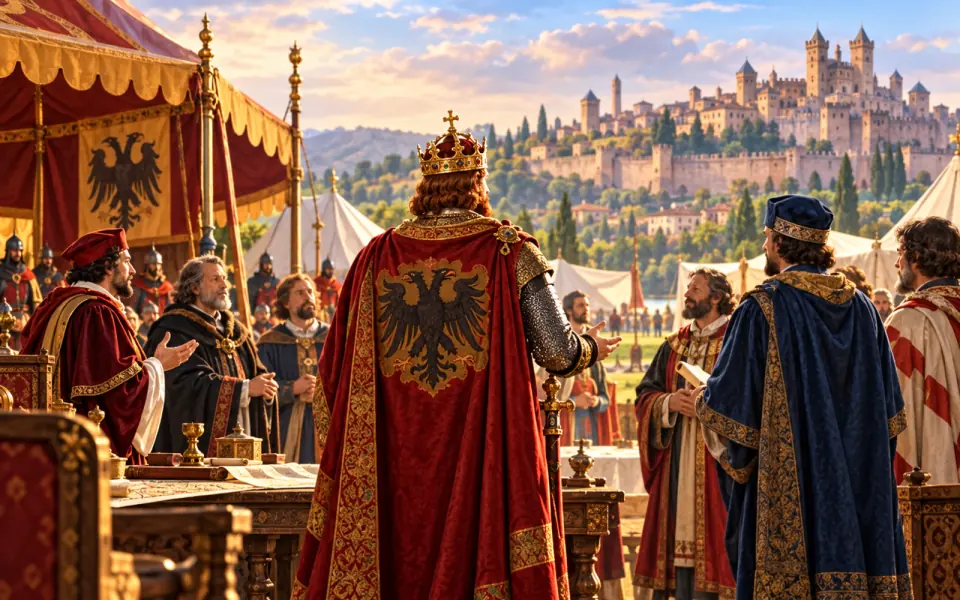
Frederick I of Hohenstaufen, called Barbarossa (“Red Beard”) by the Italians because of the colour of his beard, was born around 1122 into one of the most powerful German families. In 1152 he was elected King of Germany by the great princes of the kingdom. He was tall, determined and educated, and he thought his task was to restore the greatness of the empire, that is, the Holy Roman Empire, which included Germany and, at least on paper, northern and central Italy, and which saw itself as heir to that of ancient Rome.
In Italy, however, things were not going as he wanted: the towns of the north, rich and proud, had organised themselves into communes, collected taxes on their own account and did not obey the imperial officials. And in Rome the pope had a power of his own, which often clashed with that of the emperor.
The coronation in Rome
Barbarossa came down into Italy for the first time in 1154, with an army, to be crowned emperor by the pope. During the journey he demanded the submission of some northern towns and, when he did not get it, punished some of them. In Rome he made an agreement with Pope Adrian IV, the only English pope in history, and had Arnold of Brescia handed over to him, a preacher who asked the Church to live in poverty and had led a revolt against the pope. Arnold was hanged.
On 18 June 1155 Barbarossa was crowned emperor in St Peter's. The Romans, who had not liked it, rebelled, and there were clashes with many dead. Straight afterwards the emperor went back to Germany, because the heat and disease had weakened his army. It was the beginning of a long struggle with the towns and with the pope, which would take up almost all his reign.
Six descents into Italy
In thirty-five years of reign Barbarossa came down into Italy six times (by the traditional count). In 1158 he called at Roncaglia, near Piacenza, a great diet, that is, an assembly, where the jurists of the University of Bologna declared that the most important rights, such as minting coins, collecting taxes and appointing judges, belonged to the emperor. The communes protested. Milan, the strongest, rebelled and was besieged: in 1162 it surrendered, and Barbarossa had it destroyed, with its walls and many houses.
The emperor's harshness pushed the towns to ally: in 1167 the Lombard League was born, which rebuilt Milan and even founded a new town, called Alessandria, in honour of Pope Alexander III, who was in conflict with the emperor. On 29 May 1176, at Legnano, the League's army defeated Barbarossa's. It was a heavy defeat: the emperor was missing for a while, and was believed dead.
In 1177, at Venice, Barbarossa was reconciled with Pope Alexander III. With the Peace of Constance of 1183 he recognised the communes' right to govern themselves, in exchange for an oath of loyalty. It was a kind of compromise: the emperor did not lose all his prestige, but had to accept that he could not govern Italy as he wished.
The end in the East
In 1189, by then old, Barbarossa decided to take part in the Third Crusade, after the Sultan Saladin had retaken Jerusalem. He led a great army across the Balkans and Anatolia. On 10 June 1190, while crossing the river Saleph, in present-day Turkey, he drowned: it is not clear whether from a sudden illness or from a fall from his horse. Many crusaders turned back.
A legend spread in Germany: Barbarossa had not died, but sleeps under a mountain, the Kyffhäuser, with his beard growing around a stone table, and one day he will wake to save his people.
Why it happened
The empire was a great political construction, but in Italy the communes and the papacy had become strong. Barbarossa wanted to reassert imperial rights and the income that came from them, and for this reason he clashed with them.
The fact that the towns of the north were rich and organised, and that the pope was ready to support them, prevented the emperor from winning decisively.
What changed
The Italian communes had their independence recognised. In Germany, on the other hand, the princes became stronger and the divided empire did not manage to create a unified state like France or England.
The struggle between emperors and popes went on in the following century, with Barbarossa's grandson, Frederick II. In Italy the factions of the Guelphs, in favour of the pope, and the Ghibellines, in favour of the emperor, were born.
In the 19th century Barbarossa became a symbol: for the Germans of national unity, for the Italians of resistance to the foreign empire and of local freedoms. Historians today look at his figure with less nationalistic emphasis.
Key people and places
People
- Frederick I Barbarossa
- Emperor from 1155 to 1190 (about 1122-1190): he came down into Italy six times.
- Adrian IV
- Pope from 1154 to 1159: he crowned him in Rome.
- Alexander III
- Pope from 1159 to 1181: he led the front against the emperor.
- Arnold of Brescia
- Preacher (about 1090-1155): handed over to the emperor and hanged.
- Saladin
- Sultan of Egypt and Syria (1137-1193): the Third Crusade was organised against him.
Places
- Rome
- Where the emperor was crowned on 18 June 1155.
- Legnano
- Lombard town where the emperor was defeated in 1176.
- Alessandria
- Town founded in 1168 by the communes of the League and named in honour of the pope.
Good to know
- The nickname “Barbarossa” was given to Frederick by the Italians.
- In 1162 Barbarossa had Milan destroyed.
- Alessandria, in Piedmont, takes its name from Pope Alexander III.
- Adrian IV was the only English pope in history.
- According to legend Barbarossa sleeps under Mount Kyffhäuser.
Find out more
- Wikipedia, “Frederick Barbarossa” en.wikipedia.org
- Wikipedia, “Diet of Roncaglia” en.wikipedia.org
- Wikipedia, “Third Crusade” en.wikipedia.org
- Wikipedia, “Kyffhäuser” en.wikipedia.org
Related events
- The Italian communesabout 1100 · Late Middle AgesThe Italian communes opposed Barbarossa.
- The University of Bolognaabout 1088 · Late Middle AgesBarbarossa granted privileges to the students of Bologna.
- The First Crusade1096–1099 · Late Middle AgesThe First Crusade had been a century earlier; Barbarossa took part in the Third.
- Hildegard of Bingenabout 1150 · Late Middle AgesHildegard of Bingen wrote to Barbarossa.
Before and after, in the era “Late Middle Ages”
Event 12 of 25
 BeforeThe growth of medieval townsabout 1050
 BeforeThe East–West Schism1054
 BeforeThe Bayeux Tapestryabout 1070
 BeforeThe University of Bolognaabout 1088
 BeforeThe First Crusade1096–1099
 BeforeThe Italian communesabout 1100
 BeforeRomanesque cathedralsabout 1100
 BeforeWatermills and windmillsabout 1100
 BeforeGothic style at Saint-Denis1144
 BeforeHildegard of Bingenabout 1150
 BeforePaper arrives in Europeabout 1150
- You are hereFrederick Barbarossa1155
 AfterFrancis of Assisiabout 1182
 AfterFibonacci and the Liber abaci1202
 AfterMagna Carta1215
 AfterThe gold florin1252
 AfterMarco Polo sets off for Asia1271
 AfterSpectaclesabout 1286
 AfterThe Hanseatic League and northern tradeabout 1300
 AfterGiotto paints in Paduaabout 1305
 AfterDante begins the Divine Comedyabout 1307
 AfterThe Hundred Years' War1337–1453
 AfterThe Black Death1347–1352
 AfterPublic mechanical clocksabout 1350
 AfterJoan of Arc1429
Listen / Read next
- Music to read by: Cinematic JourneyEpic film-style music, no lyrics, by Ciro Simone IrmiciSpotifyYouTube Music
Meanwhile, elsewhere in the world
Other events of the era “Late Middle Ages”
- The growth of medieval towns
- The East–West Schism
- The Bayeux Tapestry
- The University of Bologna
- The First Crusade
- The Italian communes
- Romanesque cathedrals
- Watermills and windmills
- Gothic style at Saint-Denis
- Hildegard of Bingen
- Paper arrives in Europe
- Francis of Assisi
- Fibonacci and the Liber abaci
- Magna Carta
- The gold florin
- Marco Polo sets off for Asia
- Spectacles
- The Hanseatic League and northern trade
- Giotto paints in Padua
- Dante begins the Divine Comedy
- The Hundred Years' War
- The Black Death
- Public mechanical clocks
- Joan of Arc
