Galen, a doctor in Rome
about AD 162 Rome (Galen was born in Pergamum, now in Turkey)
In short
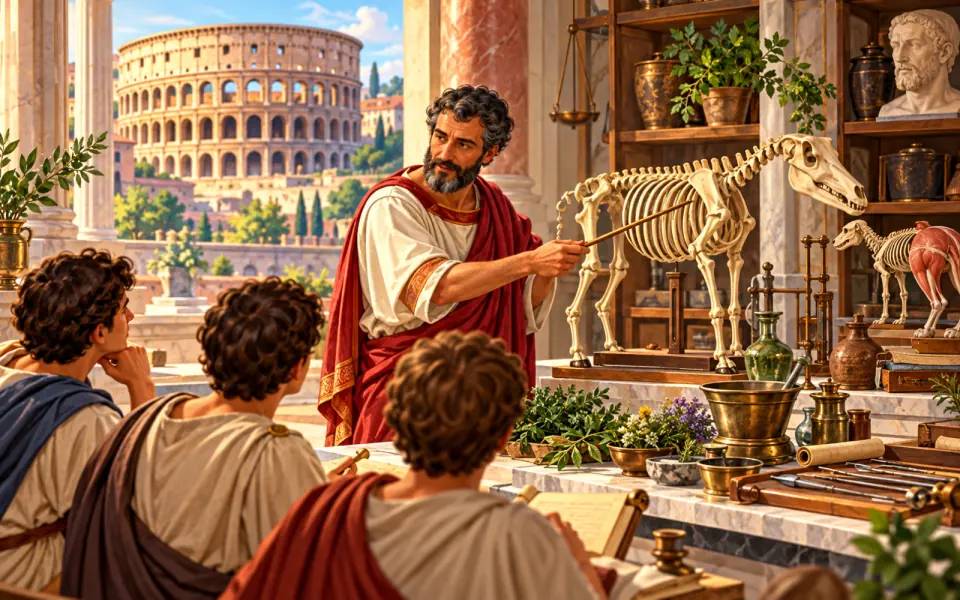
Galen was born in Pergamum, in Asia Minor, and as a young man treated the wounds of gladiators. Around AD 162 he moved to Rome, where he became so famous that he was chosen as doctor to the emperor Marcus Aurelius. He studied the body by dissecting animals such as monkeys and pigs, because human bodies could not be dissected in Rome. He wrote a huge number of works, and his ideas, even the wrong ones, were treated as almost beyond question until the 16th century.
Why it matters For more than a thousand years doctors in Europe and the Islamic world learnt medicine from his books.
Source: Encyclopaedia Britannica, “Galen”
Study card about 6 minutes of reading
The story
The doctor of gladiators and emperors
Galen was born at Pergamum, a Greek city in Asia Minor, in present-day Turkey, around AD 129. His was a family of architects: his father, Nicon, and his grandfather were, and his great-grandfather was a scholar of geometry. As a boy Galen studied philosophy, starting at the age of fourteen, with teachers from different schools: Platonists, Stoics, Aristotelians, Epicureans. At sixteen his father steered him towards medicine. After his father's death, between 148 and 149, Galen travelled to Smyrna, Corinth and Alexandria in Egypt, which were then among the most important places for medicine, and studied for about twelve years.
In 157 he returned to Pergamum and for three or four years worked as doctor to a school of gladiators. It was a valuable experience. By treating the wounds of men who were training to fight, Galen learned how the body is made, and how to treat injuries, fractures and cuts.
In Rome, at court
From 162 Galen lived in Rome. He brought with him the ideas of Greek medicine, that of Hippocrates, and the theory of the humours. He became famous and was called to court as physician to the emperor Marcus Aurelius. He also treated other emperors and members of the imperial family: Lucius Verus, Commodus and Septimius Severus.
His life was not always calm. In 166 he left Rome and went back to Pergamum. Between 168 and 169 the emperor called him back to follow the army that was fighting two Germanic peoples, the Quadi and the Marcomanni. Back in Rome in 169, he devoted himself mainly to writing. He left the court during the reign of Commodus. In 191 (or 192) many of his writings were destroyed in a fire in the library of the Temple of Peace.
How he studied the body
To understand how a body works, Galen carried out experiments and dissections, that is, he opened up and observed the organs. He did this mostly on animals, and in particular on monkeys, whose structure is somewhat like that of human beings. He also performed experiments on living animals, to study the kidneys and the spinal cord.
One of his most famous experiments was done in public, to show how the voice works. With a squealing pig, he cut the nerve of the larynx and the animal stopped making noise, showing in this way what role that nerve played. In another experiment he tied off the ducts that carry urine, to show that urine is produced in the kidneys. These are tests we would not do today, but at the time they were important for understanding physiology.
Right and wrong
Galen had brilliant insights. He showed that the arteries contain blood and not air, as many thought. He held that the mind lives not in the heart but in the brain. He made a study of the nerves and muscles that was a point of reference for centuries.
But he was wrong about other things. He believed that blood passed from the right side of the heart to the left through tiny invisible pores. He thought that there were three “spirits”: a natural one in the liver, a vital one in the heart and an animal one in the brain. And he gave great importance to the theory of the four humours, according to which health depends on the balance among four fluids of the body, linked to the four elements of antiquity. Today we know that this theory is not correct.
Galen's books
Galen wrote a great deal. 108 of his works survive, partly in Greek and partly in Arabic versions, but he wrote hundreds. Some titles: On the Usefulness of the Parts of the Body, The Method of Healing, On Anatomical Procedures, On Temperaments.
A thousand years of Galen
His ideas dominated medicine for about thirteen centuries. Nestorian monks translated his works in the centre of Jundishapur, in Persia. Then scholars of the Muslim world translated them into Arabic, and Galen became an important source for great physicians such as Avicenna and Rhazes. The Latin translations of the Arabic texts later brought Galen to western Europe.
For a long time he was considered almost infallible, and for this reason his followers stopped checking with new experiments. The change came in the 16th century with Andreas Vesalius, who, by studying the human body, showed that some things described by Galen, such as the so-called rete mirabile, do not exist in humans. In the 17th century William Harvey went beyond his model of the circulation of the blood.
About his death we do not know much: the sources do not agree: around 200 or, according to an Arab historian, in 216, in Sicily.
Why it happened
In the 2nd century the Roman Empire was united and at peace, and doctors could move from one end of the Mediterranean to the other. Galen, born in a Greek city rich in scholars, was an educated man who spoke and wrote in Greek, the language of science. Rome was the place where a famous doctor could make his fortune.
His career was made possible by a meeting of circumstances: his training in different schools, his experience with the gladiators and the protection of the emperors. Galen wanted to put the medicine of his time in order, joining the theories of Hippocrates with observations and experiments.
What changed
For over a thousand years doctors in Europe and in the Islamic world learned medicine from his books. His influence was enormous, and his theory of the four humours guided the treatment of the sick until the modern age.
The other side of the coin was that, since his description of the body was thought to be complete, many stopped checking it. Only with Vesalius and Harvey, in the 16th and 17th centuries, did people begin to correct Galen's errors thanks to new observations. It was an important step in the history of science: from the authority of ancient books to direct proof.
Today Galen is remembered as one of the fathers of medicine and physiology. His experiments on animals are an episode to look at with a critical eye, because research today has rules that pay much more attention to animal welfare. But the basic idea, that to cure you must first understand how the body works, is still the basis of medicine.
Key people and places
People
- Galen
- Greek doctor born at Pergamum around AD 129, active in Rome. He lived at the court of Marcus Aurelius and his successors.
- Marcus Aurelius
- Roman emperor and philosopher: Galen was his court physician.
- Andreas Vesalius
- Anatomist of the 16th century who, by studying the human body, showed some of Galen's errors.
- William Harvey
- English doctor of the 17th century who went beyond Galen's model of blood circulation.
Places
- Pergamum
- Greek city in Asia Minor, now in Turkey, where Galen was born and where he treated gladiators.
- Rome
- The city where Galen lived from 162 and where he became a court physician.
- Jundishapur
- Centre of learning in Persia where Galen's works were translated by Nestorian monks.
Good to know
- Galen discovered that the arteries contain blood and not air, but he was wrong about how blood passes through the heart.
- To show where the voice comes from, he cut the nerve of the larynx of a pig in front of an audience: the animal stopped squealing.
- Today 108 of his works survive, but he wrote hundreds: many were destroyed in a fire in 191.
- Before becoming the emperor's doctor he treated gladiators in his home city, Pergamum.
- His ideas dominated medicine for about thirteen centuries.
Find out more
- World History Encyclopedia, “Galen” worldhistory.org
- Wikipedia, “Galen” en.wikipedia.org
- Wikipedia, “Humorism” en.wikipedia.org
- Wikipedia, “Andreas Vesalius” en.wikipedia.org
Related events
- Hippocrates and medicineabout 400 BC · Ancient GreeceGalen drew on the ideas of Hippocrates, the father of Greek medicine.
- Harvey studies the circulation of the blood1628 · Early modern ageWilliam Harvey in the 17th century went beyond Galen's model of circulation.
- The Black Death1347–1352 · Late Middle AgesMedieval medicine, still inspired by Galen, could not stop the Black Death.
- The Medical School of Salernoabout AD 950 · Early Middle AgesThe Salerno Medical School passed on ancient medicine in the Middle Ages.
- The book with pages (the codex)about AD 300 · Ancient RomeThe works of Galen and other ancient authors survived mainly because they were copied into books with pages, the codices.
Before and after, in the era “Ancient Rome”
Event 21 of 25
 BeforeTraditional founding of Romeabout 753 BC
 BeforeBirth of the Roman Republicabout 509 BC
 BeforeThe Laws of the Twelve Tablesabout 450 BC
 BeforeThe Appian Way312 BC
 BeforeThe First Punic War264–241 BC
 BeforeHannibal crosses the Alps218 BC
 BeforePlautus and comedyabout 200 BC
 BeforeRoman concreteabout 150 BC
 BeforeThe Aqua Marcia aqueduct144–140 BC
 BeforeSpartacus leads the revolt73–71 BC
 BeforeCaesar crosses the Rubicon49 BC
 BeforeThe Julian calendar46 BC
 BeforeThe murder of Julius Caesar44 BC
 BeforeAugustus, the first emperor27 BC
 BeforeThe Pax Romana27 BC – AD 180
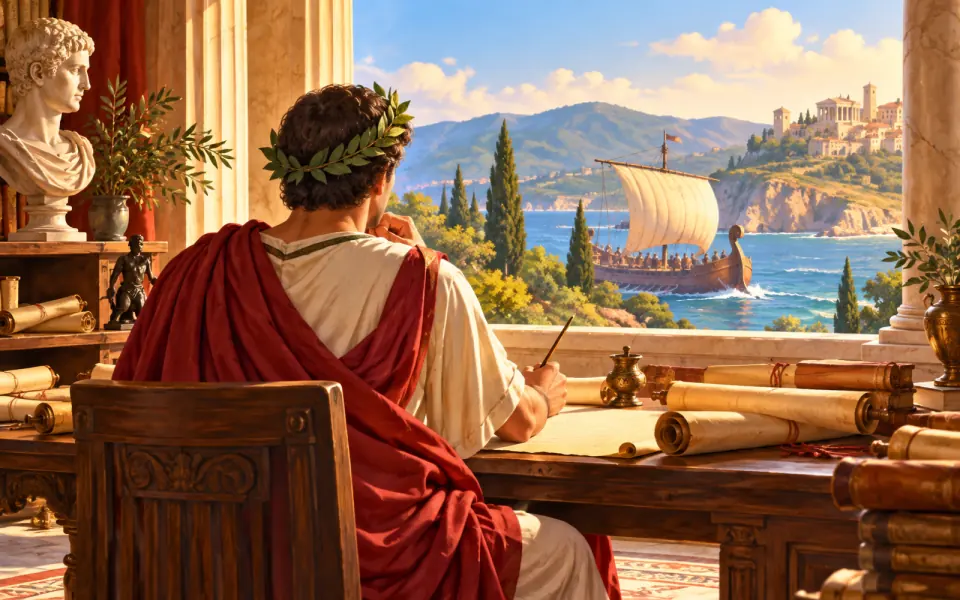 BeforeVirgil and the Aeneid19 BC
 BeforePompeii buried by VesuviusAD 79
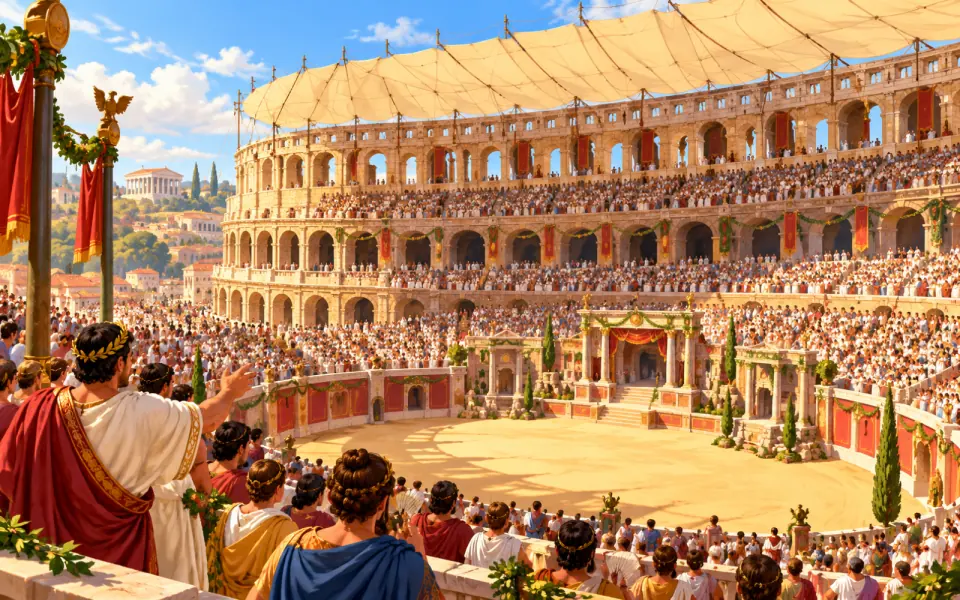 BeforeThe Colosseum opensAD 80
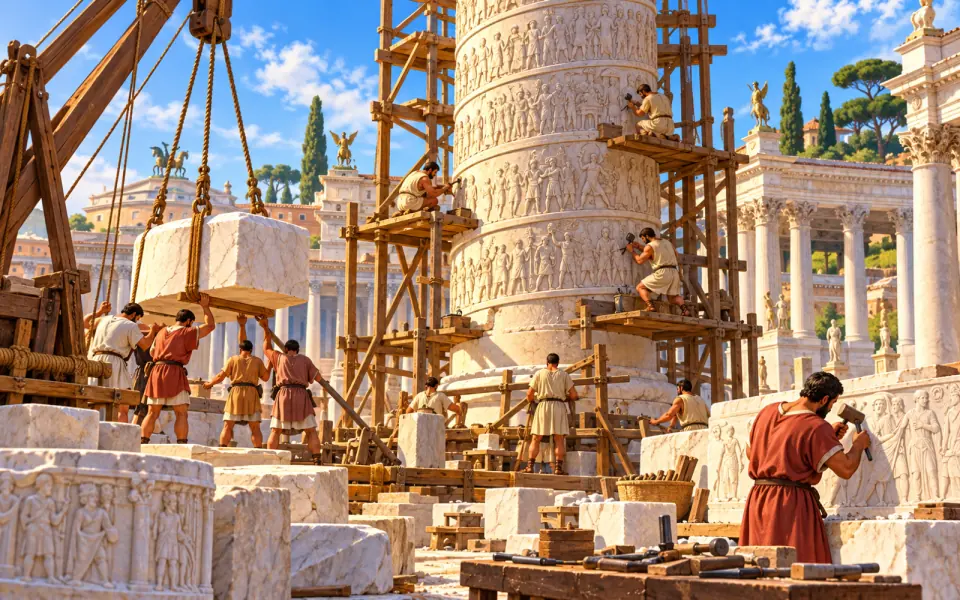 BeforeTrajan's ColumnAD 113
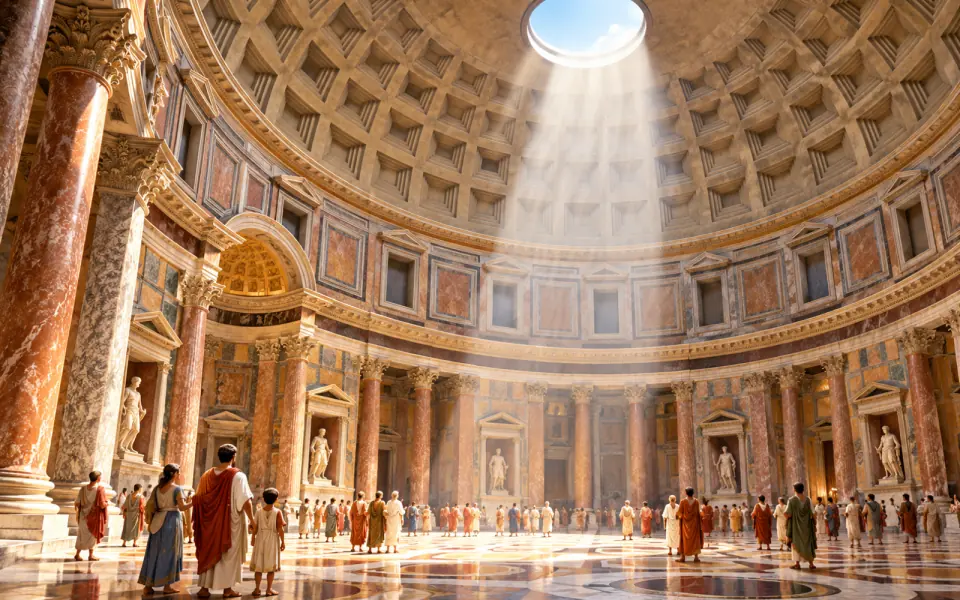 BeforeThe Pantheonabout AD 125
- You are hereGalen, a doctor in Romeabout AD 162
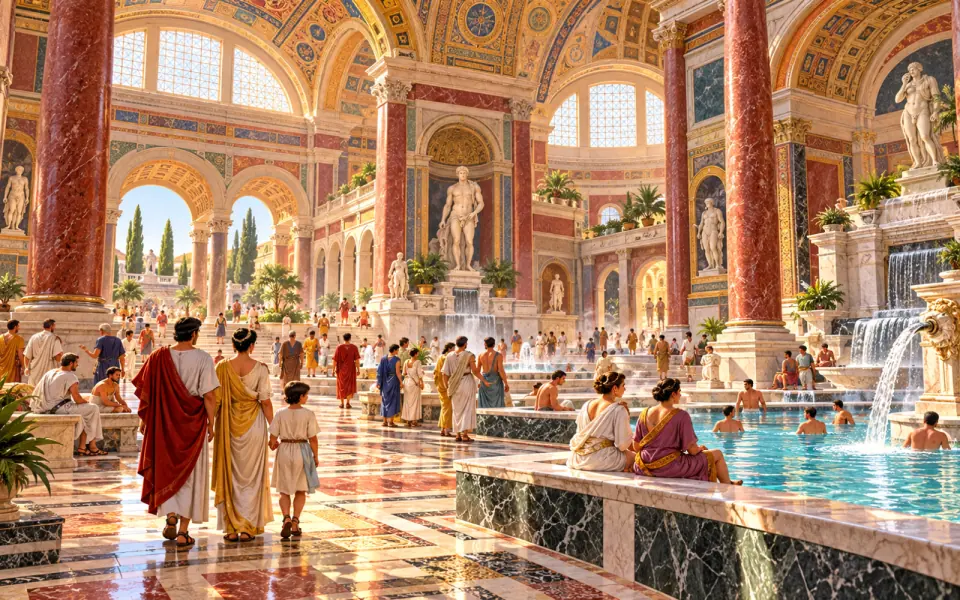 AfterThe Baths of CaracallaAD 216
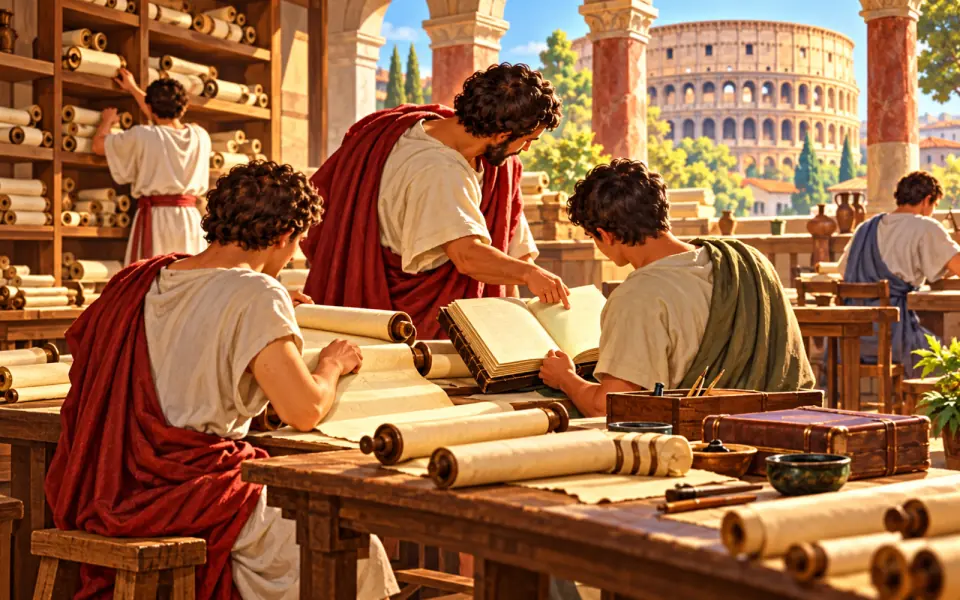 AfterThe book with pages (the codex)about AD 300
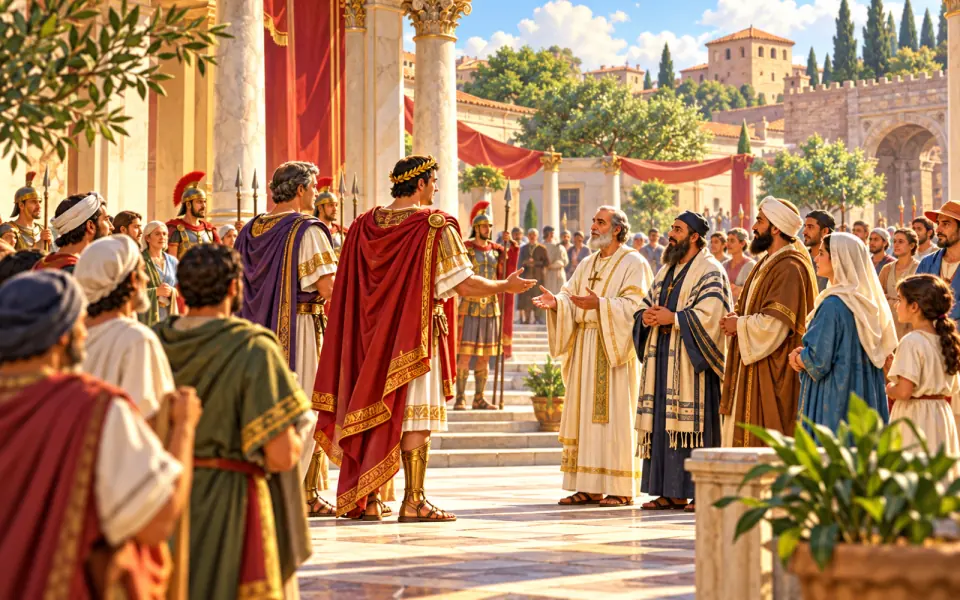 AfterThe Edict of MilanAD 313
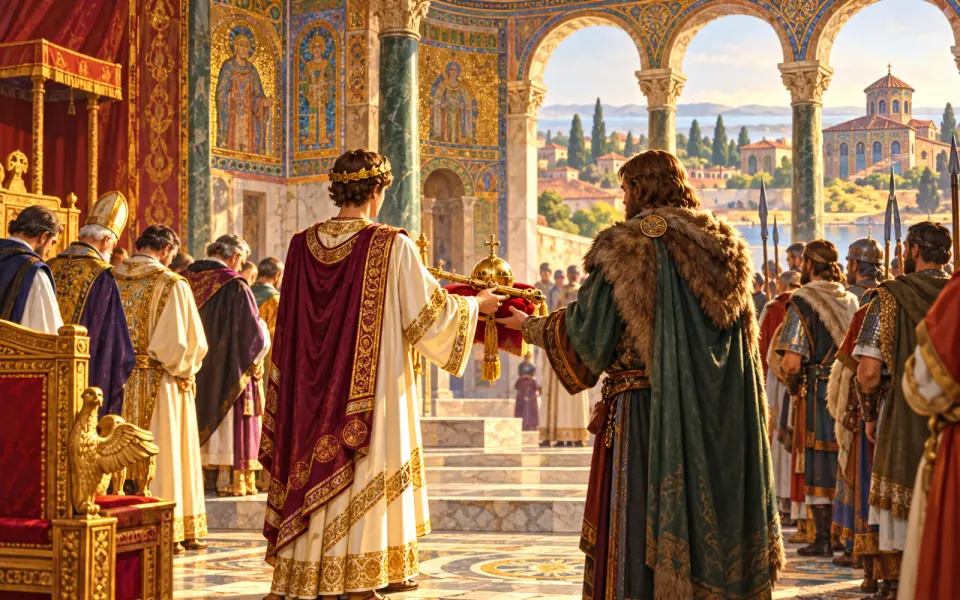 AfterFall of the Western Roman EmpireAD 476
Listen / Read next
- Music to read by: Cinematic JourneyEpic film-style music, no lyrics, by Ciro Simone IrmiciSpotifyYouTube Music
Meanwhile, elsewhere in the world
Other events of the era “Ancient Rome”
- Traditional founding of Rome
- Birth of the Roman Republic
- The Laws of the Twelve Tables
- The Appian Way
- The First Punic War
- Hannibal crosses the Alps
- Plautus and comedy
- Roman concrete
- The Aqua Marcia aqueduct
- Spartacus leads the revolt
- Caesar crosses the Rubicon
- The Julian calendar
- The murder of Julius Caesar
- Augustus, the first emperor
- The Pax Romana
- Virgil and the Aeneid
- Pompeii buried by Vesuvius
- The Colosseum opens
- Trajan's Column
- The Pantheon
- The Baths of Caracalla
- The book with pages (the codex)
- The Edict of Milan
- Fall of the Western Roman Empire
