The Colosseum opens
AD 80 Rome
In short
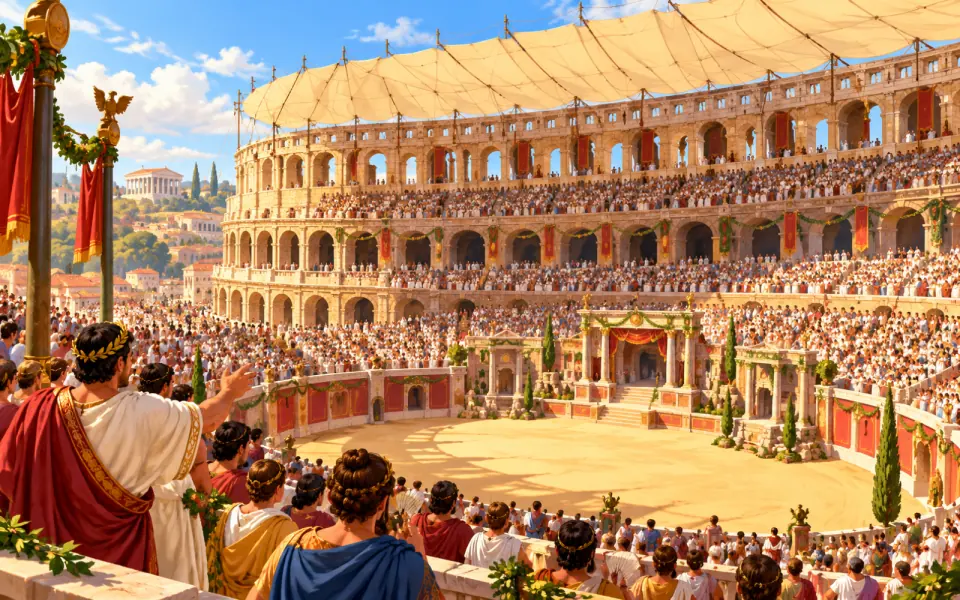
The Flavian Amphitheatre, which we now call the Colosseum, was opened by the emperor Titus with a hundred days of games. It could hold about 50,000 spectators, who came in through eighty numbered entrances. Under the arena there were corridors and lifts to make animals and scenery appear suddenly. On sunny days an enormous awning, the velarium, shaded the audience.
Why it matters It has become the symbol of Rome around the world and one of the most visited ancient monuments.
Source: Parco archeologico del Colosseo, “Colosseo”
Study card about 6 minutes of reading
The story
From Nero's lake to the amphitheatre
In the heart of Rome, between the Oppian Hill, the Caelian and the Velia, there was a valley. Before the Colosseum, on that spot stood an artificial lake, dug by the emperor Nero for his enormous residence, the Domus Aurea, the “Golden House”. After Nero's death, his successor Vespasian decided to give that space back to the people. He had the lake drained and, between AD 70 and 72, began to build a new building, a great amphitheatre, that is, a theatre with tiers of seats all around a central arena.
The work was paid for mostly with the booty of the Jewish war, that is, the treasure brought to Rome after the conquest of Jerusalem in AD 70. Vespasian died in 79, when the first two storeys had been completed. His son Titus added the third and fourth tiers of seats and inaugurated the building in AD 80 with a great celebration: the games lasted a very long time: a hundred days according to the tradition, about three months according to other calculations. Titus's brother, Domitian, completed the work.
Its official name was the Flavian Amphitheatre, from the name of the family of emperors (the Flavians). The name “Colosseum” came later, in the Middle Ages. Perhaps it comes from the Latin word colosseum, meaning “colossal”, or, more probably, from the nearness of the gigantic statue of Nero, the Colossus, which stood there beside it. That statue, according to the sources, was remodelled as an image of the Sun and moved under Hadrian, in 126, to make room for a temple.
A giant of travertine
The measurements of the Colosseum are impressive. The perimeter is about 527 metres long. The building is elliptical, with two axes of about 187.5 and 156.5 metres. The arena, where the shows took place, measures about 86 by 54 metres. Today the height is 48 metres, but originally it was about 52. How many spectators it could hold is hard to say: scholars estimate a number between 50,000 and 87,000.
Under the ground there is a foundation platform of tuff about 13 metres thick. The façade is made of travertine, a pale stone, and rises in four storeys: the first three are formed of 80 arches, with columns in three different styles (Doric, Ionic and Corinthian, from the simplest to the most elaborate), while the top storey is a solid wall. The interior parts use brick, tuff and, for the vaults, Roman concrete.
The public came in through 80 entrances, with numbers carved on the keystones of the arches: each person knew which entrance to go to in order to reach their own section, as with the tickets at a stadium today. Four entrances, on the axes of the ellipse, were reserved for special access.
The velarium and the sailors
To protect the spectators from sun and rain a great fabric cover was used, the velarium. We do not know whether it covered only the seating or the arena too. It is said that it was operated by sailors of the fleet of Misenum, who had a barracks next to the Colosseum: experts in sails and ropes, they were the best suited.
Under the arena
Beneath the floor of the arena, made of wood and covered with sand, there was a hidden world: the hypogeum. A large central passage and twelve curved corridors, with 80 lifts, were used to make animals, scenery and actors appear suddenly. The remains that can be seen today date from a rebuilding of the 3rd or 4th century, and the structures were created under Domitian.
What shows were seen
The shows followed a precise programme. In the morning there were the venationes, hunts and fights with animals, even exotic ones, brought from far away. At midday executions of condemned prisoners were held. In the afternoon the gladiators fought, men trained in schools, often slaves or prisoners. It was a cruel way of having fun, which today seems very far from our sensibilities. The last gladiator fights recorded date from about AD 435–437, the last venationes from 519 and 523, under King Theodoric.
After the Romans
The Colosseum was damaged several times: by a fire in 217, after a lightning strike, and by earthquakes, the one of about 847 and that of 1349, which brought down the south side. In the Middle Ages it was used as a cemetery, as a castle and as a quarry: from the 15th and 16th centuries many travertine blocks were carried off to build other buildings. In 1744 Pope Benedict XIV forbade stripping it and in 1749 he declared it consecrated to the Christian martyrs.
Today it is the symbol of Rome. In 2023 the Colosseum, Roman Forum and Palatine circuit had 12,298,246 visitors, the leading state museum site in Italy. It has been a UNESCO World Heritage Site since 1980 and in 2007 it was chosen as one of the “New Seven Wonders of the World”. Since 2002 it has appeared on the back of the Italian 5 euro-cent coin.
Why it happened
Vespasian was a new emperor and needed to win the Romans' goodwill. Building a great building in place of Nero's private residence was a clear message: the city was going back to its citizens.
The shows in the arena were part of Roman public life: the games served to celebrate victories, to honour the gods and to win popularity. Until then Rome had had smaller amphitheatres or ones made of wood. With the Colosseum the emperor wanted to give the capital a building worthy of its importance.
What changed
The Colosseum became the centre of Rome's shows for centuries, until the 6th century. Its elliptical shape, the tiers of arches and the layout of the entrances are still studied today by architects who design stadiums.
After the end of the games the monument survived by changing its function. Church, castle, quarry: it was also a victim of stripping, but precisely its change of use and then the protection of the popes and of the Italian state allowed it to reach us, even if partly ruined.
Today it serves for reflection. We remember the greatness of Roman engineering and the talent of the architects, but also the cruelty of shows in which men and animals died to amuse the public. In 2007 it was included among the new wonders of the world, in support of its protection.
Key people and places
People
- Vespasian
- Emperor from AD 69 to 79: he began the building of the Colosseum between 70 and 72.
- Titus
- Son of Vespasian, emperor from AD 79 to 81: in 80 he inaugurated the amphitheatre.
- Domitian
- Brother of Titus, he completed the building and had the underground chambers built.
- Nero
- Emperor before the Flavians: the artificial lake of his Domus Aurea lay where the Colosseum stands.
Places
- Colosseum
- The Flavian Amphitheatre, in the valley between the Velia, the Oppian Hill and the Caelian, in Rome.
- Hypogeum
- Underground chambers of the arena, with corridors and lifts to make animals and scenery appear.
- Misenum
- Port on the Bay of Naples where the Roman fleet was based, whose sailors would have operated the velarium.
Good to know
- There were 80 entrances and they had numbers carved on them: arrivals knew at once which one to use.
- The name “Colosseum” is medieval: perhaps it comes from the great statue of Nero that stood nearby.
- Under the arena there were 80 lifts to make animals and scenery appear.
- The Colosseum appears on the back of the Italian 5 euro-cent coin.
- In 2023 the Colosseum–Forum–Palatine circuit passed 12 million visitors.
Find out more
- Colosseum Archaeological Park, “Colosseum Arena” colosseo.it
- World History Encyclopedia, “Colosseum” worldhistory.org
- Wikipedia, “Colosseum” en.wikipedia.org
- Wikipedia, “Domus Aurea” en.wikipedia.org
Related events
- Pompeii buried by VesuviusAD 79 · Ancient RomeThe year before the inauguration the eruption of Vesuvius buried Pompeii, and Titus sent aid.
- Spartacus leads the revolt73–71 BC · Ancient RomeSpartacus had escaped from a gladiator school, the same men who fought in the arenas.
- Roman concreteabout 150 BC · Ancient RomeThe Colosseum is built with travertine and Roman concrete.
- The Pantheonabout AD 125 · Ancient RomeThe Pantheon too is a great Roman building in concrete.
- The Baths of CaracallaAD 216 · Ancient RomeThe Baths of Caracalla, another meeting place for the people, were built a century and a half later.
Before and after, in the era “Ancient Rome”
Event 18 of 25
 BeforeTraditional founding of Romeabout 753 BC
 BeforeBirth of the Roman Republicabout 509 BC
 BeforeThe Laws of the Twelve Tablesabout 450 BC
 BeforeThe Appian Way312 BC
 BeforeThe First Punic War264–241 BC
 BeforeHannibal crosses the Alps218 BC
 BeforePlautus and comedyabout 200 BC
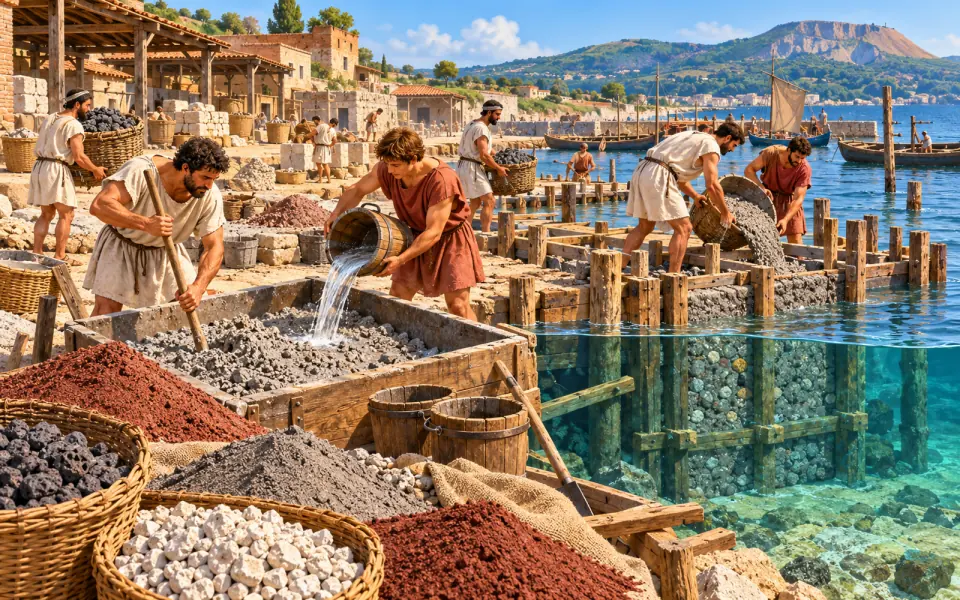 BeforeRoman concreteabout 150 BC
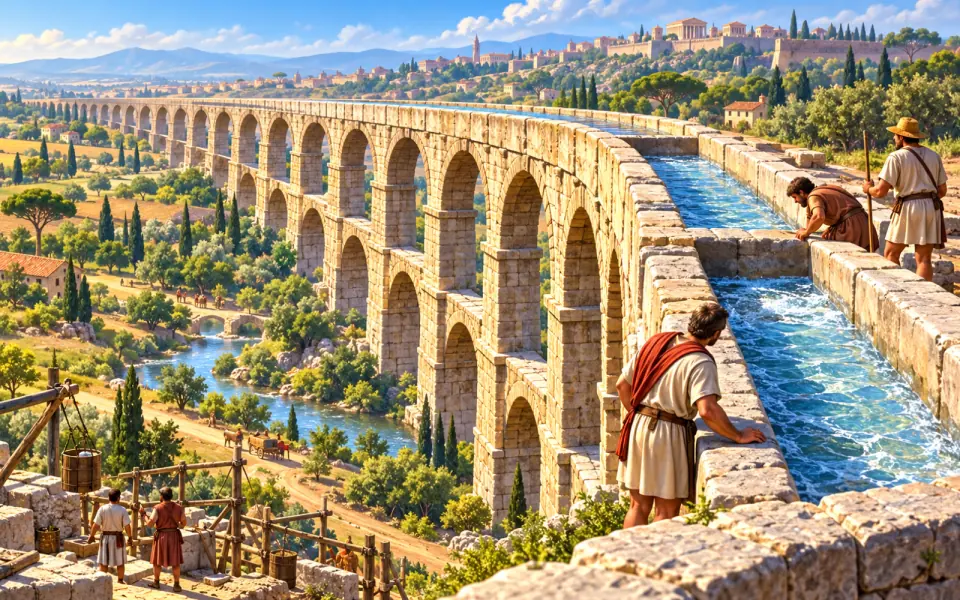 BeforeThe Aqua Marcia aqueduct144–140 BC
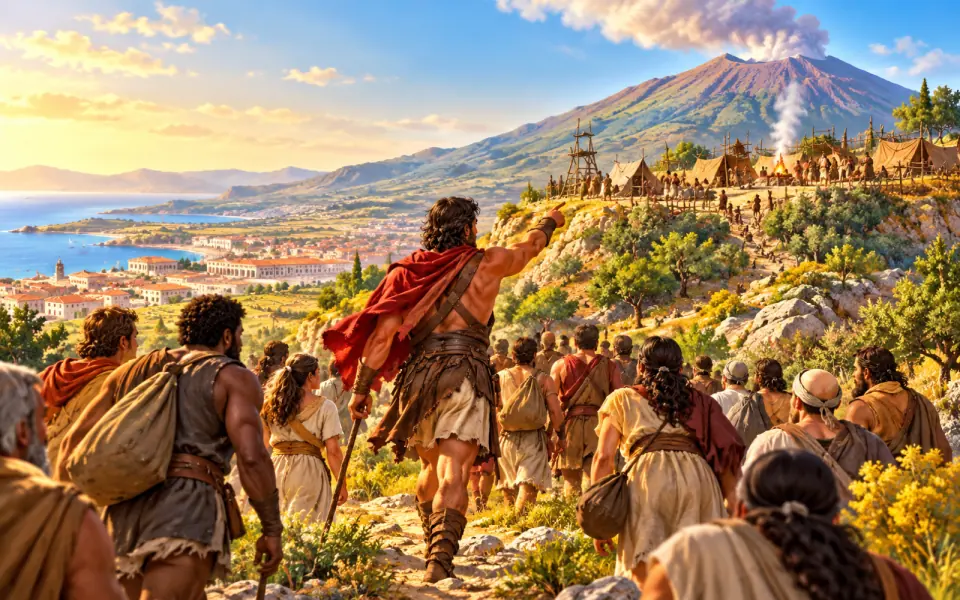 BeforeSpartacus leads the revolt73–71 BC
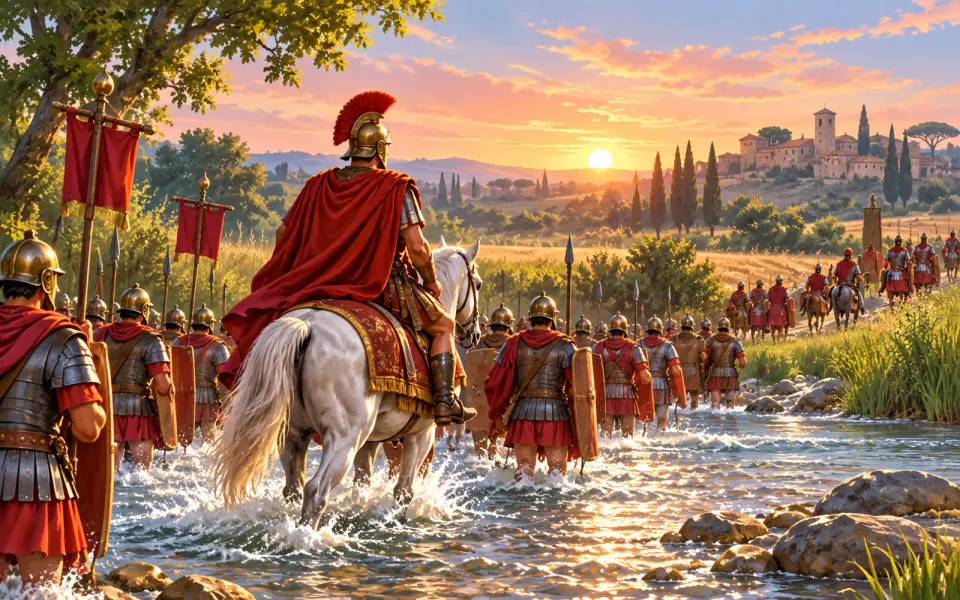 BeforeCaesar crosses the Rubicon49 BC
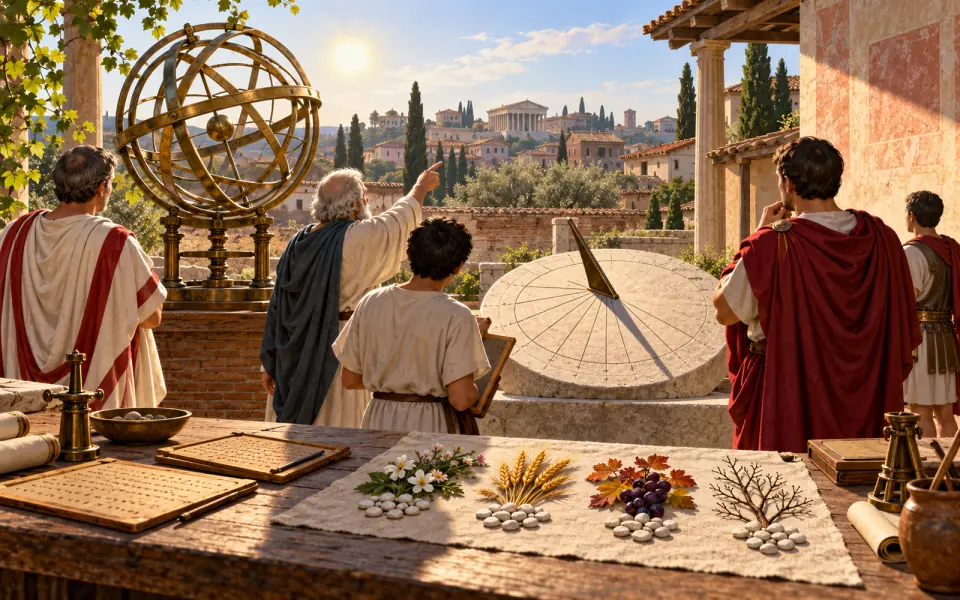 BeforeThe Julian calendar46 BC
 BeforeThe murder of Julius Caesar44 BC
 BeforeAugustus, the first emperor27 BC
 BeforeThe Pax Romana27 BC – AD 180
 BeforeVirgil and the Aeneid19 BC
 BeforePompeii buried by VesuviusAD 79
- You are hereThe Colosseum opensAD 80
 AfterTrajan's ColumnAD 113
 AfterThe Pantheonabout AD 125
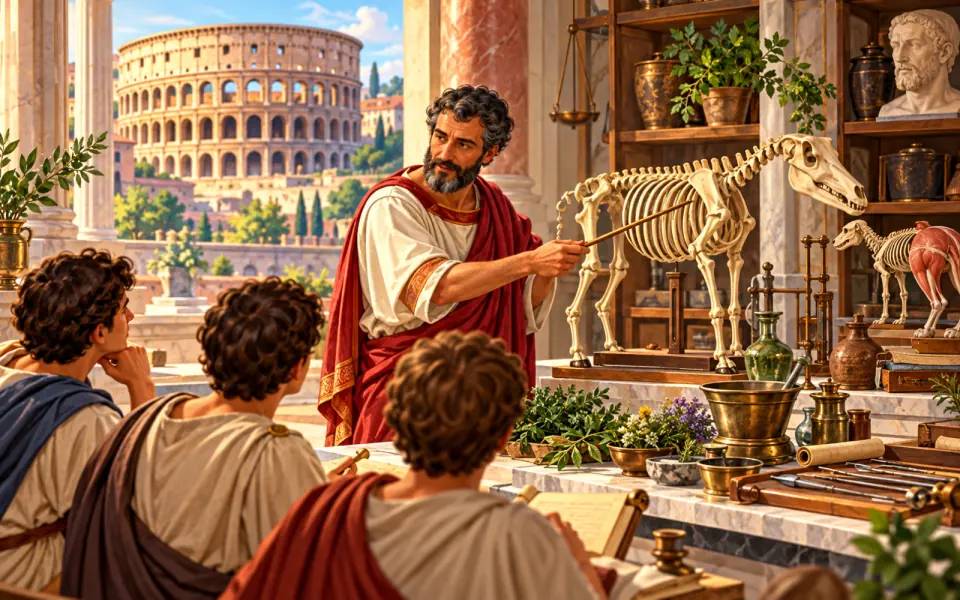 AfterGalen, a doctor in Romeabout AD 162
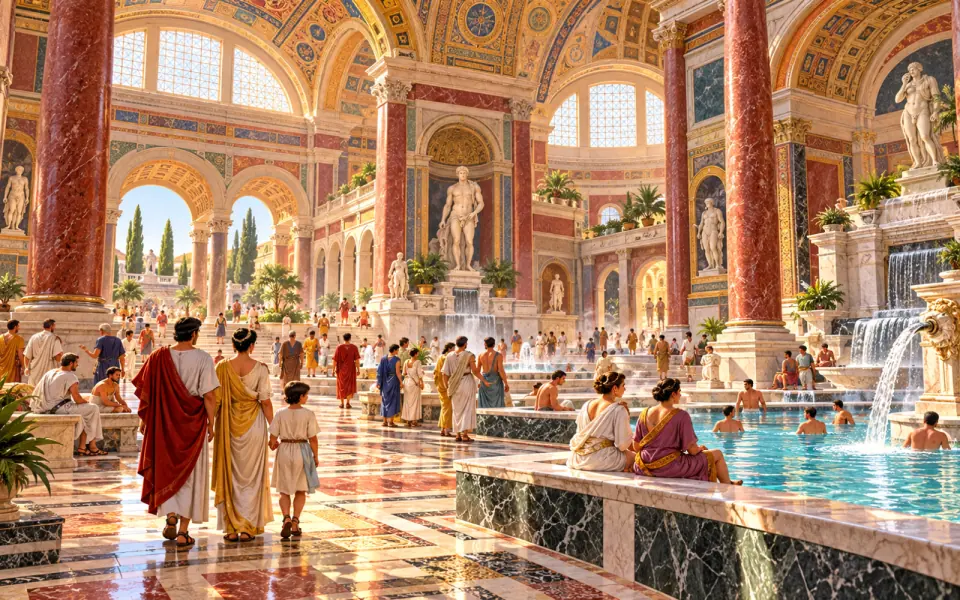 AfterThe Baths of CaracallaAD 216
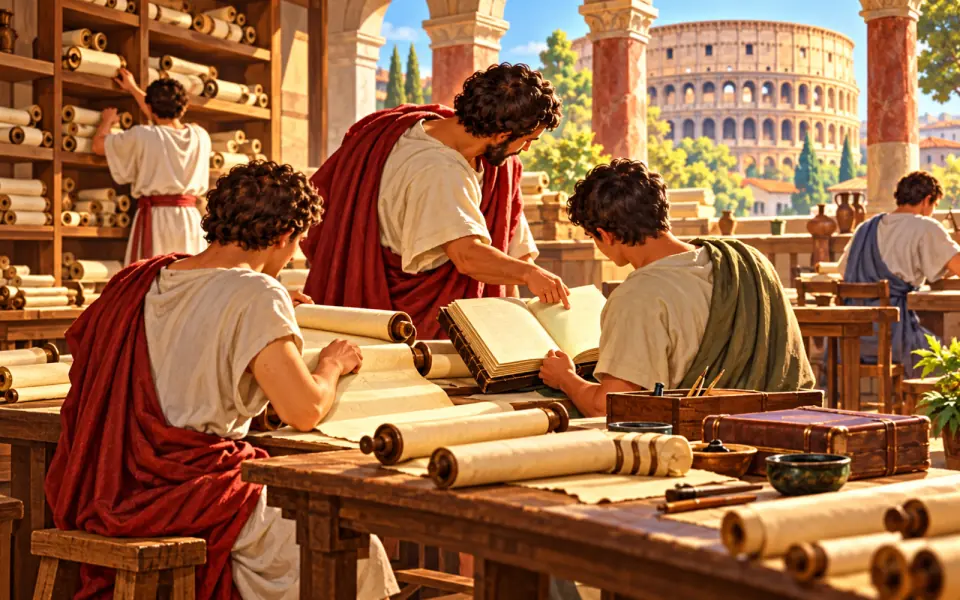 AfterThe book with pages (the codex)about AD 300
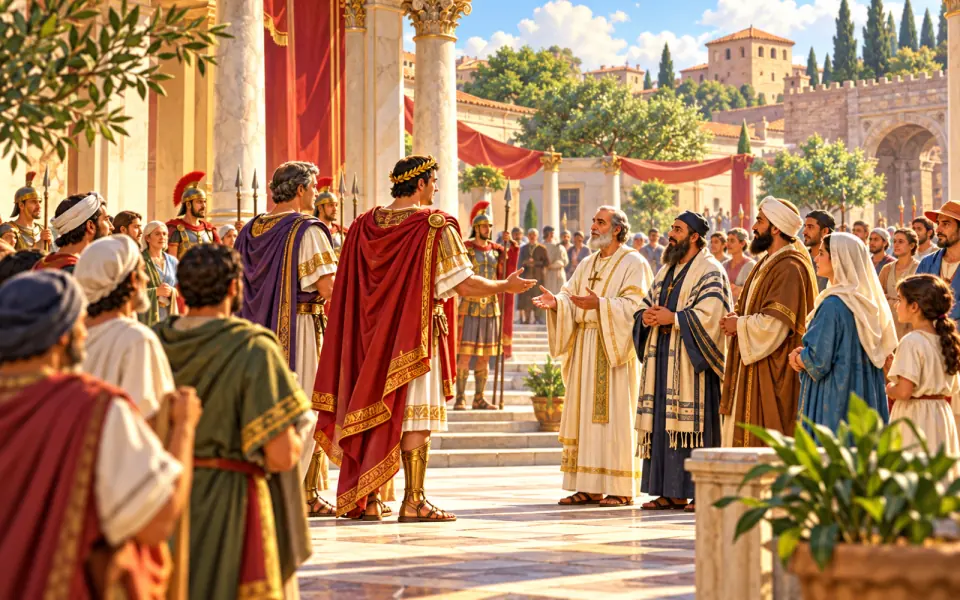 AfterThe Edict of MilanAD 313
 AfterFall of the Western Roman EmpireAD 476
Listen / Read next
- Music to read by: Cinematic JourneyEpic film-style music, no lyrics, by Ciro Simone IrmiciSpotifyYouTube Music
Meanwhile, elsewhere in the world
Other events of the era “Ancient Rome”
- Traditional founding of Rome
- Birth of the Roman Republic
- The Laws of the Twelve Tables
- The Appian Way
- The First Punic War
- Hannibal crosses the Alps
- Plautus and comedy
- Roman concrete
- The Aqua Marcia aqueduct
- Spartacus leads the revolt
- Caesar crosses the Rubicon
- The Julian calendar
- The murder of Julius Caesar
- Augustus, the first emperor
- The Pax Romana
- Virgil and the Aeneid
- Pompeii buried by Vesuvius
- Trajan's Column
- The Pantheon
- Galen, a doctor in Rome
- The Baths of Caracalla
- The book with pages (the codex)
- The Edict of Milan
- Fall of the Western Roman Empire
