The murder of Julius Caesar
44 BC Curia of Pompey, Rome
In short
On 15 March 44 BC, the day called the Ides of March, Julius Caesar was killed during a meeting of the Senate in Rome. He had had himself made dictator for life, and many senators feared he wanted to become king. Among the plotters were Brutus and Cassius, who saw themselves as defenders of the republic. But his death did not save the republic and started another long series of civil wars.
Why it matters The struggle over Caesar's inheritance led to the end of the republic and the birth of the empire.
Source: Encyclopaedia Britannica, “Julius Caesar”
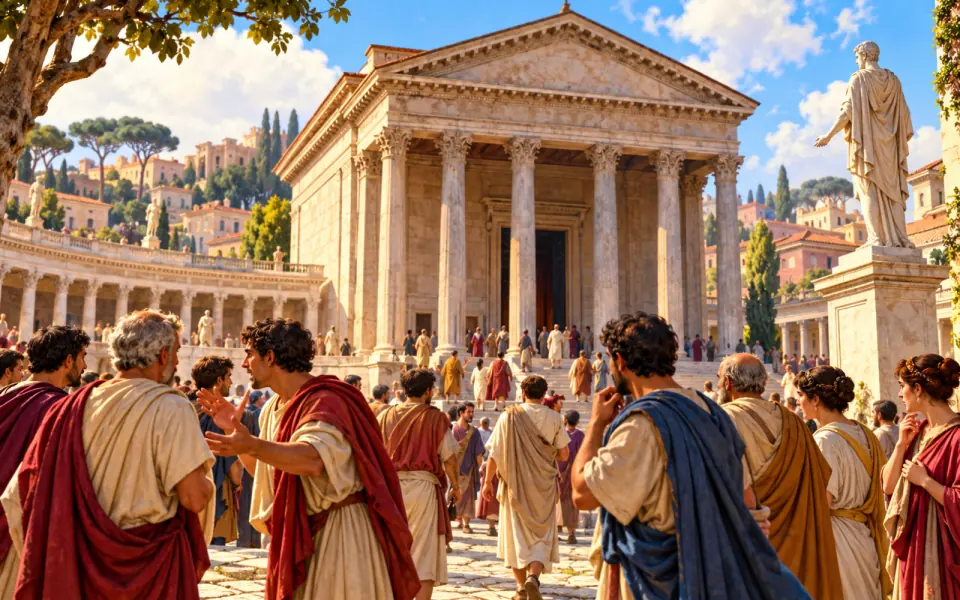
Study card about 6 minutes of reading
The story
The Ides of March
In the Roman calendar the days were not counted as we do, but were referred to three fixed dates of each month: the Kalends, the Nones and the Ides. The Ides fell on the 13th of the month, but in March, May, July and October they fell on the 15th. They were sacred to Jupiter. For us the “Ides of March” have become a byword for betrayal, because of what happened on 15 March 44 BC.
On that day Julius Caesar, the most powerful man in Rome, was killed during a meeting of the Senate. After winning the civil war against Pompey, he had become dictator, and shortly before he had had himself named dictator for life. Many senators thought he was about to become king, and for the Romans, who had driven out their kings almost five centuries earlier, this was the gravest accusation that could be made against a citizen.
The plot
The conspirators were numerous. The ancient sources speak of some sixty senators, perhaps as many as eighty people, involved in the plot or informed of it. They were led by Gaius Cassius Longinus, Marcus Junius Brutus and Decimus Junius Brutus. In the group there were also friends and supporters of Caesar, who had been upset by disappointments or personal grudges. They considered themselves the defenders of the Republic and called themselves the “liberators”.
Before that day, the ancient authors tell us, there were many omens. Suetonius lists sacred horses that refused to eat and seemed to weep, a little bird with a sprig of laurel killed in front of the Curia, the dreams of Caesar and of his wife Calpurnia. A soothsayer, the haruspex Spurinna, had warned Caesar to beware of a danger that would not last beyond the Ides of March. When Caesar met him that day and told him with a smile that the Ides had come, Spurinna replied that they had come, yes, but had not yet gone. These stories should be taken with caution: many were perhaps added afterwards, when everybody knew how it had ended.
The blow
That day the Senate was meeting in the Curia of Pompey, a large hall beside the theatre built by Pompey, Caesar's old rival. In the hall there was a statue of Pompey and, according to the tradition, Caesar fell at its feet. The statue, found in the 16th century, is today in Palazzo Spada, in Rome.
What was the attack like? According to Suetonius, one of the conspirators, Tillius Cimber, came up on a pretext and seized Caesar's toga, and one of the Casca brothers struck him first, in the shoulder or the neck depending on the sources. Caesar covered his head with his toga. In all he was struck, says Suetonius, by 23 stab wounds; a doctor named Antistius reported that only the second wound, in the chest, had been fatal. Some authors tell that Caesar said to Marcus Brutus, who was striking him: “You too, son?” We do not know if it is true: it is a tradition. The body was taken home by three slaves.
The next day
The conspirators counted on being welcomed as heroes. Instead the senators ran away, the city was seized by panic and the liberators did not manage to take control. They had wanted to throw Caesar's body into the Tiber, but gave up the idea for fear of Mark Antony and Lepidus, Caesar's supporters.
A few days later, Antony gave a funeral speech and Caesar's will was opened, naming his adopted son Octavian as heir. The crowd, moved and angry, burned the body in the Forum, and Antony had to restore calm. The Curia was walled up, the Ides of March were called the “day of parricide” and the Senate never met again on that date.
The settling of scores
Octavian, the young heir, came forward. With Quintus Pedius he had a law passed, the lex Pedia, which condemned the conspirators to exile. Most of them were dead by 43 BC. In 42 BC, at Philippi, in Greece, Brutus and Cassius were defeated by Antony and Octavian and took their own lives. A few years after Caesar's killing, Rome had not gone back to the days of the Republic: it was at war, and in the end Octavian would found the empire.
Today, in the centre of Rome, the place of the assassination is in the sacred area of Largo di Torre Argentina, where archaeologists have uncovered temples and the remains of buildings. In 2012 some scholars once again pointed out the spot where Caesar sat.
Why it happened
After the civil war Caesar had gathered a power never seen in the Republic: dictator, with a loyal army and command over the Senate. He had made reforms and pardoned many opponents, but many senators saw in his offices, above all the one for life, the end of the traditional freedoms.
Personal rivalries, disappointments and the fear that Caesar wanted to be called king were added. The conspirators thought that by eliminating him they would save the Republic. They had no plan for afterwards, and that is one of the reasons their act failed.
What changed
Caesar's death did not save the Republic. On the contrary, it opened another phase of civil wars. Antony and Octavian allied to avenge Caesar and defeated Brutus and Cassius at Philippi. Then they clashed with each other, and in the end Octavian won, who in 27 BC received the title of Augustus and founded the empire.
Caesar, after his death, was honoured as a god by some of the Romans. His name, Caesar, became an imperial title: from it come the words “tsar” in Russia and “Kaiser” in Germany. The calendar he had reformed also stayed in use for centuries.
The Ides of March are still a way today of remembering that power and politics can be dangerous, and that violent acts seldom solve problems: the conspirators' choice opened an even harsher period. Historians study it to understand how republics end.
Key people and places
People
- Julius Caesar
- Roman general and dictator. He was killed on 15 March 44 BC in the Curia of Pompey.
- Marcus Junius Brutus
- One of the leaders of the conspirators. He was defeated at Philippi in 42 BC and killed himself.
- Gaius Cassius Longinus
- Another leader of the plot, defeated at Philippi together with Brutus.
- Mark Antony
- Supporter of Caesar: he gave the funeral speech and allied with Octavian.
Places
- Curia of Pompey
- Hall beside Pompey's theatre where the Senate met on the day of the assassination.
- Largo di Torre Argentina
- Area of Rome where the remains of the temples and of the Curia of Pompey lie; in 2012 some scholars once again pointed out the spot of the assassination.
- Philippi
- City in Greece where in 42 BC Brutus and Cassius were defeated.
Good to know
- The Ides were the 15th day of March, May, July and October, and the 13th of the other months.
- According to Suetonius Caesar was struck by 23 stab wounds, but only one, in the chest, was fatal.
- After the assassination the Curia was walled up, and the Senate never again met on the day of the Ides of March.
- The statue of Pompey at whose feet Caesar fell, found in the 16th century, is today in Palazzo Spada.
- The name “Caesar” is the origin of the words “Kaiser” and “tsar”.
Find out more
- Wikipedia, “Assassination of Julius Caesar” en.wikipedia.org
- World History Encyclopedia, “The Assassination of Julius Caesar” worldhistory.org
- Wikipedia, “Theatre of Pompey” en.wikipedia.org
- Wikipedia, “Largo di Torre Argentina” en.wikipedia.org
Related events
- Caesar crosses the Rubicon49 BC · Ancient RomeFive years earlier, Caesar had crossed the Rubicon.
- Augustus, the first emperor27 BC · Ancient RomeAfter his death the young Octavian became Augustus.
- The Julian calendar46 BC · Ancient RomeThe calendar reformed by Caesar stayed in use for centuries.
- Birth of the Roman Republicabout 509 BC · Ancient RomeThe conspirators believed they were defending the Republic born in 509 BC.
- Plautus and comedyabout 200 BC · Ancient RomePompey's theatre, next to the Curia, was the first stone theatre in Rome.
Before and after, in the era “Ancient Rome”
Event 13 of 25
 BeforeTraditional founding of Romeabout 753 BC
 BeforeBirth of the Roman Republicabout 509 BC
 BeforeThe Laws of the Twelve Tablesabout 450 BC
 BeforeThe Appian Way312 BC
 BeforeThe First Punic War264–241 BC
 BeforeHannibal crosses the Alps218 BC
 BeforePlautus and comedyabout 200 BC
 BeforeRoman concreteabout 150 BC
 BeforeThe Aqua Marcia aqueduct144–140 BC
 BeforeSpartacus leads the revolt73–71 BC
 BeforeCaesar crosses the Rubicon49 BC
 BeforeThe Julian calendar46 BC
- You are hereThe murder of Julius Caesar44 BC
 AfterAugustus, the first emperor27 BC
 AfterThe Pax Romana27 BC – AD 180
 AfterVirgil and the Aeneid19 BC
 AfterPompeii buried by VesuviusAD 79
 AfterThe Colosseum opensAD 80
 AfterTrajan's ColumnAD 113
 AfterThe Pantheonabout AD 125
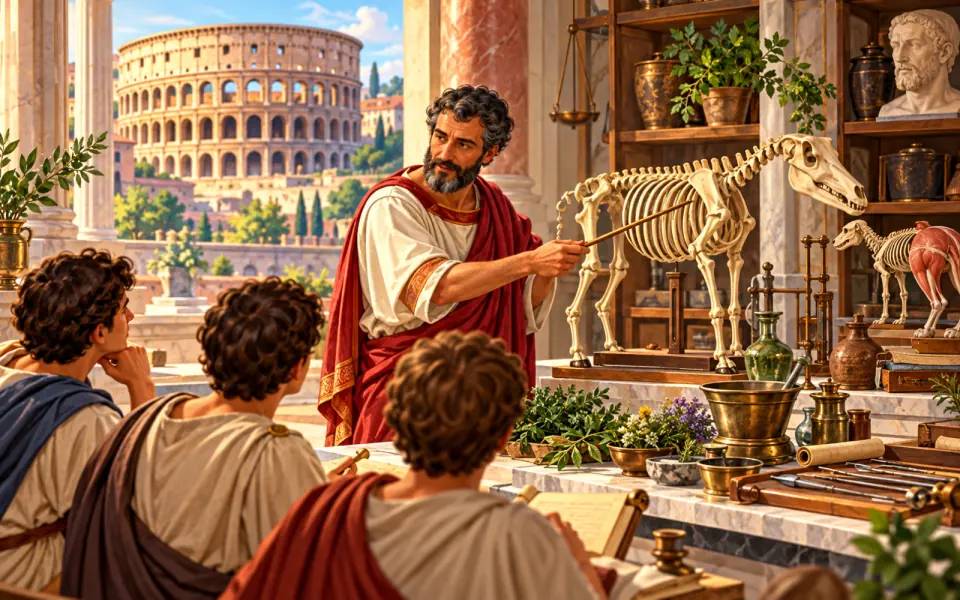 AfterGalen, a doctor in Romeabout AD 162
 AfterThe Baths of CaracallaAD 216
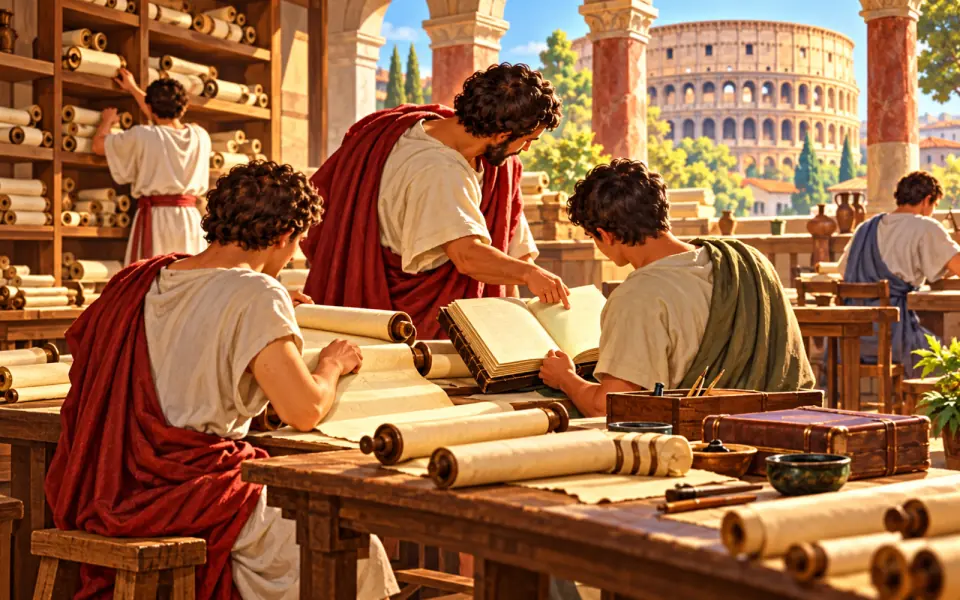 AfterThe book with pages (the codex)about AD 300
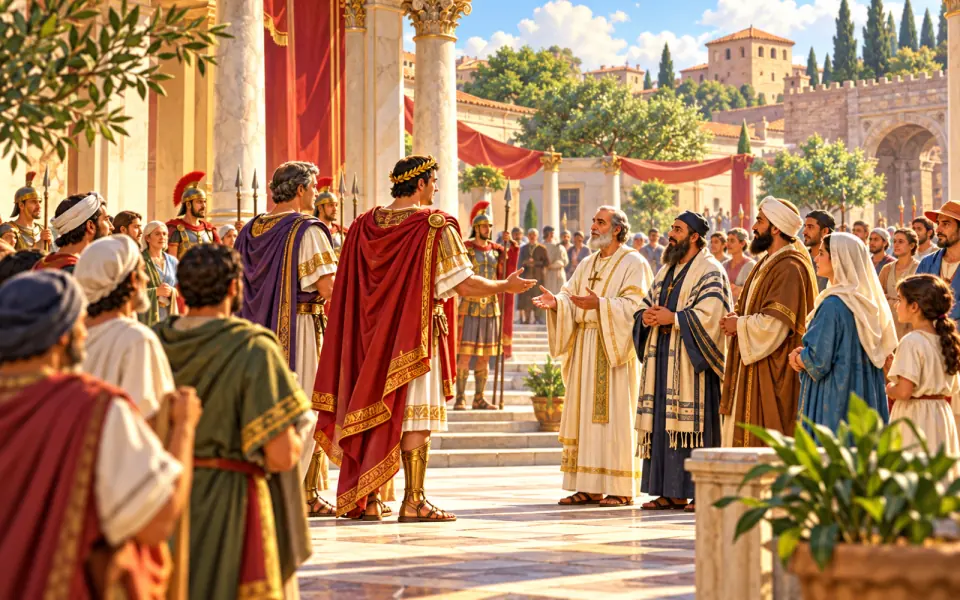 AfterThe Edict of MilanAD 313
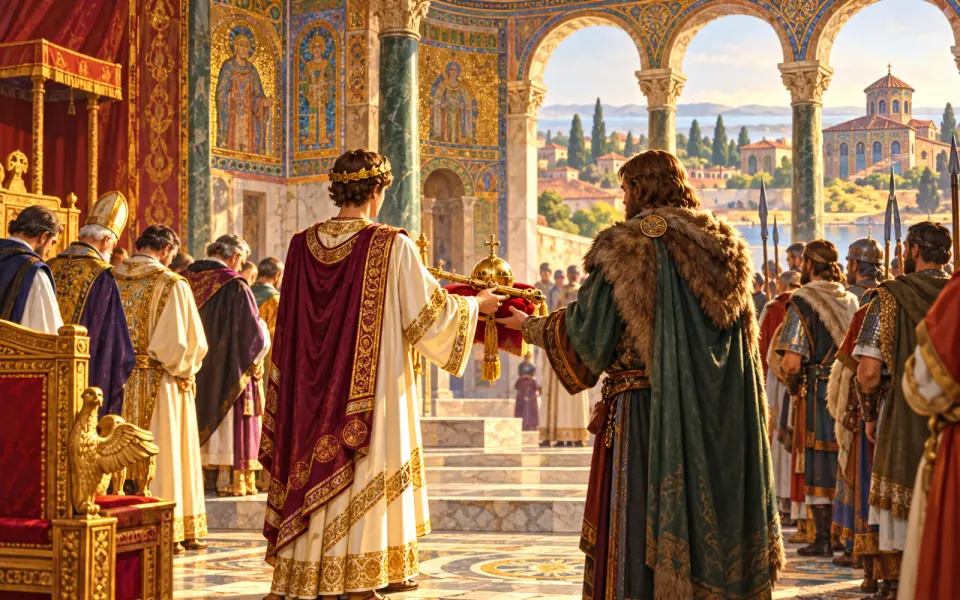 AfterFall of the Western Roman EmpireAD 476
Listen / Read next
- Music to read by: Cinematic JourneyEpic film-style music, no lyrics, by Ciro Simone IrmiciSpotifyYouTube Music
Meanwhile, elsewhere in the world

Other events of the era “Ancient Rome”
- Traditional founding of Rome
- Birth of the Roman Republic
- The Laws of the Twelve Tables
- The Appian Way
- The First Punic War
- Hannibal crosses the Alps
- Plautus and comedy
- Roman concrete
- The Aqua Marcia aqueduct
- Spartacus leads the revolt
- Caesar crosses the Rubicon
- The Julian calendar
- Augustus, the first emperor
- The Pax Romana
- Virgil and the Aeneid
- Pompeii buried by Vesuvius
- The Colosseum opens
- Trajan's Column
- The Pantheon
- Galen, a doctor in Rome
- The Baths of Caracalla
- The book with pages (the codex)
- The Edict of Milan
- Fall of the Western Roman Empire
