The eruption of Thera
about 1600 BC Thera, now Santorini (Greece)
In short
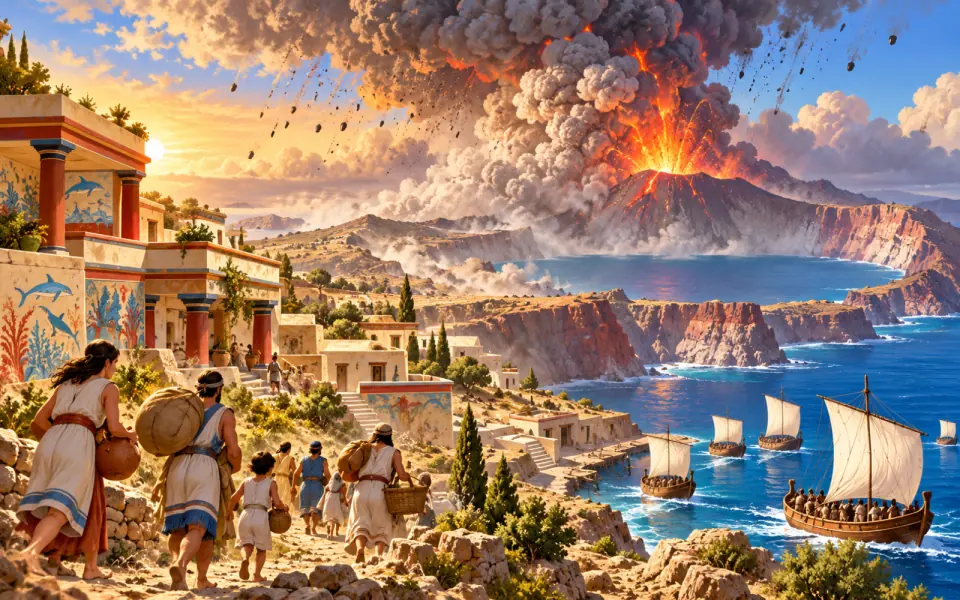
The island of Thera, today's Santorini, was shattered by one of the largest volcanic eruptions of the last ten thousand years. The centre of the island collapsed and the sea filled the huge hollow, the caldera, that can still be seen today. Ash buried the town of Akrotiri, which had already been abandoned: its people had managed to escape in time. Under the ash, two-storey houses with splendid frescoes have been preserved.
Why it matters Akrotiri is a kind of Bronze Age Pompeii, a town frozen in time.
Source: Encyclopaedia Britannica, “Thera”
Study card about 6 minutes of reading
The story
An island shaped like a ring
Santorini, in the Cyclades, is one of the best-loved destinations in the Aegean Sea: white houses on top of very high cliffs, sunsets over the sea. Seen from above, though, it has a strange shape. The island is not a solid disc but a crescent, which opens onto a deep, circular bay. That bay is the caldera, an enormous crater formed when a volcano sank in on its own centre. In the middle of the bay is a small volcanic island, Nea Kameni.
Before the eruption we are talking about, the island looked different: it was almost a continuous ring of land, with only one gap between the islands of Thera and Aspronisi. Inside that ring was a sheltered sea, a natural harbour. Today we call the island Thera in archaeology books and Santorini in everyday speech.
A city frozen in time
In the southern part of the island stood Akrotiri, a village of fishermen and farmers that had begun as early as the fifth millennium BC and had grown over time thanks to trade and copper working. Before the catastrophe it had become a real small town, with streets, little squares and houses of several storeys. The town was Cycladic, but closely tied to Crete: its art has Minoan features, and inscriptions in Linear A have been found there.
In 1867 a French geologist carried out the first digs there. But the most important discovery began in 1967, with the Greek archaeologist Spyridon Marinatos. Beneath metres of pumice and ash there appeared streets and houses still standing, with buildings of several storeys, vases and pottery, plaster casts of wooden furniture that had disappeared, and above all frescoes whose colours are still vivid. Among the most beautiful are the “Spring Fresco” and the “Blue Monkeys”. After Marinatos died (1974), from 1975 the excavations were led by Christos Doumas.
The surprising thing is that in the whole excavated area no human body has been found, and only one gold object. In 1999 a gold figurine of an ibex came to light. For archaeologists this means that the inhabitants had time to leave, taking their valuables with them. This is also because it seems that, before the real eruption, there were tremors and warning signs for months.
The eruption
The eruption was among the biggest of the last ten thousand years. Volcanologists classify it as grade 7 on the VEI scale, which runs from 0 to 8. Recent estimates, based on data collected at sea, speak of an amount of material between 28 and 41 cubic kilometres of solid rock, and of a column of gas and ash about 30–35 kilometres high, reaching the stratosphere. In the final phase the centre of the volcano collapsed and the sea flooded into the enormous empty space: this created the caldera we see today.
The collapse and the explosions generated tsunamis, enormous waves, which struck the north of Crete. At Palaikastro geologists estimate waves of about nine metres; for other places the estimates are much higher and uncertain. On Crete ash fell and earthquakes shook the ground, and some villages were destroyed.
But when?
The date is one of the most debated problems in archaeology. On one side are the radiocarbon measurements, which say around 1627–1600 BC: an olive branch buried alive by the pumice was analysed. On the other, archaeologists who look at the pots and at links with Egypt suggest about 1550–1480 BC, a century later. In 2018 the team of Charlotte Pearson showed that the curve used to calibrate radiocarbon might have an error of a few decades; since then the two schools have drawn closer. In 2020 one study gave 1619–1596 or 1576–1545 BC; another, in 2023, gave a range between 1610 and 1510 BC. In practice today we say: between the late 17th and the 16th century BC, with the exact year still not fixed. This is why the event is dated to about 1600.
And the Minoans?
For a long time people believed that the eruption had destroyed Minoan civilisation. The excavations say otherwise: Crete recovered quickly, and the following period is considered the most splendid of its culture. Damaged sites were rebuilt and new palaces were built. Later on, however, that civilisation was swept away by other crises, which are discussed in the card on the Minoans.
A very famous idea holds that the eruption is the historical memory of Atlantis, the vanished island described by the philosopher Plato. The hypothesis was put forward by Marinatos himself, but today scholars do not consider it valid: Plato writes many centuries later and his account is a philosophical story.
Why it happened
The Cyclades are volcanic because they lie at the point where the great African plate slides beneath the Eurasian one. Deep down the rock heats up and melts, and the magma rises into a chamber beneath the volcano. The volcano of Thera had already been active many times in the previous millennia, and its eruptions had formed and re-formed the ring of islands.
Before the explosion, magma built up beneath the island for months or years. When the pressure of the gases became too strong, a first phase of eruption began, followed by the most violent explosion, the one that hurled the column up to the stratosphere. In the end, with the magma chamber emptied, the roof gave way and the centre of the island sank. The inhabitants, warned by the earthquakes, had already left the town.
What changed
In the short term the eruption transformed the island and the sea around it: ash and pumice covered Akrotiri, tsunamis and earthquakes struck Crete, and for a time the sky was filled with dust. Even so, the societies of the Aegean did not collapse straight away. The Minoans rebuilt and for a few generations they still prospered.
In the long term, burial under the ash has made Akrotiri an extraordinary time capsule. We can see what houses of the 16th century BC were like, what was painted on the walls, how the streets were laid out. The frescoes are among the most important of ancient art.
The eruption still keeps scientists arguing: it is a test case for understanding how ancient events are dated, because it sets radiocarbon, tree rings, ice cores and Egyptian chronologies against one another. As for Santorini, today the caldera is a bay open to the sea, and in its centre lies the small volcanic island of Nea Kameni.
Key people and places
People
- Spyridon Marinatos
- Greek archaeologist who began the excavations at Akrotiri in 1967; he died in 1974.
- Christos Doumas
- Greek archaeologist who directed the excavations at Akrotiri after Marinatos's death.
- Charlotte Pearson
- Researcher who with her team, in 2018, showed a possible error of a few decades in the calibration of radiocarbon.
Places
- Thera (Santorini)
- A volcanic island in the Cyclades, in the Aegean Sea, shaped like a crescent around a caldera.
- Akrotiri
- A Bronze Age town on the south side of the island, buried under pumice and ash, with multi-storey houses and frescoes.
- Nea Kameni
- A small volcanic island in the middle of the Santorini caldera.
- Palaikastro
- A Minoan site on the east coast of Crete, hit by waves of about nine metres.
Good to know
- In the streets of Akrotiri no human body has been found: the inhabitants seem to have managed to escape in time.
- The only gold object discovered on the site is a small figurine of an ibex, found in 1999.
- The olive branch buried alive by the pumice was used to date the eruption with radiocarbon.
- In 2005 the roof that protected the excavations collapsed and killed a visitor: the site stayed closed until 2012.
- The eruption is classed as VEI 7, one of the highest grades on the scale, and is among the largest of the last ten thousand years.
Find out more
- Wikipedia, “Santorini caldera” en.wikipedia.org
- Wikipedia, “Akrotiri (prehistoric city)” en.wikipedia.org
- Wikipedia, “Santorini” en.wikipedia.org
- Wikipedia, “Minoan eruption” en.wikipedia.org
Related events
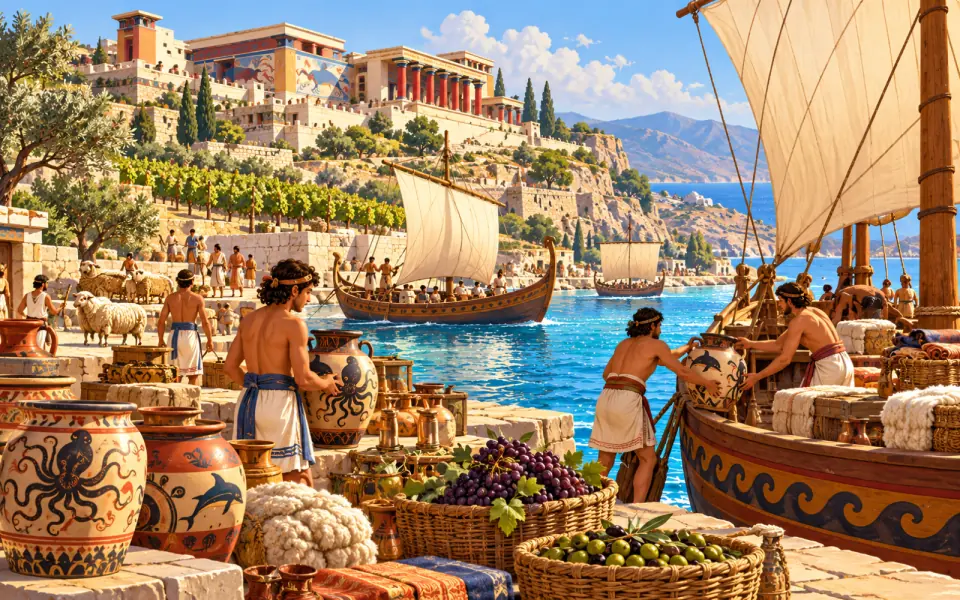
- Minoan civilisation on Creteabout 2000 BC · Sea civilisationsMinoan civilisation on Crete was hit by the eruption and its waves.
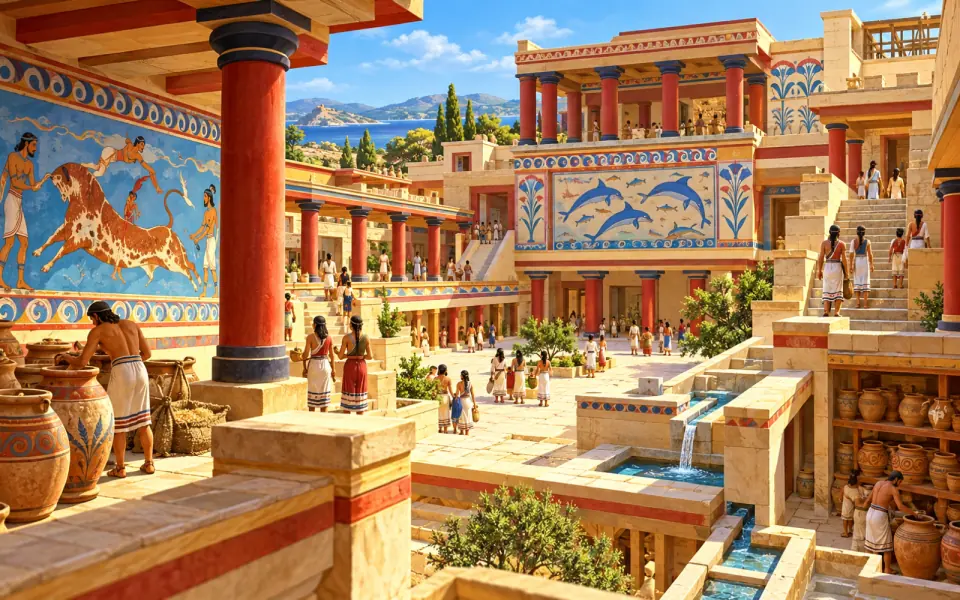
- The palace of Knossosabout 1900 BC · Sea civilisationsThe palace of Knossos was the centre of the island struck by ash and earthquakes.
- Pompeii buried by VesuviusAD 79 · Ancient RomeAnother city of antiquity buried by a volcano and preserved by ash.
- The Bronze Age collapseabout 1200 BC · River civilisationsA few centuries later, the end of the Bronze Age overwhelmed many peoples of the Aegean.
- Linear Babout 1450 BC · Sea civilisationsA few decades or centuries later, the Mycenaeans take the place of the Minoans.
Before and after, in the era “Sea civilisations”
Event 4 of 25
 BeforeMinoan civilisation on Creteabout 2000 BC
 BeforeThe palace of Knossosabout 1900 BC
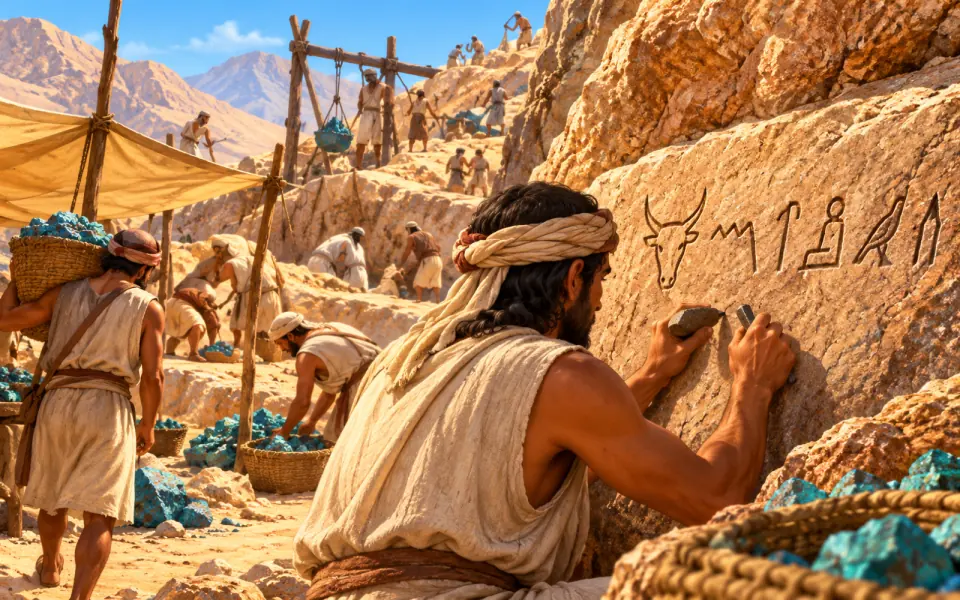 BeforeThe Proto-Sinaitic alphabetabout 1800 BC
- You are hereThe eruption of Theraabout 1600 BC
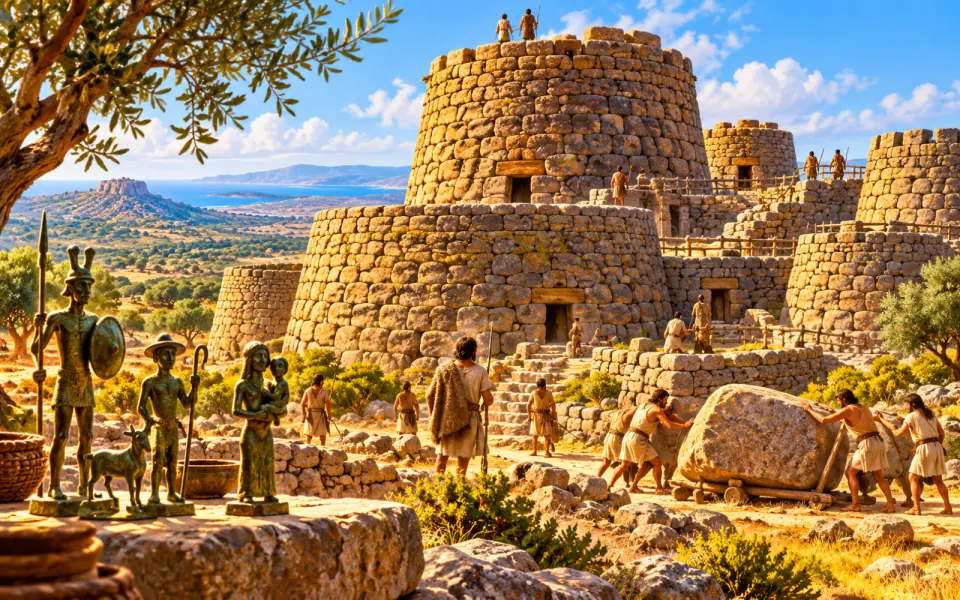 AfterThe nuraghi of Sardiniaabout 1600 BC
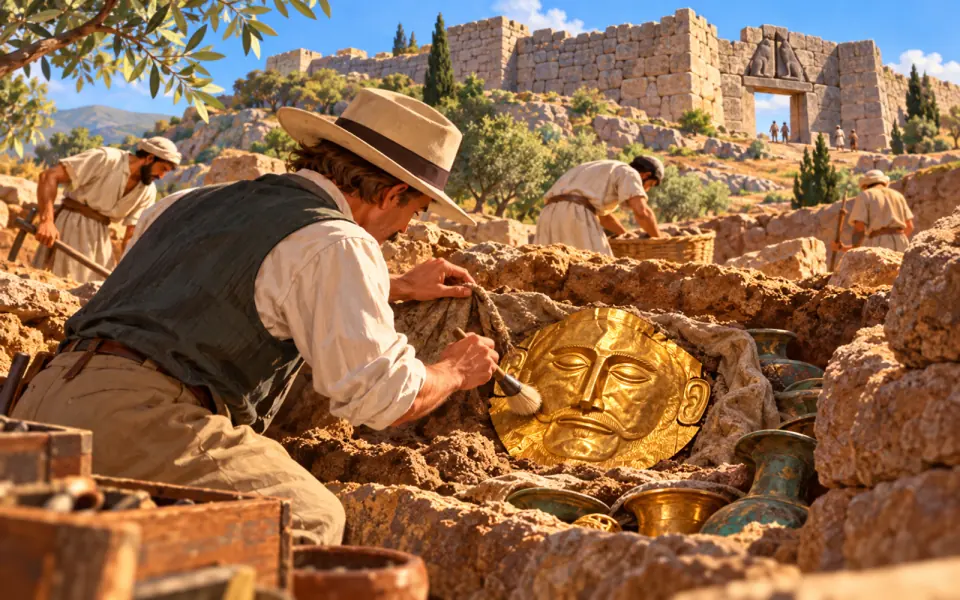 AfterThe gold mask of Mycenaeabout 1550 BC
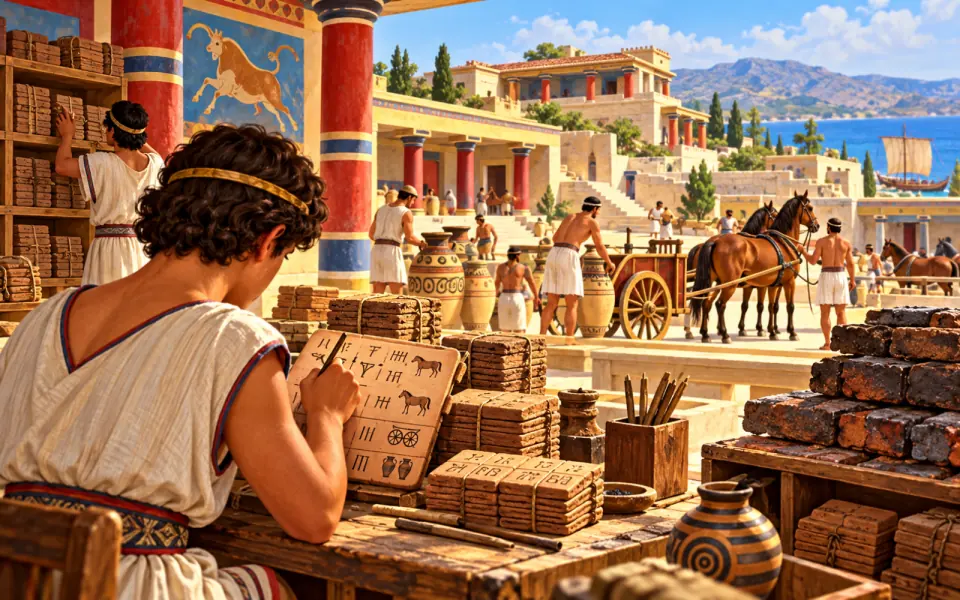 AfterLinear Babout 1450 BC
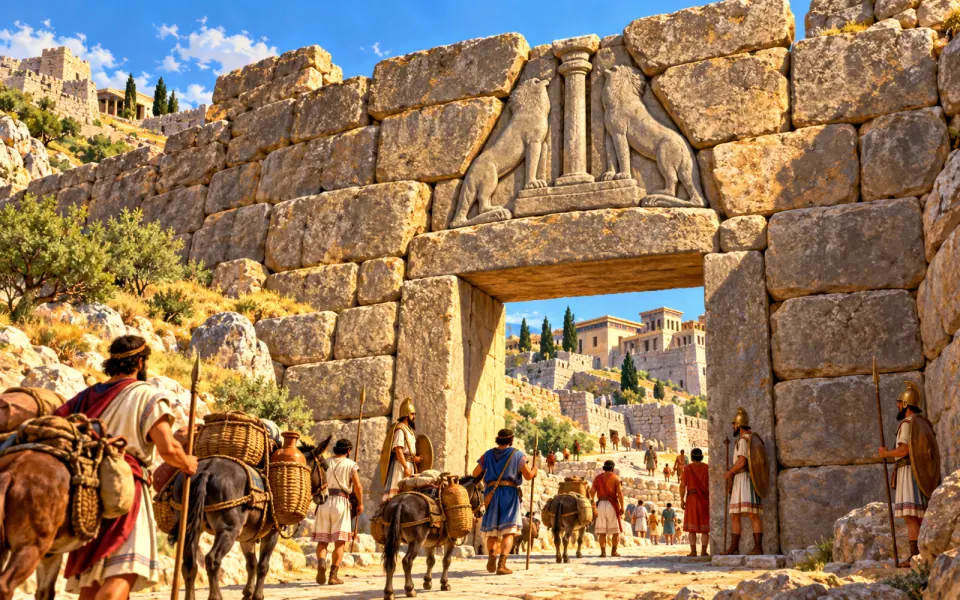 AfterThe Lion Gate at Mycenaeabout 1250 BC
 AfterThe Iron Age beginsabout 1200 BC
 AfterThe Phoenicians spread outabout 1200 BC
 AfterPhoenician purpleabout 1100 BC
 AfterThe Phoenician alphabetabout 1050 BC
 AfterThe Kingdom of Israelabout 1000 BC
 AfterPhoenician seafaringabout 1000 BC
 AfterThe Villanovan culture in Italyabout 900 BC
 AfterTraditional founding of Carthageabout 814 BC
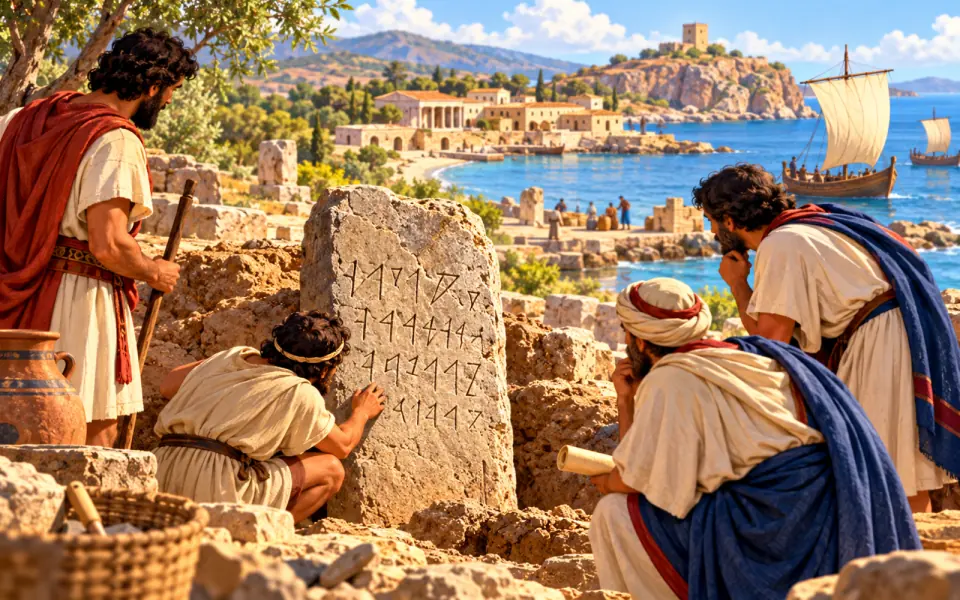 AfterThe Nora Stoneabout 800 BC
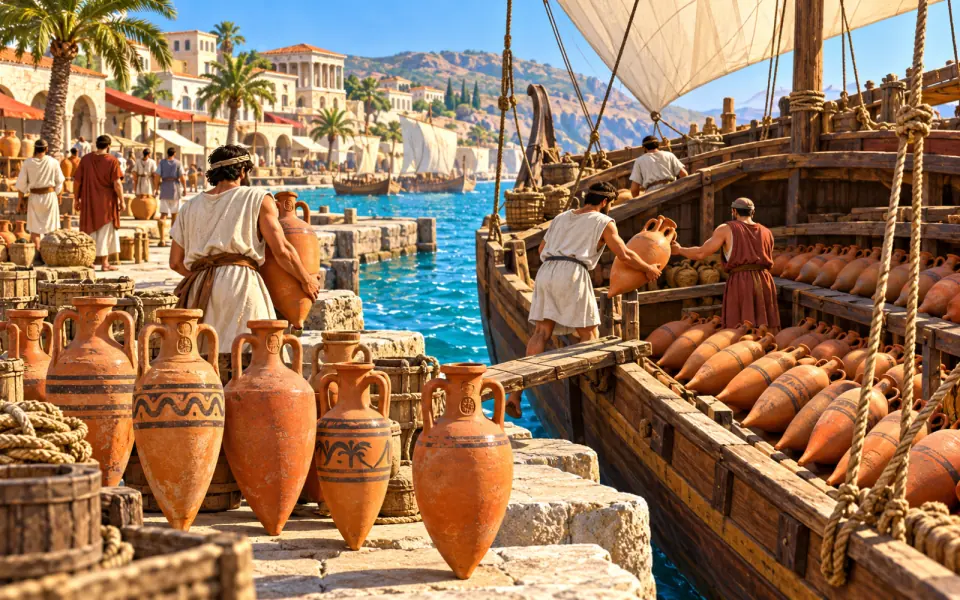 AfterAmphorae for oil and wineabout 800 BC
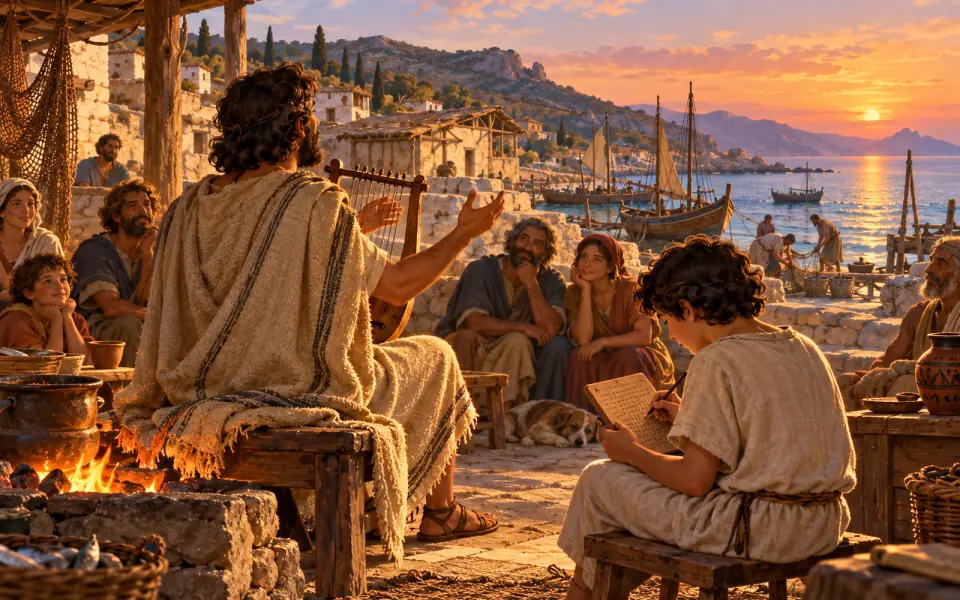 AfterHomer's poems are written downabout 750 BC
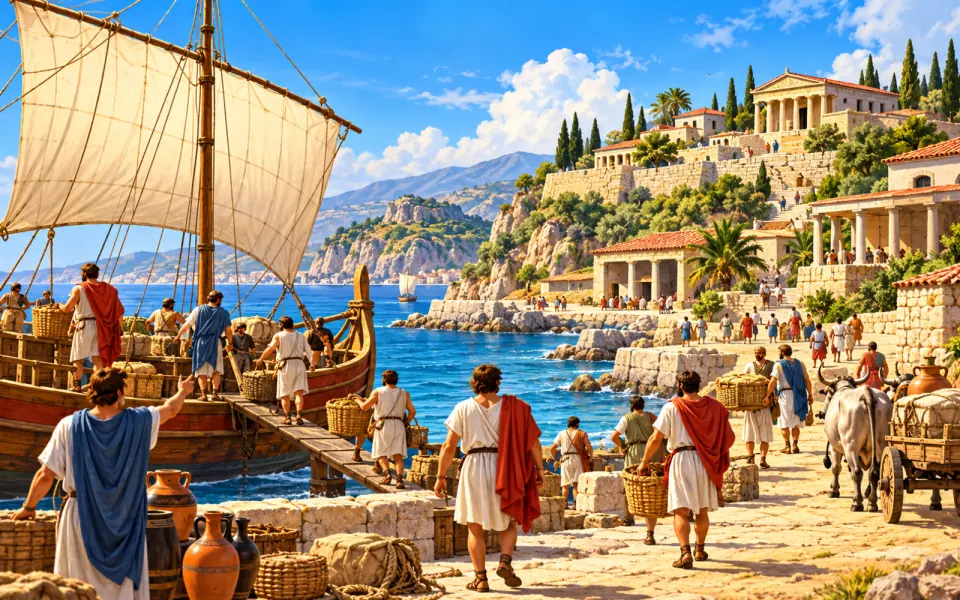 AfterGreek colonies in the Westabout 750 BC
 AfterThe Etruscans, lords of the Tyrrhenian Seaabout 700 BC
 AfterPhoenician glass spreadsabout 600 BC
 AfterCoins in the Mediterraneanabout 600 BC
 AfterThe Babylonian Exileabout 586 BC
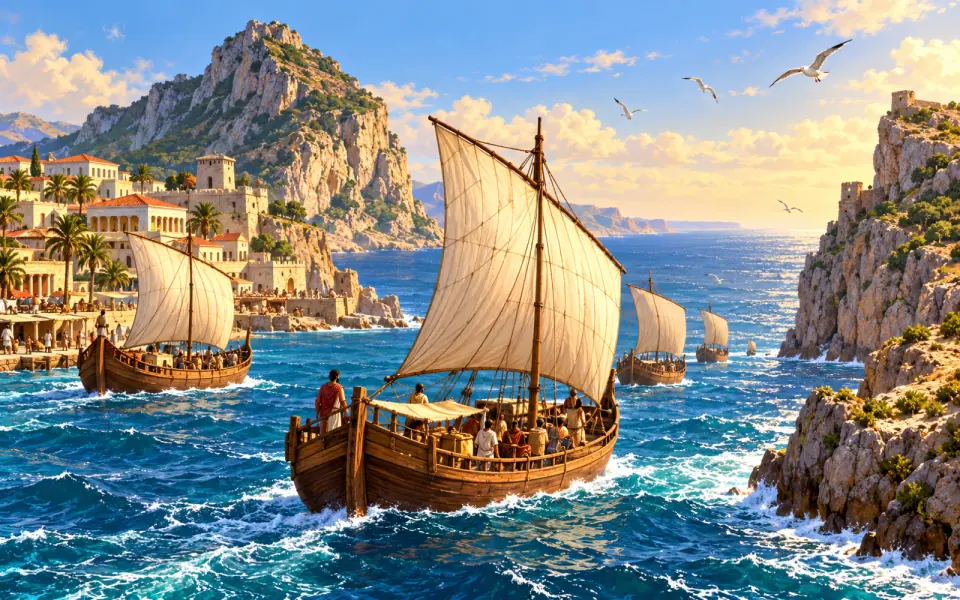 AfterSailing beyond Gibraltarabout 500 BC
Listen / Read next
- Music to read by: Cinematic JourneyEpic film-style music, no lyrics, by Ciro Simone IrmiciSpotifyYouTube Music
Meanwhile, elsewhere in the world
Other events of the era “Sea civilisations”
- Minoan civilisation on Crete
- The palace of Knossos
- The Proto-Sinaitic alphabet
- The nuraghi of Sardinia
- The gold mask of Mycenae
- Linear B
- The Lion Gate at Mycenae
- The Iron Age begins
- The Phoenicians spread out
- Phoenician purple
- The Phoenician alphabet
- The Kingdom of Israel
- Phoenician seafaring
- The Villanovan culture in Italy
- Traditional founding of Carthage
- The Nora Stone
- Amphorae for oil and wine
- Homer's poems are written down
- Greek colonies in the West
- The Etruscans, lords of the Tyrrhenian Sea
- Phoenician glass spreads
- Coins in the Mediterranean
- The Babylonian Exile
- Sailing beyond Gibraltar
