Sailing beyond Gibraltar
about 500 BC Strait of Gibraltar and the Atlantic
In short
For the ancients, the ‘Pillars of Hercules’, the Strait of Gibraltar, marked the edge of the known world. But sailors from Carthage went beyond them: according to an ancient account, Hanno sailed down the coast of West Africa with a large fleet. Another Carthaginian captain, Himilco, pushed north along the Atlantic coasts of Europe, perhaps in search of tin. Long before that, the Phoenicians had founded Gadir, today's Cádiz, facing the ocean.
Why it matters They were among the first to take on the open ocean, almost two thousand years before the great voyages of exploration.
Source: Encyclopaedia Britannica, “Hanno”
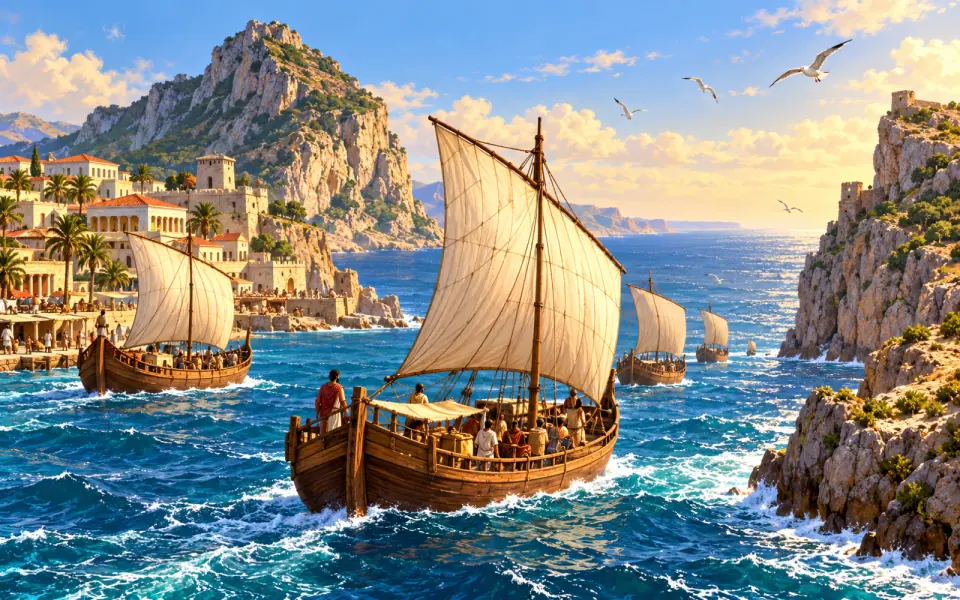
Study card about 5 minutes of reading
The story
The gates of the ocean
At the far west of the Mediterranean, Spain and Morocco draw close until they leave a narrow passage of sea: the Strait of Gibraltar. In antiquity it was called the Pillars of Hercules, because according to the myth Hercules, in his labours, had planted two pillars at the edge of the known world. Beyond lay no longer the Mediterranean, the sea that was well known, but the Atlantic Ocean, vast, unpredictable and full of mysteries. For most ancient sailors, going beyond meant risking their lives.
The Phoenicians and their Carthaginian descendants were among the few to venture out. At Cadiz, in Spain, facing right onto the Atlantic, stood the Phoenician colony of Gadir. Tradition says it was founded around 1100 BC, but archaeologists have found no layers on the site older than the 9th century BC. Gadir had a celebrated temple of Melqart, the god of Tyre whom the Greeks and Romans identified with Hercules. Some historians think the name “Pillars of Hercules” may have arisen from the columns of that very temple, but this is only a hypothesis.
Hanno's voyage
Around the 5th century BC Carthage sent an explorer named Hanno south, along the Atlantic coast of Africa. He may have belonged to a powerful Carthaginian family, the Magonids. According to the account, the fleet numbered sixty ships, and the text speaks of thirty thousand people on board, men and women, although some scholars think the real number was much lower, around five thousand. The aim was to found colonies on the north-western coast of Africa.
The account of the voyage, called a “periplus” (that is, a voyage round by sea), has reached us only in abridged Greek copies: the original in the Punic language is lost. The text breaks off suddenly, and scholars think the Carthaginians may have altered it so as not to reveal to their rivals the routes and the places of trade. It is considered the closest thing to Carthaginian “literature” that we have.
How far did Hanno get? Estimates vary widely: from southern Morocco to Gabon, in equatorial Africa. The account also speaks of hostile peoples. The most famous passage concerns an island where hairy people lived, whom the translators rendered with the word “gorillai”. Hanno killed three of them, and their skins were taken to Carthage and kept in a temple until the destruction of the city in 146 BC, according to the Roman writer Pliny. The name of the gorilla derives from this account.
Himilco's voyage
Another Carthaginian, Himilco, lived more or less at the same time, in the early 5th century BC. He may have been a relative of Hanno. He headed north: beyond the Pillars of Hercules, along the coasts of Atlantic Europe. His account too has been lost. Only short quotations remain in Pliny the Elder and in a late Latin poem, the Ora Maritima of Avienus, written in the 4th century AD.
According to Avienus, Himilco reached a “sacred island” near the Oestrymnides, lands rich in tin and lead. He says the sea was still, full of seaweed that slowed the ships, with shallow waters and monstrous animals, and that the crossing “is hardly made in four months”. Scholars suspect that Himilco exaggerated the dangers, to make his achievement greater or to discourage Greek competitors. He probably reached Brittany, perhaps the British Isles. The sacred island could be Ireland, but this is only a hypothesis. He certainly did not reach the Sargasso Sea.
Why tin
Tin is the metal that, mixed with copper, gives bronze, and Avienus says the lands of the north were rich in it. Whoever managed to get it directly secured a valuable trade. This may explain why the Carthaginians had an interest in going north.
The great voyage round Africa
In the same period there circulated an older tale, which we discuss in another card: that of the Phoenician sailors sent by the pharaoh Necho to sail round Africa. If it were true, the Phoenicians would have travelled the whole coast of the continent long before the Portuguese. Historians have no proof of it, but nor can they rule it out. The achievements of Hanno and Himilco, by contrast, are better attested, even though they have reached us in incomplete forms.
Why it happened
Carthage, in the 5th century BC, was a great trading power. It needed new markets, raw materials such as tin, gold and ivory, and new bases for its ships. Exploring the Atlantic coast served to find these resources and to found ports where ships could stop.
The Mediterranean, moreover, was crowded with rivals, above all Greeks. Sailing beyond the Pillars of Hercules allowed the Carthaginians to open routes that others did not know or did not dare to follow, and to keep them secret. Perhaps this is also why the accounts of the voyages are incomplete: they did not want to give information to competitors.
What changed
The voyages of Hanno and Himilco made the Carthaginians the first, among the Mediterranean peoples of whom we have knowledge, to venture decisively onto the Atlantic. They opened trade routes towards West Africa and towards the lands of tin. Cadiz and the other Phoenician colonies outside the Pillars of Hercules became very important centres.
The writings that came from them, fragmentary as they are, influenced Greek and Roman geographers, who took up the tale of the “hairy people”, the mists and the islands of tin. The name “gorilla” is a legacy of those tales.
Almost two thousand years later, Portuguese navigators sailed those coasts again, with different ships but the same curiosity. And Cadiz, founded by the Phoenicians, is still today a living city and one of the oldest inhabited towns in western Europe.
Key people and places
People
- Hanno
- Carthaginian explorer of about the 5th century BC: he led a large fleet along the Atlantic coast of Africa.
- Himilco
- Carthaginian navigator who is said to have explored the Atlantic coasts of Europe, in search of tin.
- Avienus
- Latin poet of the 4th century AD, in whose Ora Maritima short reports on Himilco's voyage survive.
- Hercules (Melqart)
- Greek hero, identified with the god of Tyre, Melqart; linked to the Pillars of Hercules.
Places
- Strait of Gibraltar
- The passage between Spain and Morocco that separates the Mediterranean from the Atlantic, the “Pillars of Hercules” of the ancients.
- Gadir (Cadiz)
- A Phoenician colony in Spain, on the Atlantic, still a living city today.
- Oestrymnides
- Lands of the northern Atlantic rich in tin and lead, in the account of Avienus.
Good to know
- The name “gorilla” comes from Hanno's account of the “hairy people” of an African island.
- Hanno's account has survived only in abridged Greek copies: the Carthaginian original is lost.
- Himilco, according to Avienus, said that the ocean “is hardly crossed in four months”.
- According to Pliny, the skins of the “hairy people” stayed in a temple at Carthage until 146 BC.
- Cadiz is considered one of the oldest cities of western Europe still inhabited.
Find out more
- Wikipedia, “Periplus of Hanno” en.wikipedia.org
- Wikipedia, “Himilco the Navigator” en.wikipedia.org
- Wikipedia, “Cádiz” en.wikipedia.org
- Wikipedia, “Hanno the Navigator” en.wikipedia.org
Related events
- Traditional founding of Carthageabout 814 BC · Sea civilisationsCarthage, founded by the Phoenicians of Tyre, sent these expeditions.
- Phoenician seafaringabout 1000 BC · Sea civilisationsPhoenician seafaring had already opened up the routes of the Mediterranean.
- The Phoenicians spread outabout 1200 BC · Sea civilisationsGadir was one of the farthest Phoenician colonies.
- Vasco da Gama reaches India1498 · Early modern ageAlmost two thousand years later Vasco da Gama sailed the coasts of Africa to India.
- Hannibal crosses the Alps218 BC · Ancient RomeHannibal, a Carthaginian general, set out from Spain to cross the Alps.
Before and after, in the era “Sea civilisations”
Event 25 of 25
 BeforeMinoan civilisation on Creteabout 2000 BC
 BeforeThe palace of Knossosabout 1900 BC
 BeforeThe Proto-Sinaitic alphabetabout 1800 BC
 BeforeThe eruption of Theraabout 1600 BC
 BeforeThe nuraghi of Sardiniaabout 1600 BC
 BeforeThe gold mask of Mycenaeabout 1550 BC
 BeforeLinear Babout 1450 BC
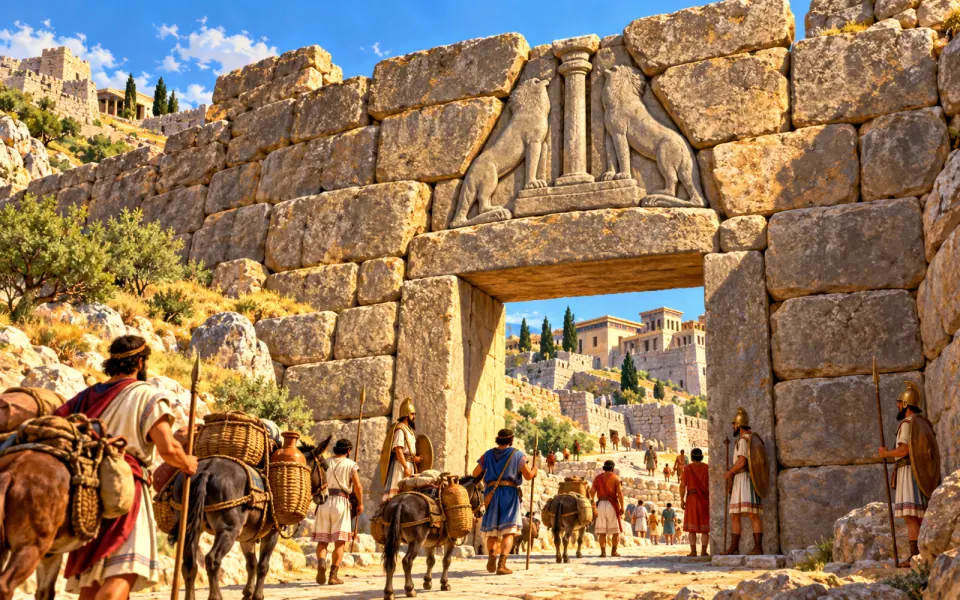 BeforeThe Lion Gate at Mycenaeabout 1250 BC
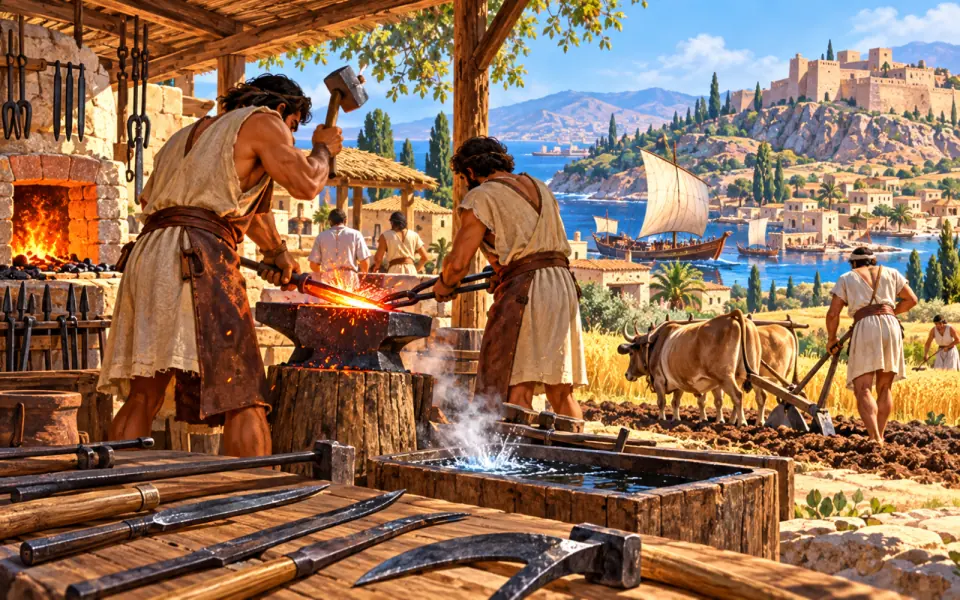 BeforeThe Iron Age beginsabout 1200 BC
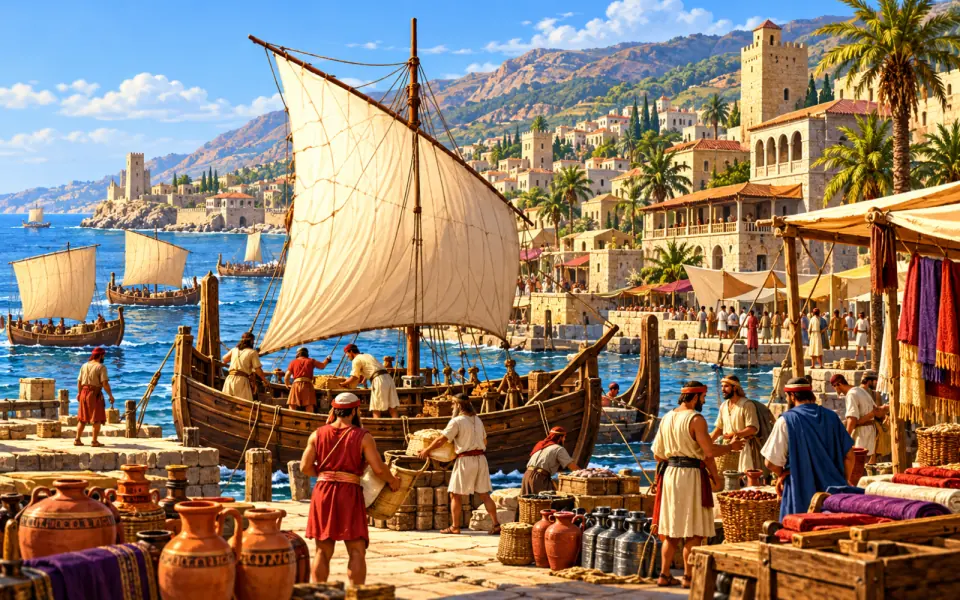 BeforeThe Phoenicians spread outabout 1200 BC
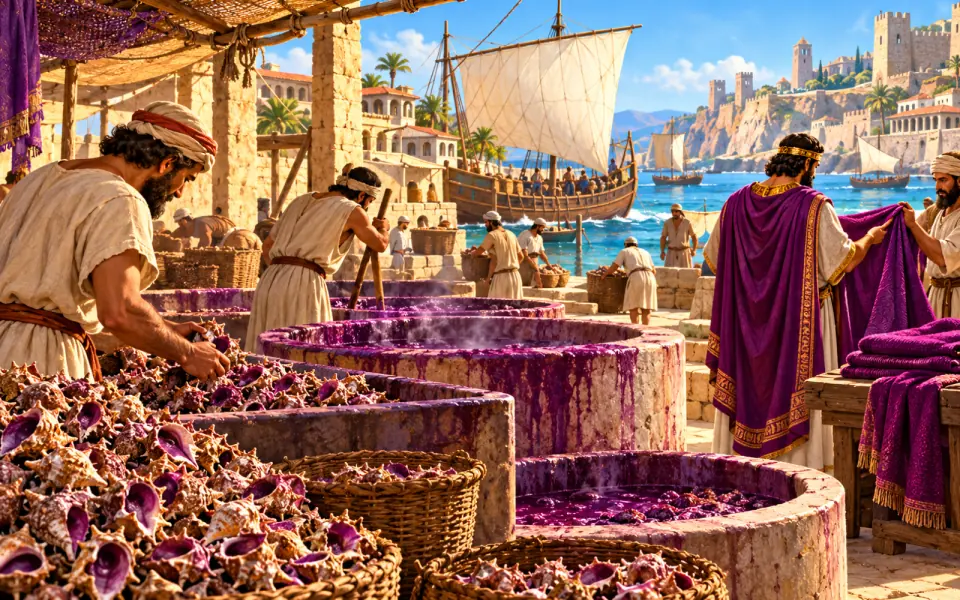 BeforePhoenician purpleabout 1100 BC
 BeforeThe Phoenician alphabetabout 1050 BC
 BeforeThe Kingdom of Israelabout 1000 BC
 BeforePhoenician seafaringabout 1000 BC
 BeforeThe Villanovan culture in Italyabout 900 BC
 BeforeTraditional founding of Carthageabout 814 BC
 BeforeThe Nora Stoneabout 800 BC
 BeforeAmphorae for oil and wineabout 800 BC
 BeforeHomer's poems are written downabout 750 BC
 BeforeGreek colonies in the Westabout 750 BC
 BeforeThe Etruscans, lords of the Tyrrhenian Seaabout 700 BC
 BeforePhoenician glass spreadsabout 600 BC
 BeforeCoins in the Mediterraneanabout 600 BC
 BeforeThe Babylonian Exileabout 586 BC
- You are hereSailing beyond Gibraltarabout 500 BC
Listen / Read next
- Music to read by: Cinematic JourneyEpic film-style music, no lyrics, by Ciro Simone IrmiciSpotifyYouTube Music
Meanwhile, elsewhere in the world
Other events of the era “Sea civilisations”
- Minoan civilisation on Crete
- The palace of Knossos
- The Proto-Sinaitic alphabet
- The eruption of Thera
- The nuraghi of Sardinia
- The gold mask of Mycenae
- Linear B
- The Lion Gate at Mycenae
- The Iron Age begins
- The Phoenicians spread out
- Phoenician purple
- The Phoenician alphabet
- The Kingdom of Israel
- Phoenician seafaring
- The Villanovan culture in Italy
- Traditional founding of Carthage
- The Nora Stone
- Amphorae for oil and wine
- Homer's poems are written down
- Greek colonies in the West
- The Etruscans, lords of the Tyrrhenian Sea
- Phoenician glass spreads
- Coins in the Mediterranean
- The Babylonian Exile
