Linear B
about 1450 BC Knossos (Crete) and Pylos (Greece)
In short
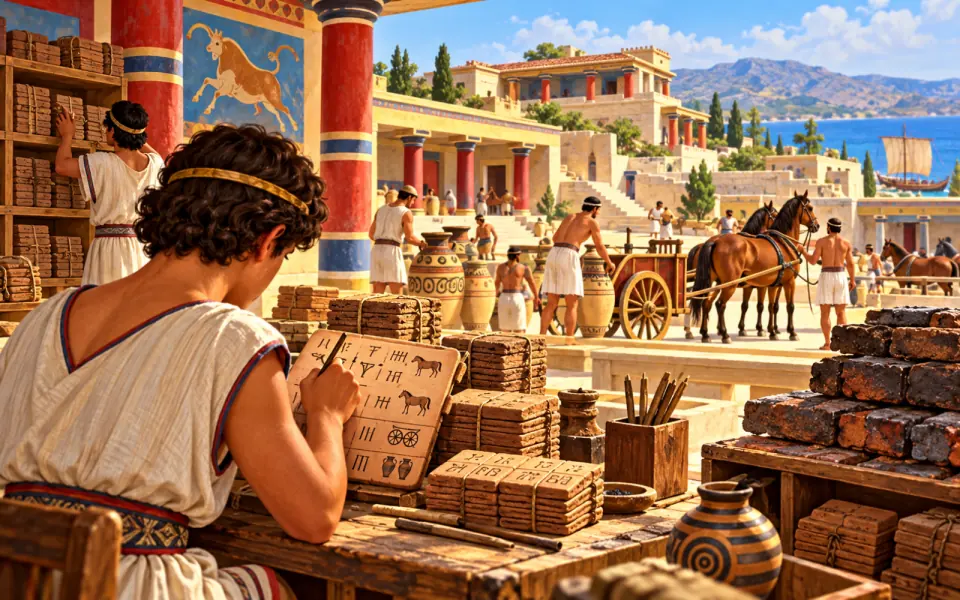
Linear B is the writing the Mycenaeans used in the archives of their palaces, at Knossos, Pylos and Mycenae. It was made up of signs standing for syllables, together with pictures for counting things like horses, chariots and jars of oil. In 1952 the English architect Michael Ventris discovered that it hid a very early form of Greek. The clay tablets survived because the fires that destroyed the palaces baked them like bricks.
Why it matters They are the oldest written documents in the Greek language.
Source: Encyclopaedia Britannica, “Linear B”
Study card about 5 minutes of reading
The story
Tablets baked by accident
In April 1900, a few days after the start of the digs at the palace of Knossos, on Crete, the English archaeologist Arthur Evans found a large number of clay tablets covered with signs. They carried writing in horizontal lines. Clay usually dissolves in damp and crumbles. These tablets had survived because the fires that destroyed the palace had baked them, turning them into something like terracotta.
Evans studied them and compared them with other inscriptions from Crete. He recognised two different scripts, which he called Linear A and Linear B, because of the thin lines with which the signs are drawn. Linear A is older and is the script of the Minoans; nobody has yet managed to read it. Linear B appeared later, and it is the one we are talking about here.
What it is like
Linear B has about eighty-seven signs that stand for syllables, such as “pa”, “ko”, “ti”, and more than a hundred ideograms, that is, little pictures that stand for a whole object: a vase, a horse, a chariot, a sheep, a measure of grain. It is not an alphabet like ours, in which each sign is a letter. Each syllable has its own sign. This is why writing certain words takes some tricks, and some sounds are left out.
Tablets in Linear B have been found at Knossos, Pylos, Mycenae and other centres. There are thousands of them: about 4,158 at Knossos and about 1,026 at Pylos, where the American archaeologist Carl Blegen dug them up in 1939. The period of use runs from 1450 BC to about 1200 BC, but the date of the Knossos tablets is debated: Evans placed them around 1400 BC, Blegen around 1200 BC, and the question has never been fully settled.
What was written on them
Anyone expecting poems or stories was disappointed. The tablets are registers, lists, inventories. They tell how much wool, how many sheep, how much grain or oil were delivered and to whom, often to groups linked to religion. Some deal with military matters. They are, in essence, the accounts of the palaces, written by officials who kept the king's wealth under control.
The mystery
For fifty years nobody managed to read them. The language was not known, and hardly anyone expected that behind those signs there would be Greek. Even Ventris, as a young man, thought of a link with Etruscan. This is exactly why the solution was so surprising.
The decipherment
A milestone was the work of Alice Kober, a scholar of ancient languages at Brooklyn College, in New York. Kober worked with extraordinary patience, cutting out and sorting about 180,000 paper slips. Between 1945 and 1948 she showed two things: that the language used words whose endings changed according to their function in the sentence, just as in Latin, and that certain signs shared the same consonant or vowel sound, and she arranged them in a grid. Kober died in 1950, aged 43, without knowing whether her work would be of use.
It was. A young English architect, Michael Ventris, had attended a lecture by Evans at the age of 14, in 1936, and had decided to decipher that script. At 18 he still thought it was linked to Etruscan. Then, starting from Kober's grids and his own calculations, he began to give a sound to the signs. At first he did not believe it was Greek. But when the sounds began to make sense, archaic Greek words appeared. On 1 July 1952, in a BBC radio broadcast, he announced the discovery: Linear B wrote Greek.
A listener, John Chadwick, a linguist at Cambridge, immediately understood its importance and offered to help. A decisive proof came in 1953, from a tablet from Pylos, which showed the drawing of a tripod, a three-legged stand, next to a word that, read with the new key, sounded like “ti-ri-po-de”, that is, “tripods”. The word was Greek and the drawing confirmed it. Ventris and Chadwick wrote the book “Documents in Mycenaean Greek” together. It came out in 1956, a few weeks after the death of Ventris, who lost his life in a car accident on 6 September of that year.
Why it happened
The Mycenaeans were a Greek-speaking people who dominated mainland Greece and, after about 1450 BC, took control of Knossos too. They had large, rich palaces, similar to the Cretan ones, and like the Cretans they needed to keep track of everything that went in and out of the storerooms.
To write their language, Greek, they adapted the script that already existed on the island: the Linear A of the Minoans. The original system was designed for another language, and so Linear B was born as a rather awkward adaptation. It was not perfect for writing Greek, but it was enough for keeping accounts.
What changed
The decipherment of 1952 pushed the written history of Greek back by about 700 years. Before, people thought the Greeks had learned to write around the 8th century BC. The tablets proved that already in the 2nd millennium BC the palaces of the Peloponnese and of Crete used a script for their language. The tablets are the oldest written documents in Greek that we know.
Besides the language, the tablets tell us about Mycenaean society: trades, groups of workers, offerings to the gods and deliveries of goods. They show a world organised by palaces that controlled the production of wool, oil and bronze.
The story of this discovery has also become a lesson in method. It shows how the work of many people, often forgotten like Alice Kober, is needed for someone to reach the final result. Today Linear B is studied at universities and many tablets are kept in the museums of Greece.
Key people and places
People
- Arthur Evans
- English archaeologist (1851–1941): he found the tablets at Knossos in 1900 and distinguished Linear A from Linear B.
- Alice Kober
- American scholar (1906–1950): with 180,000 slips she showed that the language had word endings and prepared the way for the decipherment.
- Michael Ventris
- English architect (1922–1956): in 1952 he showed that Linear B wrote Greek.
- John Chadwick
- Cambridge linguist who worked with Ventris and wrote with him the book on Mycenaean Greek.
- Carl Blegen
- American archaeologist who dug Pylos and in 1939 found a large collection of tablets there.
Places
- Knossos
- Palace on Crete where in 1900 Evans discovered the first great archive of tablets.
- Pylos
- Mycenaean palace in the south-west Peloponnese: about 1,026 tablets found by Blegen.
- Mycenae
- Citadel in the Peloponnese where tablets in Linear B were found.
Good to know
- The tablets survived because the fire that destroyed the palaces baked them like bricks.
- Ventris was 14 years old when he decided to decipher this script.
- Alice Kober worked with about 180,000 slips cut from scrap paper.
- The drawing of a tripod next to the word “ti-ri-po-de” was decisive proof that the language was Greek.
- There are no poems or stories on the tablets: only accounts, lists of goods and names.
Find out more
- Wikipedia, “Linear B” en.wikipedia.org
- Wikipedia, “Linear A” en.wikipedia.org
- Wikipedia, “Michael Ventris” en.wikipedia.org
- Wikipedia, “Alice Kober” en.wikipedia.org
Related events
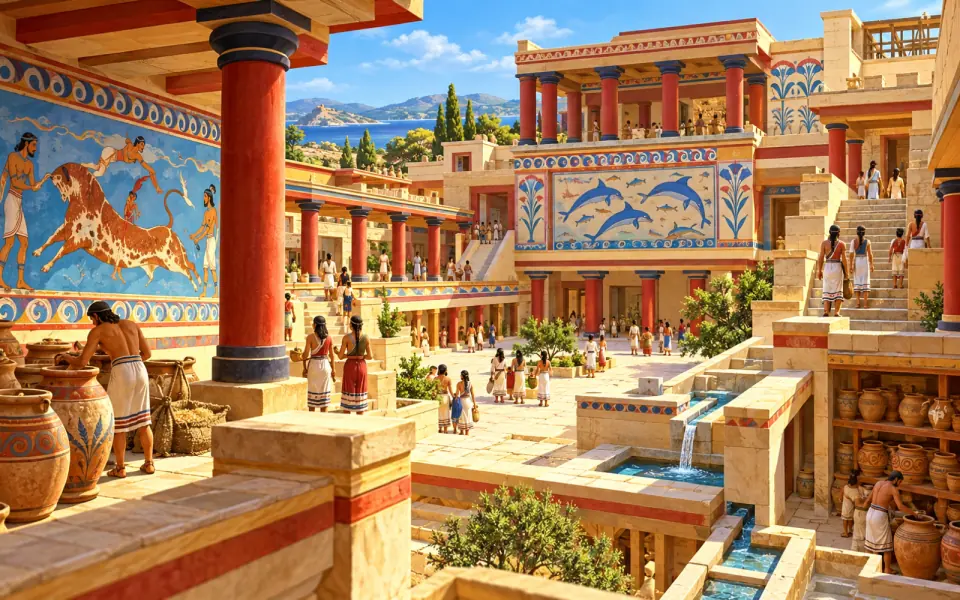
- The palace of Knossosabout 1900 BC · Sea civilisationsThe first tablets were found in the palace of Knossos.
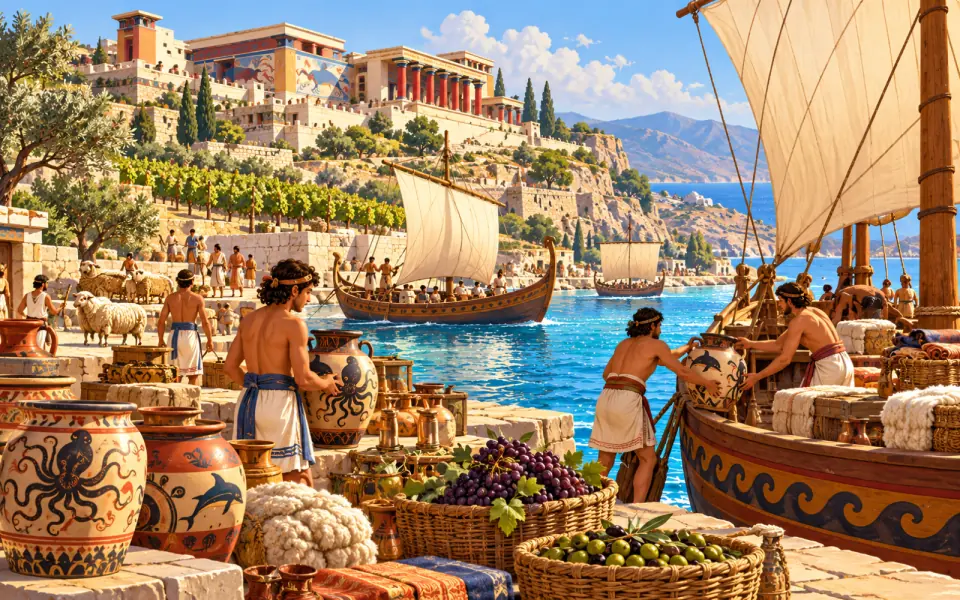
- Minoan civilisation on Creteabout 2000 BC · Sea civilisationsLinear A, the script of the Minoans, has still not been deciphered.
- The gold mask of Mycenaeabout 1550 BC · Sea civilisationsThe Mycenaeans who used this script are the same as the kings of Mycenae.
- Homer's poems are written downabout 750 BC · Sea civilisationsThe Greek of the Homeric poems is the heir of the Greek of the tablets.
- The Phoenician alphabetabout 1050 BC · Sea civilisationsThe Phoenician alphabet replaced scripts of syllables and ideograms.
Before and after, in the era “Sea civilisations”
Event 7 of 25
 BeforeMinoan civilisation on Creteabout 2000 BC
 BeforeThe palace of Knossosabout 1900 BC
 BeforeThe Proto-Sinaitic alphabetabout 1800 BC
 BeforeThe eruption of Theraabout 1600 BC
 BeforeThe nuraghi of Sardiniaabout 1600 BC
 BeforeThe gold mask of Mycenaeabout 1550 BC
- You are hereLinear Babout 1450 BC
 AfterThe Lion Gate at Mycenaeabout 1250 BC
 AfterThe Iron Age beginsabout 1200 BC
 AfterThe Phoenicians spread outabout 1200 BC
 AfterPhoenician purpleabout 1100 BC
 AfterThe Phoenician alphabetabout 1050 BC
 AfterThe Kingdom of Israelabout 1000 BC
 AfterPhoenician seafaringabout 1000 BC
 AfterThe Villanovan culture in Italyabout 900 BC
 AfterTraditional founding of Carthageabout 814 BC
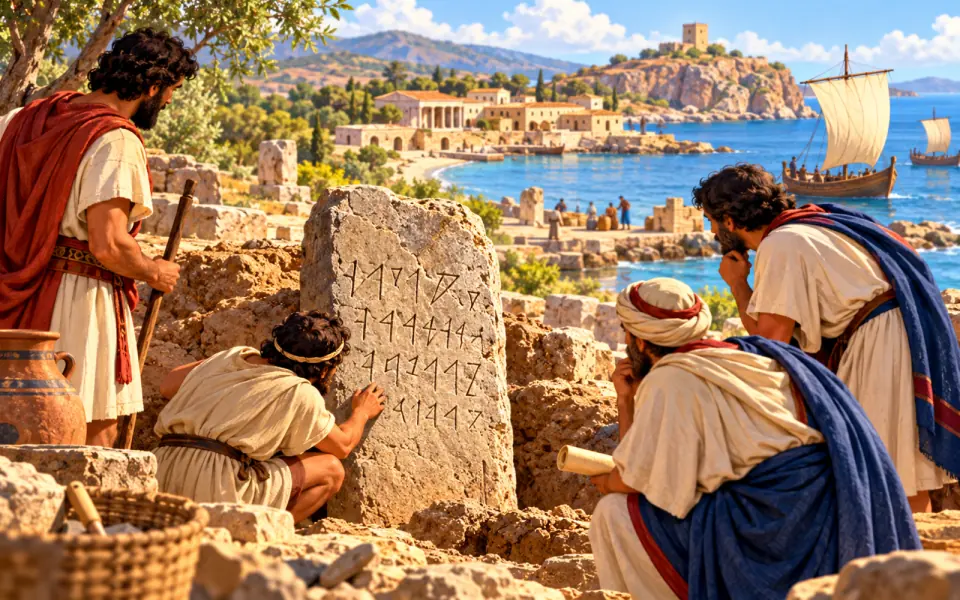 AfterThe Nora Stoneabout 800 BC
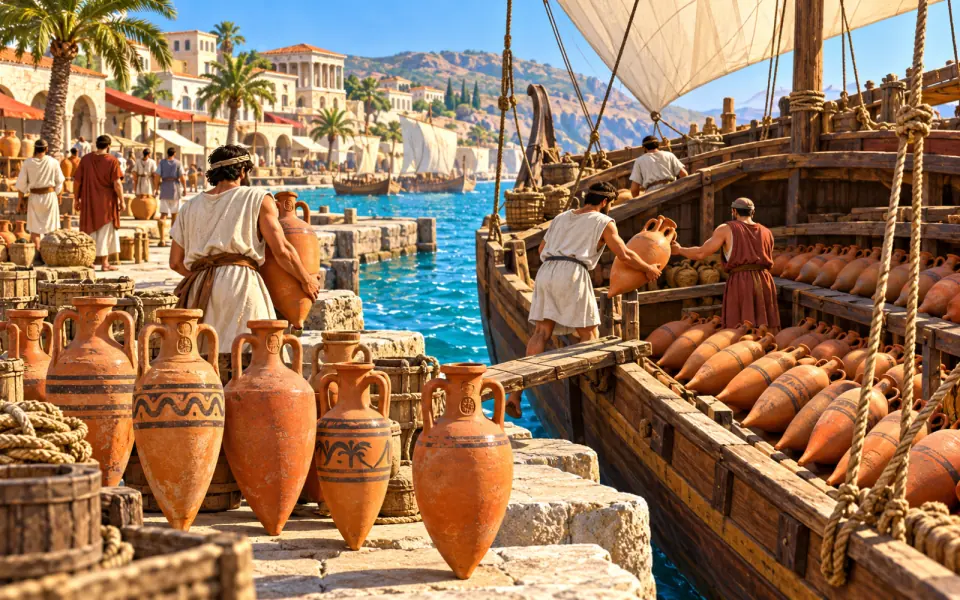 AfterAmphorae for oil and wineabout 800 BC
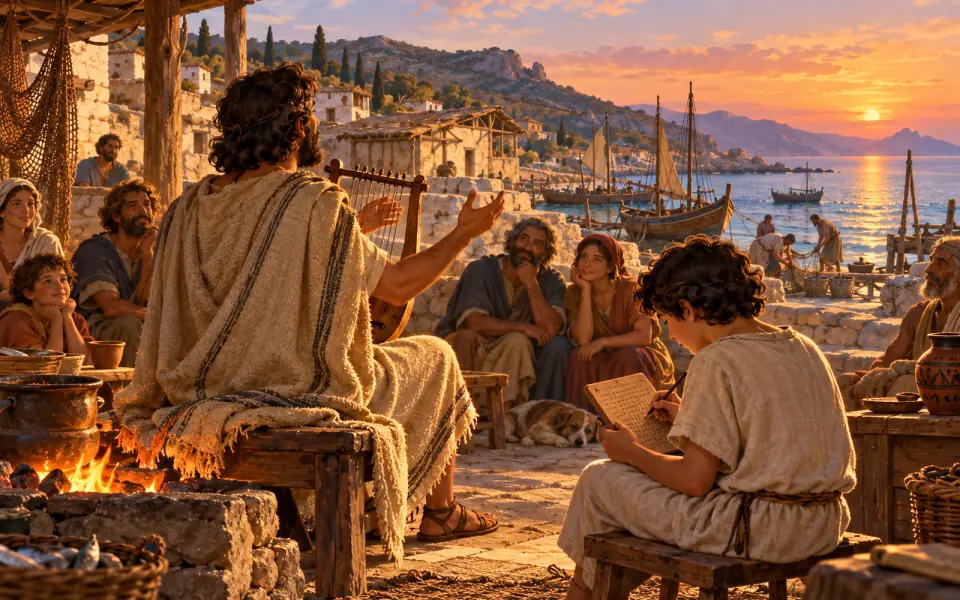 AfterHomer's poems are written downabout 750 BC
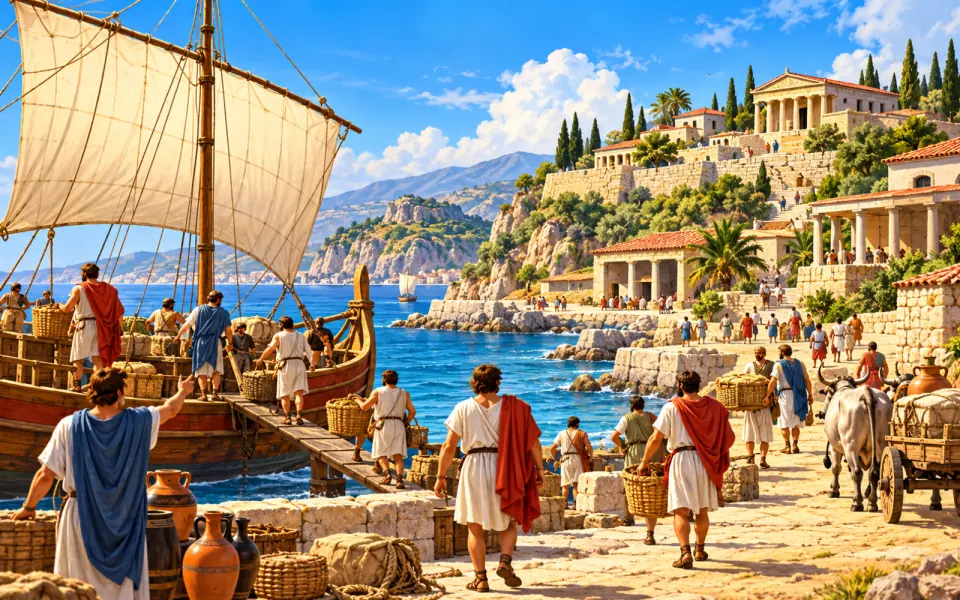 AfterGreek colonies in the Westabout 750 BC
 AfterThe Etruscans, lords of the Tyrrhenian Seaabout 700 BC
 AfterPhoenician glass spreadsabout 600 BC
 AfterCoins in the Mediterraneanabout 600 BC
 AfterThe Babylonian Exileabout 586 BC
 AfterSailing beyond Gibraltarabout 500 BC
Listen / Read next
- Music to read by: Cinematic JourneyEpic film-style music, no lyrics, by Ciro Simone IrmiciSpotifyYouTube Music
Meanwhile, elsewhere in the world
Other events of the era “Sea civilisations”
- Minoan civilisation on Crete
- The palace of Knossos
- The Proto-Sinaitic alphabet
- The eruption of Thera
- The nuraghi of Sardinia
- The gold mask of Mycenae
- The Lion Gate at Mycenae
- The Iron Age begins
- The Phoenicians spread out
- Phoenician purple
- The Phoenician alphabet
- The Kingdom of Israel
- Phoenician seafaring
- The Villanovan culture in Italy
- Traditional founding of Carthage
- The Nora Stone
- Amphorae for oil and wine
- Homer's poems are written down
- Greek colonies in the West
- The Etruscans, lords of the Tyrrhenian Sea
- Phoenician glass spreads
- Coins in the Mediterranean
- The Babylonian Exile
- Sailing beyond Gibraltar
