The first insects
about 400 million years ago Dry land
In short
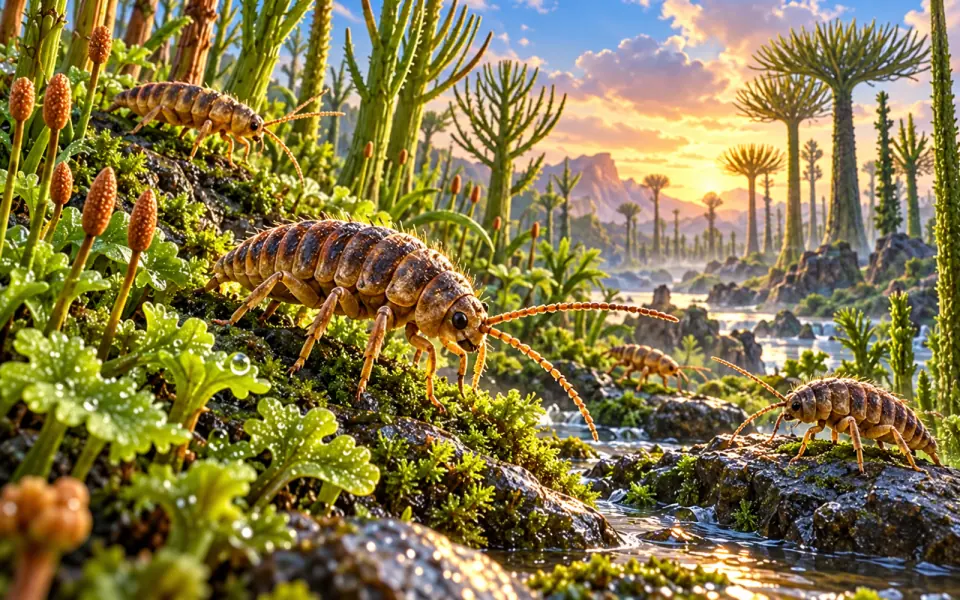
The oldest fossils thought to be insects are about 400 million years old and come from Rhynie, in Scotland. Insects are related to spiders, crabs and millipedes: they all have jointed legs and a hard outer shell. An insect's body is divided into head, thorax and abdomen, with six legs. When wings appeared, insects could quickly reach new places to live.
Why it matters Insects would become the animal group with the largest number of known species.
Study card about 5 minutes of reading
The story
Small, countless, everywhere
Look around you: a fly on the window, an ant on the ground, a mosquito in the evening. Insects are the most numerous group of animals on the planet. More than a million species have been described, more than half of all the living things we know, and scientists think there are many more still to be discovered. They are found almost everywhere: in deserts, forests, caves, cities. How did they begin?
Arthropods: animals in armour
Insects belong to a big group, the arthropods, which also includes spiders, scorpions, crabs, shrimps and millipedes. They have one thing in common: an outer skeleton, a kind of armour made of a hard substance called chitin, and jointed legs, that is, legs divided into segments. The name comes from this, from the Greek for “jointed feet”. To grow they have to change their armour, in a process called moulting.
A true insect has its body divided into three parts: head, thorax and abdomen. It has six legs attached to the thorax and, usually, two antennae. Many also have wings. According to DNA studies, the closest relatives of insects are the crustaceans: flies and ants are therefore, in their own way, cousins of shrimps.
The Rhynie fossil
The oldest fossil attributed (but disputed) to an insect comes from Rhynie, in Scotland, the same place where the very ancient plants we talked about in the card on the first plants are preserved. In the Rhynie chert, about 407 million years old, the fragment of a tiny animal, a head with two mandibles, was collected in 1919 and named Rhyniognatha hirsti in 1928. In 2004 two entomologists re-examined the mandibles: they had a shape typical of flying insects, and for this reason the fossil was considered the oldest insect in the world.
But the fossil is small and very little of it is left. In 2017 two German researchers, Joachim and Carolin Haug, re-analysed the remains with more modern tools and suggested that it might not be an insect but a myriapod, that is, a relative of centipedes and millipedes. The question is still open. So today, when it is said that insects are about 400 million years old, we have to add that the date is disputed.
Other clues come from DNA. By comparing the genes of insects today and estimating how fast they change, in 2014 a large group of researchers calculated that insects might have originated about 480 million years ago, in the Ordovician. The undisputed hexapods (the group that includes insects) are instead those of Rhynie, about 405 million years old, such as the little springtail Rhyniella; at Gilboa, in New York State, there are arthropod cuticles about 385 million years old that perhaps include ancient insects, but the interpretation is provisional.
The invention of wings
Insects were the first animals to fly, and they did it long before birds, bats and pterosaurs. The first certain winged insects appear in rocks of about 325 to 330 million years ago, in the Carboniferous. How wings arose is one of the big mysteries of biology. One hypothesis says they come from small outgrowths on the sides of the body that served for gliding or for controlling temperature; another says they come from the gills of water-living ancestors. Studies of genes have given arguments for both ideas.
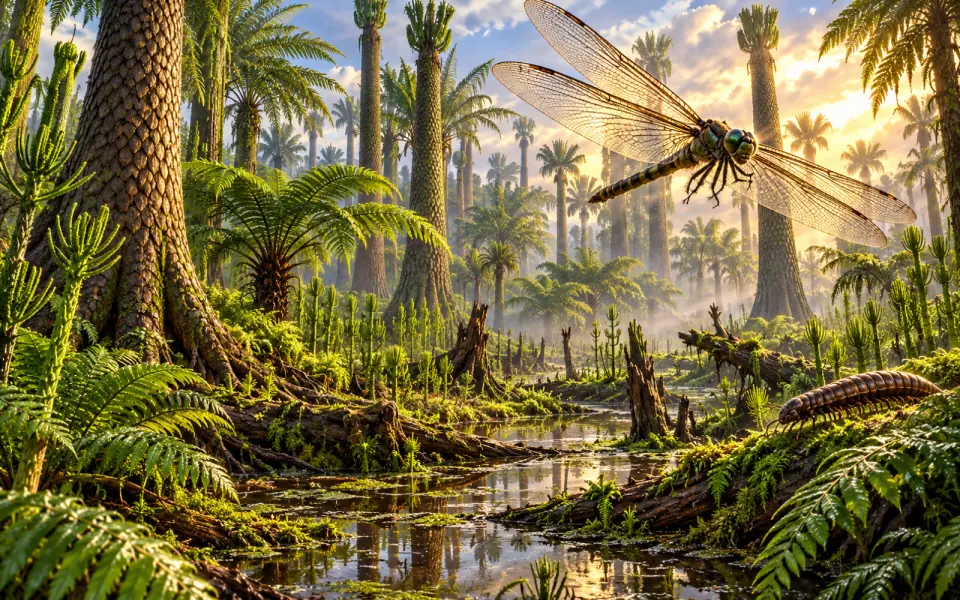
Wings let insects escape predators, look for food in faraway places, and reach plants and flowers. They were a huge success. In the Carboniferous some insects became gigantic: the dragonfly-like insects of the Meganeura group had wings up to about 70 centimetres across, among the biggest ever had by an insect: like those of a small bird of prey. Scientists think that the large amount of oxygen in the air at that time, and the lack of predatory birds, allowed these giants to grow.
Why it happened
Why did insects come out of the water? Plants had by now arrived on dry land, and with plants there was food: leaves, spores, sap, decaying remains. The ancestors of insects, small animals of the water or of wet places, found a rich environment with no competitors.
The outer skeleton was an advantage. The armour, covered in waxy substances, stops the loss of water, which is essential in the air. Insects breathe through small holes on the sides of the body, the spiracles, connected to tiny tubes that carry air to all parts of the body. This system works well in small animals and explains, among other things, why insects do not grow enormous.
Small size was another advantage: an insect can live in a corner of a leaf, eat little and reproduce fast. This favoured the evolution of thousands of different forms.
What changed
Insects changed the ecosystems of the Earth. When, much later, flowers appeared, about 130 million years ago according to fossils, bees, butterflies and beetles became pollinators, that is, they carried pollen from one flower to another. Much of the fruit and vegetables we eat depends on them. Insects are also food for birds, fish, frogs and bats, and they break down leaves and dead animals, returning the substances to the soil.
For human beings insects are both allies and enemies. They produce honey, wax and silk. But some carry serious diseases, such as malaria, carried by certain mosquitoes, and others destroy crops. The struggle against mosquitoes and locusts has gone along with the history of civilisations.
Today many species of insects are in difficulty because of pesticides, loss of habitats and climate change. Some studies in Europe have shown a sharp fall in the total weight of flying insects in certain areas. Protecting them means protecting the food we live on.
Key people and places
People
- Michael Engel and David Grimaldi
- American entomologists who in 2004 re-examined Rhyniognatha (described in 1928) and considered it the oldest known fossil insect.
- Joachim and Carolin Haug
- German palaeontologists who in 2017 suggested that Rhyniognatha might be a myriapod and not an insect.
- William Mackie
- Scottish geologist who in 1912 discovered the Rhynie chert, where plants and animals 407 million years old are preserved.
Places
- Rhynie, Aberdeenshire (Scotland)
- A village near Aberdeen where the chert preserves a whole ecosystem 407 million years old.
- Gilboa, New York (United States)
- A place with the remains of a forest 385 million years old, where fragments of arthropods are found, perhaps including very ancient insects (a provisional idea).
- Commentry, France
- A Carboniferous deposit where the fossils of the big Meganeura dragonfly-like insects were found in the 19th century.
Good to know
- Meganeura, with a wingspan of up to about 70 centimetres, was not a true dragonfly but a close relative: it belonged to a group of flying insects that is now completely extinct.
- According to a widely used estimate, about ten quintillion insects live on Earth: roughly 1.4 billion for every human being.
- Insects breathe without lungs: air enters through small holes in the body and reaches the cells through tiny tubes.
- Ants have lived in large, organised societies, with queens and workers, for more than 100 million years.
- The word “insect” comes from the Latin insectum, “cut into”, because the body of these animals looks divided into segments.
Find out more
- Natural History Museum, London, “Insects” nhm.ac.uk
- Wikipedia, “Insect” en.wikipedia.org
- Wikipedia, “Meganeura” en.wikipedia.org
- Wikipedia, “Carboniferous” en.wikipedia.org
Related events
- The first plants on landabout 475 million years ago · The Earth before usThe plants on dry land offered food and shelter to the first insects.
- Carboniferous forestsabout 320 million years ago · The Earth before usIn the forests of the Carboniferous lived giant dragonfly-like insects.
- The first birdsabout 150 million years ago · The Earth before usAfter insects, vertebrates too conquered the air: the birds.
- The Neolithic Revolutionabout 12,000 years ago · PrehistoryWith farming, human beings depended even more on pollinating insects.
Before and after, in the era “The Earth before us”
Event 18 of 25
 BeforeThe Big Bangabout 13.8 billion years ago
 BeforeThe first starsabout 13.5 billion years ago
 BeforeBirth of the Milky Wayabout 13 billion years ago
 BeforeFormation of the Solar Systemabout 4.6 billion years ago
 BeforeBirth of the Earthabout 4.5 billion years ago
 BeforeFormation of the Moonabout 4.5 billion years ago
 BeforeThe oldest pieces of Earthabout 4.4 billion years ago
 BeforeThe first oceansabout 4.3 billion years ago
 BeforeThe first life on Earthabout 3.5 billion years ago
 BeforeCyanobacteria and photosynthesisabout 2.7 billion years ago
 BeforeThe Great Oxidation Eventabout 2.4 billion years ago
 BeforeThe first complex cellsabout 1.8 billion years ago
 BeforeThe first many-celled living thingsabout 1 billion years ago
 BeforeThe Ediacaran creaturesabout 555 million years ago
 BeforeThe Cambrian explosionabout 539 million years ago
 BeforeThe first plants on landabout 475 million years ago
 BeforeThe first fish with jawsabout 440 million years ago
- You are hereThe first insectsabout 400 million years ago
 AfterThe first amphibiansabout 375 million years ago
 AfterCarboniferous forestsabout 320 million years ago
 AfterThe great Permian extinctionabout 252 million years ago
 AfterThe first dinosaursabout 230 million years ago
 AfterThe first mammalsabout 225 million years ago
 AfterThe first birdsabout 150 million years ago
 AfterExtinction of the non-avian dinosaursabout 66 million years ago
Listen / Read next
- Music to read by: Cinematic JourneyEpic film-style music, no lyrics, by Ciro Simone IrmiciSpotifyYouTube Music
Meanwhile, elsewhere in the world
Other events of the era “The Earth before us”
- The Big Bang
- The first stars
- Birth of the Milky Way
- Formation of the Solar System
- Birth of the Earth
- Formation of the Moon
- The oldest pieces of Earth
- The first oceans
- The first life on Earth
- Cyanobacteria and photosynthesis
- The Great Oxidation Event
- The first complex cells
- The first many-celled living things
- The Ediacaran creatures
- The Cambrian explosion
- The first plants on land
- The first fish with jaws
- The first amphibians
- Carboniferous forests
- The great Permian extinction
- The first dinosaurs
- The first mammals
- The first birds
- Extinction of the non-avian dinosaurs
