Cyanobacteria and photosynthesis
about 2.7 billion years ago Shallow coastal waters around the world
In short
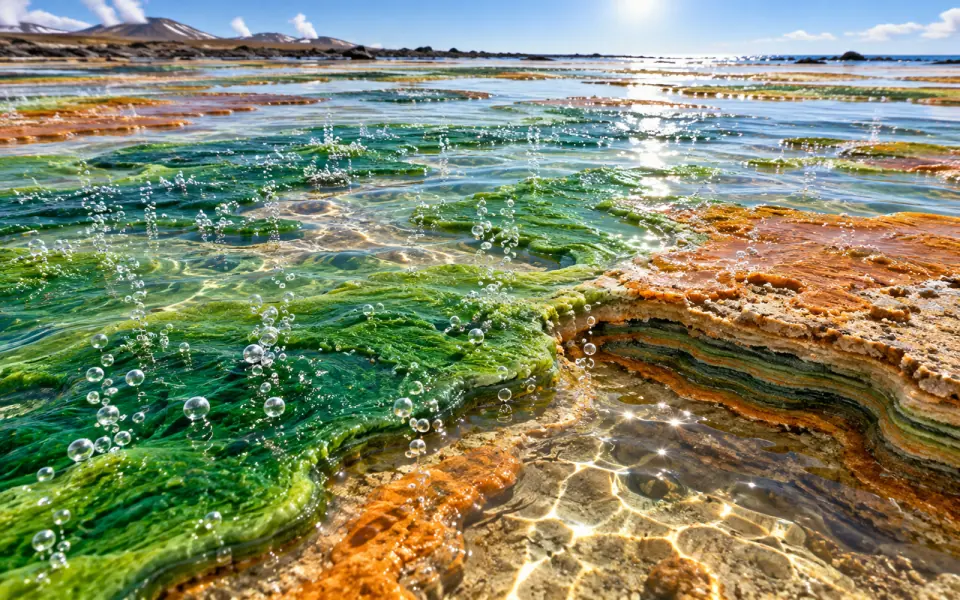
Cyanobacteria learnt to use sunlight to get energy from water and carbon dioxide. During this process, called photosynthesis, they gave off oxygen. In shallow water they formed layered mats which over time became stromatolites.
Why it matters Photosynthesis began to change the atmosphere and made more complex life possible.
Study card about 5 minutes of reading
The story
A trick that changed the world
Every green leaf you see is a small factory. It takes light from the Sun, carbon dioxide from the air and water from the soil, and turns them into sugars, which the plant feeds on, giving off oxygen. This process is called photosynthesis, from the Greek for “putting together with light”. But plants did not invent it: they inherited it from much smaller and much older living things, the cyanobacteria.
Cyanobacteria are bacteria that live in water, and for a long time they were called “blue-green algae”, because they are a colour between green and blue and can be seen as a film on the stones of a river or on the surface of a pond. They are microscopic, but they live in enormous colonies. They are thought to have been the first organisms able to do what is called oxygenic photosynthesis, the kind that splits water molecules and releases oxygen.
The discovery of another way of living
Before them there were already bacteria able to use light, but without producing oxygen: they used other substances, such as hydrogen sulphide, instead of water. Water, however, is everywhere, and splitting it takes a great deal of energy and a very sophisticated chemical machine. Scientists think that the switch to this mechanism was one of the most important events in evolution. Once the cyanobacteria managed it, they had an almost endless resource at their disposal: light, water and carbon dioxide are found everywhere.
We do not know exactly when it happened. The most likely traces go back about 2.7 billion years, and come from rocks of the Tumbiana Formation in Western Australia: microbial mats and stromatolites that left chemical signs of photosynthesis, although some scholars debate whether it produced oxygen. There are hints that it began earlier, perhaps as far back as 3.2 billion years ago, but they are disputed. That is why the date on the timeline is approximate.
Mats in the shallow seas
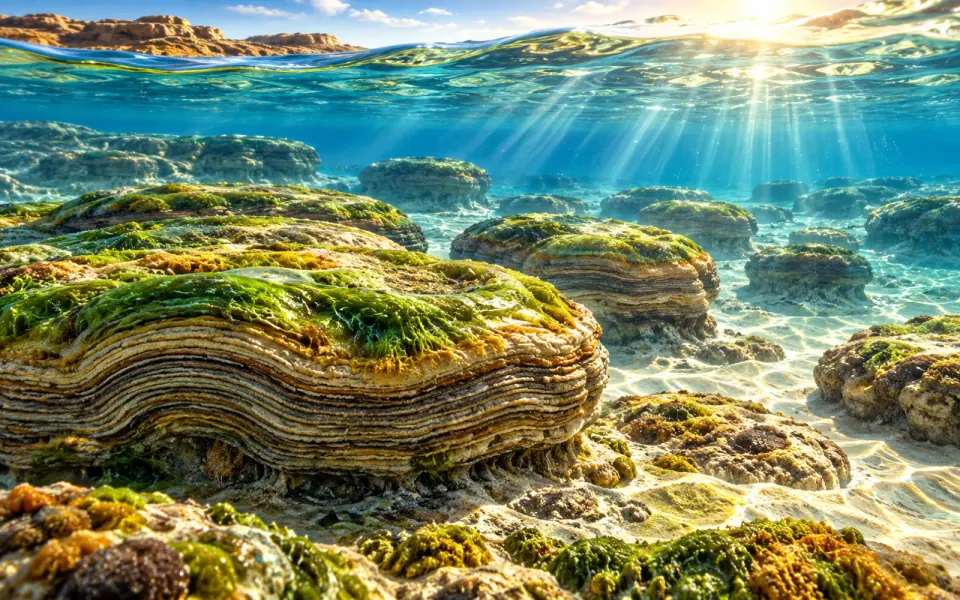
Cyanobacteria grew in shallow water near the coasts, where the light reached. They formed colourful mats of colonies, one on top of another. By day, in the light, the bacteria produced oxygen and moved upwards; at night, or when they were covered by sand, they climbed up again. In this way, little by little, their mats and the grains of sediment built up in layers and became stromatolites. These layered rocks are the oldest traces of life visible to the naked eye, and in a few places in the world, such as Shark Bay in Australia, living ones can still be found.
Cyanobacteria have not disappeared: they are everywhere. They live in oceans, lakes, soil, deserts and even in the rocks of Antarctica. One of them, Prochlorococcus, discovered only in 1986 by the American biologist Sallie Chisholm and her colleagues, is so small that its cells are less than a thousandth of a millimetre across; it is estimated to be the most numerous photosynthetic organism on Earth, and it produces a large part of the oxygen in the oceans.
Inside today's plants
There is one last chapter. More than a billion years ago, a complex cell swallowed a cyanobacterium without digesting it; the two began to live together, and over time that cyanobacterium became a part of the cell, called a chloroplast. All green algae and all plants have chloroplasts, and inside them there is still a small piece of DNA like that of cyanobacteria. So when you look at a wood, you are looking at descendants of that ancient partnership.
Today it is calculated that about half the oxygen we breathe comes from the plankton of the seas: microscopic algae and cyanobacteria. They are far more important than they look.
Why it happened
Cyanobacteria developed oxygenic photosynthesis because powering life is hard. Sources of chemical energy, such as volcanic gases, are limited and found in few places. Sunlight, by contrast, arrives everywhere, but to use it you need special molecules able to catch it and a way of getting the electrons you need. Water is the most plentiful source of electrons there is.
Scientists think that this ability arose gradually, after many steps in earlier bacteria, and that it appeared only once, in the cyanobacteria, and then spread to other organisms. Exactly how it happened is still being researched; the traces are few and the rocks have been greatly altered.
The result was an enormous advantage: anything that could use light and water could grow almost anywhere there was water and light. That is why cyanobacteria spread to all the seas.
What changed
The biggest consequence was oxygen. At first it was quickly absorbed by iron and rocks, but as it went on being produced for hundreds of millions of years it ended up changing the planet's air, as the next event on the timeline tells. For microbes that could not stand oxygen it was a crisis; for others it was the start of a new way of getting far more energy from food.
The whole food chain depends on this trick. Almost every living thing, directly or indirectly, eats energy that was captured by a photosynthetic organism. When you eat a sandwich, you are eating sunlight turned into food by a wheat plant. Oil, coal and gas, too, are what is left of ancient photosynthetic organisms.
Cyanobacteria are studied even today for what they might offer: some are used to make useful substances, and scientists are thinking of using them to make fuels and to capture carbon dioxide. Some species, such as spirulina, are eaten, and for space missions it is thought they could be used to make oxygen.
Key people and places
People
- Sallie Chisholm
- American marine biologist. In 1986, with colleagues, she discovered Prochlorococcus, the most abundant photosynthetic bacterium in the oceans.
- Lynn Margulis
- American biologist (1938–2011). She strongly supported the idea that chloroplasts and mitochondria come from bacteria swallowed by other cells.
- Joseph Priestley
- English chemist (1733–1804). In 1771 he noticed that a plant puts back into circulation the air “used up” by a candle; in 1774 he isolated oxygen.
Places
- Tumbiana Formation, Western Australia
- Rocks 2.7 billion years old with microbial mats and stromatolites, among the likeliest evidence of photosynthesis with oxygen (debated).
- Shark Bay, Western Australia
- A bay where stromatolites built by cyanobacteria still live.
- Shallow waters of the early coasts
- The place where cyanobacteria formed mats, helped by sunlight passing through the water.
Good to know
- Although they are called “blue-green algae”, cyanobacteria are bacteria, not algae.
- The word “cyanobacteria” comes from the Greek kyanos, “dark blue”, and means “blue bacteria”.
- If the history of the Earth were a year, photosynthesis with oxygen would appear at the end of May, but the first animals only in mid-November.
- On hot days some lakes turn green with the growth of cyanobacteria: some species produce dangerous toxins, and so swimming is sometimes banned.
- Some species live in deserts under stones of semi-transparent quartz, which let some light through and shield them from the too-strong sun.
Find out more
- Wikipedia, “Prochlorococcus” en.wikipedia.org
- Wikipedia, “Cyanobacteria” en.wikipedia.org
- Wikipedia, “Symbiogenesis” en.wikipedia.org
- University of California Museum of Paleontology (Berkeley), cyanobacteria (in English) ucmp.berkeley.edu
Related events
- The first life on Earthabout 3.5 billion years ago · The Earth before usCyanobacteria descend from the first microbes that appeared in the seas.
- The Great Oxidation Eventabout 2.4 billion years ago · The Earth before usThe oxygen produced by cyanobacteria ended up changing the planet's air.
- The first complex cellsabout 1.8 billion years ago · The Earth before usThe chloroplast of plants was a cyanobacterium swallowed by a complex cell.
- Carboniferous forestsabout 320 million years ago · The Earth before usThe great forests of the Carboniferous used photosynthesis to turn into coal.
- Darwin publishes On the Origin of Species1859 · Age of revolutionsDarwin taught us to read these long stories of evolution.
Before and after, in the era “The Earth before us”
Event 10 of 25
 BeforeThe Big Bangabout 13.8 billion years ago
 BeforeThe first starsabout 13.5 billion years ago
 BeforeBirth of the Milky Wayabout 13 billion years ago
 BeforeFormation of the Solar Systemabout 4.6 billion years ago
 BeforeBirth of the Earthabout 4.5 billion years ago
 BeforeFormation of the Moonabout 4.5 billion years ago
 BeforeThe oldest pieces of Earthabout 4.4 billion years ago
 BeforeThe first oceansabout 4.3 billion years ago
 BeforeThe first life on Earthabout 3.5 billion years ago
- You are hereCyanobacteria and photosynthesisabout 2.7 billion years ago
 AfterThe Great Oxidation Eventabout 2.4 billion years ago
 AfterThe first complex cellsabout 1.8 billion years ago
 AfterThe first many-celled living thingsabout 1 billion years ago
 AfterThe Ediacaran creaturesabout 555 million years ago
 AfterThe Cambrian explosionabout 539 million years ago
 AfterThe first plants on landabout 475 million years ago
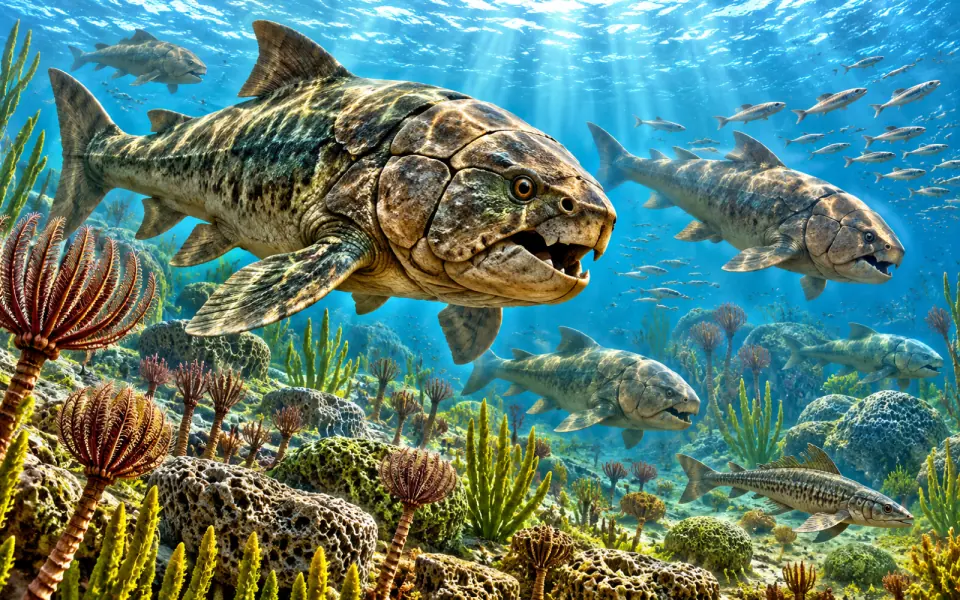 AfterThe first fish with jawsabout 440 million years ago
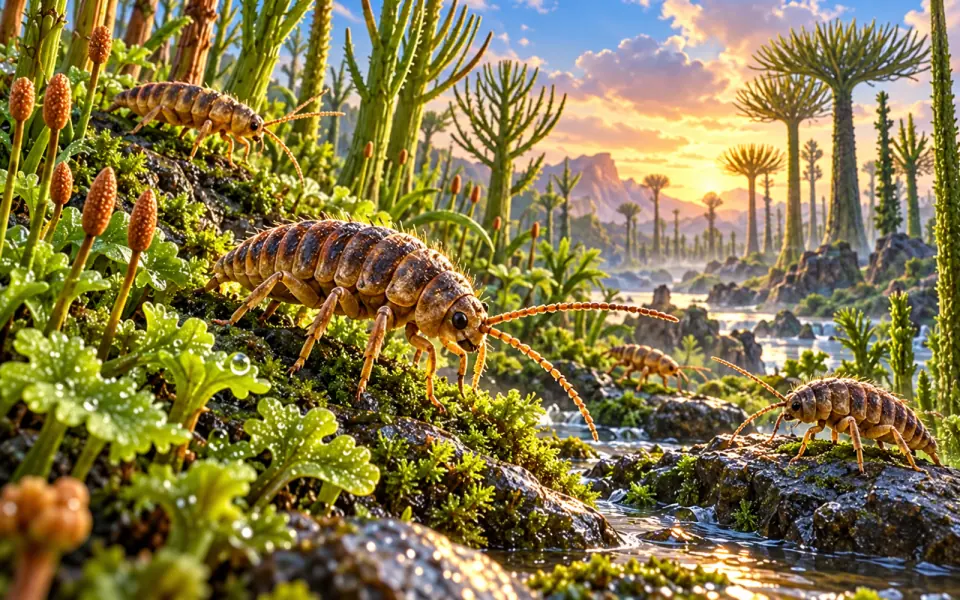 AfterThe first insectsabout 400 million years ago
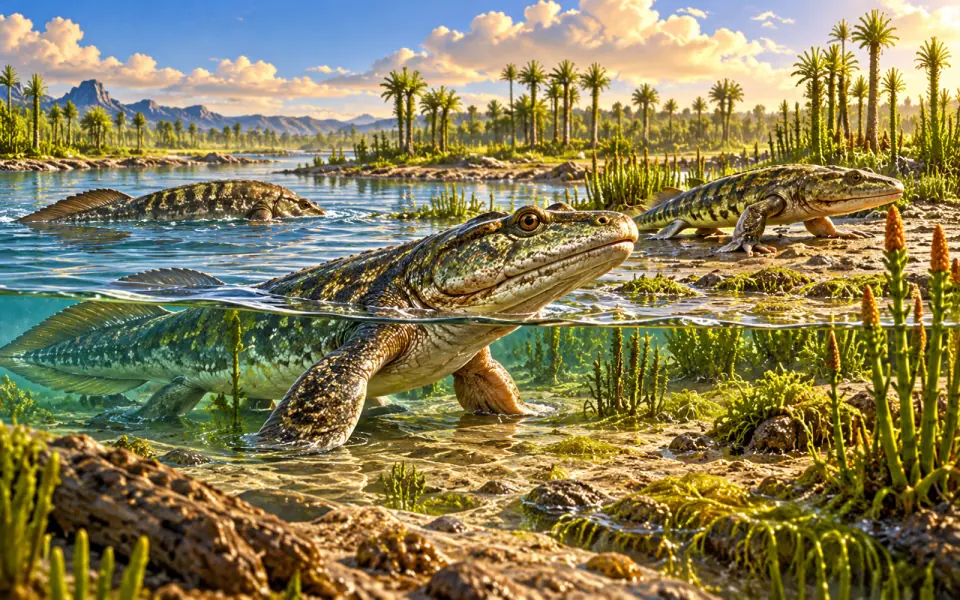 AfterThe first amphibiansabout 375 million years ago
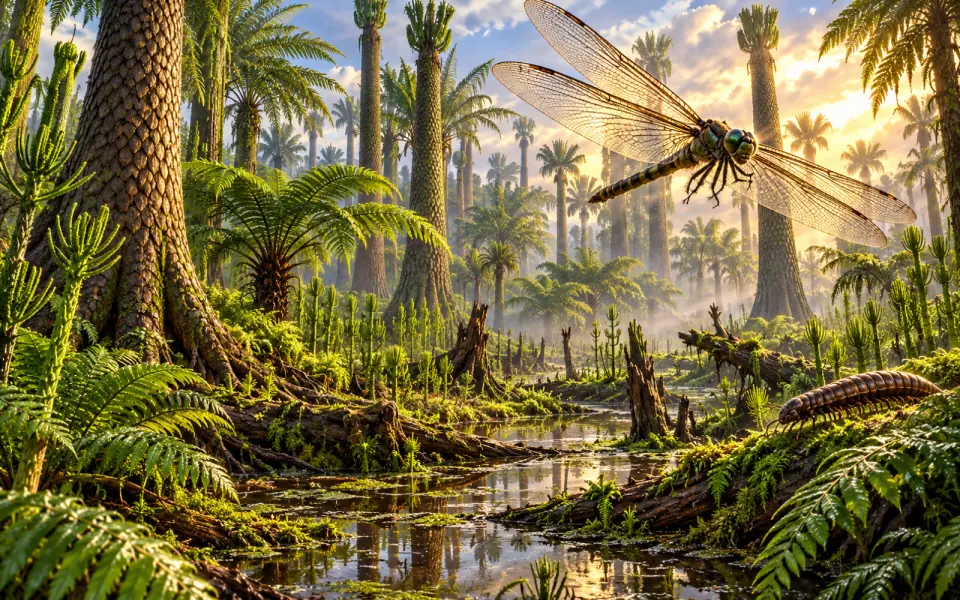 AfterCarboniferous forestsabout 320 million years ago
 AfterThe great Permian extinctionabout 252 million years ago
 AfterThe first dinosaursabout 230 million years ago
 AfterThe first mammalsabout 225 million years ago
 AfterThe first birdsabout 150 million years ago
 AfterExtinction of the non-avian dinosaursabout 66 million years ago
Listen / Read next
- Music to read by: Cinematic JourneyEpic film-style music, no lyrics, by Ciro Simone IrmiciSpotifyYouTube Music
Meanwhile, elsewhere in the world
Other events of the era “The Earth before us”
- The Big Bang
- The first stars
- Birth of the Milky Way
- Formation of the Solar System
- Birth of the Earth
- Formation of the Moon
- The oldest pieces of Earth
- The first oceans
- The first life on Earth
- The Great Oxidation Event
- The first complex cells
- The first many-celled living things
- The Ediacaran creatures
- The Cambrian explosion
- The first plants on land
- The first fish with jaws
- The first insects
- The first amphibians
- Carboniferous forests
- The great Permian extinction
- The first dinosaurs
- The first mammals
- The first birds
- Extinction of the non-avian dinosaurs
