Birth of the Earth
about 4.5 billion years ago The Earth
In short
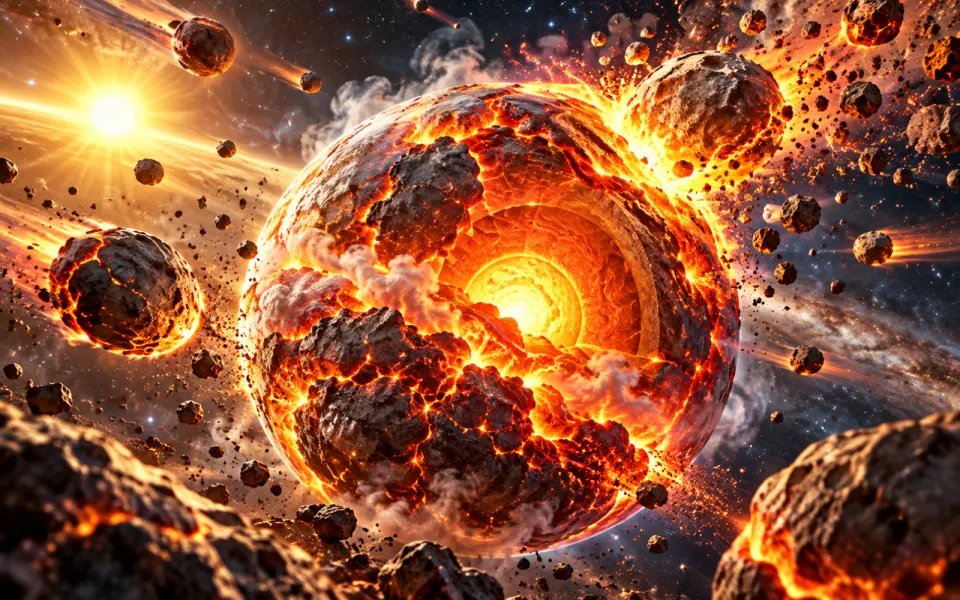
The Earth formed about 4.54 billion years ago as many rocky bodies came together. Collisions and the decay of radioactive elements made it very hot at first. Heavy materials sank towards the core, while lighter ones formed the mantle and the crust.
Why it matters This sorting into layers shaped the inside of the planet we live on.
Study card about 5 minutes of reading
The story
A planet built by collisions
The Earth was not born in a day, and it was not born calm. In the nebula around the young Sun, at a distance where it was hot enough to leave only rocks and metals, billions of small bodies kept colliding and joining together. The bigger ones pulled in the others and grew. Scientists estimate that the Earth formed over a few tens of millions of years, and that its age is about 4.54 billion years, with an uncertainty of about one per cent.
How do you measure an age like that? You cannot use any Earth rock from the very first hour, because the Earth has changed all the time and the oldest rocks have been destroyed and remade. Instead we use meteorites, which are leftovers that have stayed almost the same since the Solar System formed. In 1953 an American geochemist, Clair Patterson, measured in the Canyon Diablo meteorite, which fell in Arizona, the amounts of different kinds of lead. These form from the decay of uranium, which happens at a steady, known rate, like a clock. The result was about 4.55 billion years, still very close to the accepted figure today.
A sea of molten rock
The young planets were extremely hot, for three reasons. The first was the constant collisions, which turn the energy of movement into heat. The second was radioactive elements, which release energy from the inside when they decay. The third was gravity itself, which squeezed the planet as it grew. The outer part of the Earth melted into an ocean of magma, that is, molten rock, perhaps hundreds of kilometres deep.
In this ocean of rock something fundamental happened: the material sorted itself by weight. Iron and nickel, which are heavy, sank towards the centre and formed the core. The lighter rocks stayed on top and formed the mantle, and at the surface, as it cooled, a thin crust appeared. That is why the Earth is still made of layers, like an onion.
Inside the Earth
Nobody has ever gone deeper than 12 kilometres: the deepest hole ever dug, in Russia, on the Kola Peninsula, reaches about 12,262 metres, a tiny amount compared with the Earth's radius of about 6,370 kilometres. Yet we know what the inside is like, thanks to earthquakes. Seismic waves travel through the planet and change speed and direction when the material changes. By studying them, seismologists have found that under the crust (between 5 and 70 kilometres thick) lies the mantle, of hot rock that flows slowly for almost 2,900 kilometres; then a liquid outer core of iron and nickel; and at the centre a solid inner core, about three quarters the size of the Moon.
The inner core was discovered in 1936 by the Danish seismologist Inge Lehmann, who noticed that certain earthquake waves behaved strangely and realised that they must be bent by a solid sphere inside the liquid core. The movement of the liquid metal in the outer core produces the Earth's magnetic field, the invisible shield that deflects much of the Sun's charged particles and makes a compass useful for finding your way.
The Hadean eon
The first period in the history of the Earth, up to about 4 billion years ago, is called the Hadean, after Hades, the Greek god of the underworld, because of the idea of a fiery world. In fact scholars think that quite early on the surface had cooled enough to have a solid crust and even liquid water. We do not know how hot or how calm that world was: very little remains of the Earth of those days, because the planet keeps recycling its rocks.
Why it happened
The Earth was born because, in the disc of material around the Sun, solid bodies stuck together as they collided and grew. It is the same process that formed the other rocky planets. In the zone near the Sun ice could not stay solid, so worlds of rock and metal formed, smaller than the giants.
The arrangement in layers is a consequence of the molten phase. As long as the rock was liquid or soft, the densest substances could sink and the lightest could rise. This process is called differentiation, and it also happened on the other rocky planets, on the Moon and even in some large asteroids.
The inner heat has not run out: part of it is left over from the formation, and part comes from radioactive decay, which goes on. It is this heat that moves the mantle and makes plate tectonics work.
What changed
Having a moving iron core gave the Earth a magnetic field. Together with the atmosphere, the magnetic field protects us from the streams of particles from the Sun, which over billions of years could otherwise have stripped away air and water. Mars, smaller and cooled earlier, lost almost all its field and today has a very thin atmosphere.
The inner heat pushes the plates, the great pieces of the crust, to move a few centimetres a year. This movement, plate tectonics, creates mountains, volcanoes and oceans, recycles rocks and gases, and makes the Earth a planet in constant change. Without these processes the surface might look more like that of Mercury.
Throughout the whole story told on this site, from the dinosaurs to human beings, the Earth has been the stage: earthquakes, eruptions and drifting continents have shaped the places where civilisations were born. Knowing how the Earth is built is useful today too, for predicting earthquakes, finding water and minerals, and understanding how the climate is changing.
Key people and places
People
- Clair Patterson
- American geochemist (1922–1995). He measured the age of the Earth by studying lead in meteorites. He also showed that lead in the environment had risen dangerously, and helped get lead removed from petrol.
- Inge Lehmann
- Danish seismologist (1888–1993). In 1936, studying earthquake waves, she discovered that the centre of the Earth is a solid core inside a liquid one.
- Lord Kelvin
- British physicist (1824–1907). In the 19th century he calculated that the Earth was only a few tens of millions of years old; he was wrong because he did not know about radioactivity.
Places
- Meteor Crater (Canyon Diablo), Arizona (United States)
- The crater made by the impact of an iron meteorite about 50,000 years ago; its fragments were used to date the Earth.
- Kola Superdeep Borehole, Russia
- The deepest hole ever dug, 12,262 metres: it took more than twenty years, and it stopped because the heat was too high and the funding ended.
- The inner core
- The solid sphere of iron and nickel at the centre of the Earth, about 6,000 kilometres beneath our feet, almost as hot as the surface of the Sun.
Good to know
- The temperature of the inner core is estimated at around 5,000–6,000 degrees, similar to that of the surface of the Sun.
- If the Earth were an apple, its crust would be as thin as the peel.
- The Kola borehole, drilled from 1970 to 1992, reached 12,262 metres but had to stop because deep down it was about 180 degrees.
- Every year the Atlantic widens by about 2–3 centimetres, roughly as fast as your fingernails grow.
- The Earth is not a perfect sphere: as it spins it flattens a little at the poles, and its diameter at the equator is greater by about 43 kilometres.
Find out more
- U.S. Geological Survey, “Age of the Earth” pubs.usgs.gov
- Wikipedia, “History of Earth” en.wikipedia.org
- U.S. Geological Survey, “The Dynamic Earth: Inside the Earth” pubs.usgs.gov
- NASA, the Earth (in English) science.nasa.gov
Related events
- Formation of the Solar Systemabout 4.6 billion years ago · The Earth before usThe Earth was born in the same disc of material in which the Sun formed.
- Formation of the Moonabout 4.5 billion years ago · The Earth before usSoon after its birth, the impact of another body gave rise to the Moon.
- The oldest pieces of Earthabout 4.4 billion years ago · The Earth before usOf the very earliest times only tiny zircon crystals remain.
- The first oceansabout 4.3 billion years ago · The Earth before usAs it cooled, the planet became covered with oceans.
- Darwin publishes On the Origin of Species1859 · Age of revolutionsDarwin and the enormous age of the Earth: evolution needs very long spans of time.
Before and after, in the era “The Earth before us”
Event 5 of 25
 BeforeThe Big Bangabout 13.8 billion years ago
 BeforeThe first starsabout 13.5 billion years ago
 BeforeBirth of the Milky Wayabout 13 billion years ago
 BeforeFormation of the Solar Systemabout 4.6 billion years ago
- You are hereBirth of the Earthabout 4.5 billion years ago
 AfterFormation of the Moonabout 4.5 billion years ago
 AfterThe oldest pieces of Earthabout 4.4 billion years ago
 AfterThe first oceansabout 4.3 billion years ago
 AfterThe first life on Earthabout 3.5 billion years ago
 AfterCyanobacteria and photosynthesisabout 2.7 billion years ago
 AfterThe Great Oxidation Eventabout 2.4 billion years ago
 AfterThe first complex cellsabout 1.8 billion years ago
 AfterThe first many-celled living thingsabout 1 billion years ago
 AfterThe Ediacaran creaturesabout 555 million years ago
 AfterThe Cambrian explosionabout 539 million years ago
 AfterThe first plants on landabout 475 million years ago
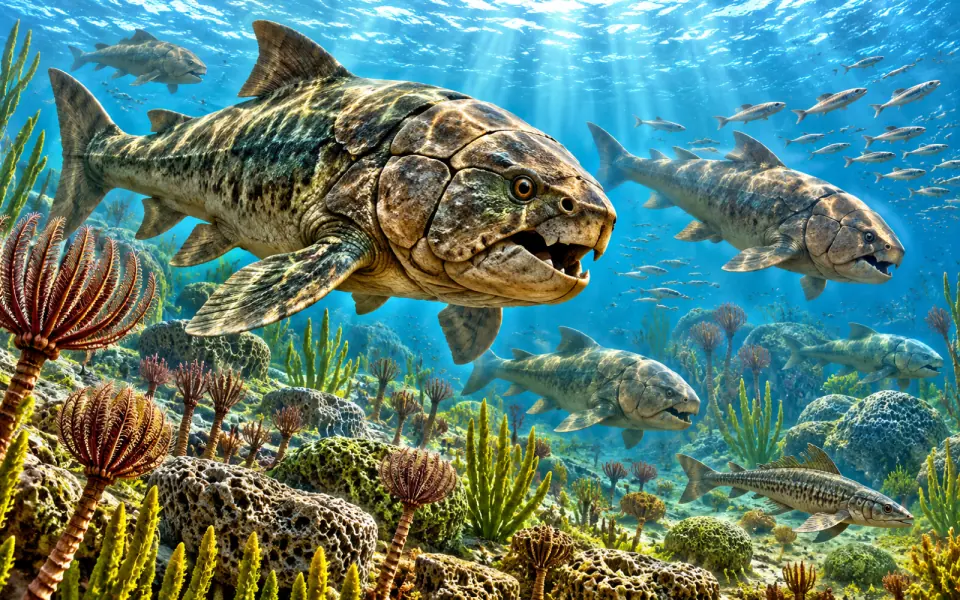 AfterThe first fish with jawsabout 440 million years ago
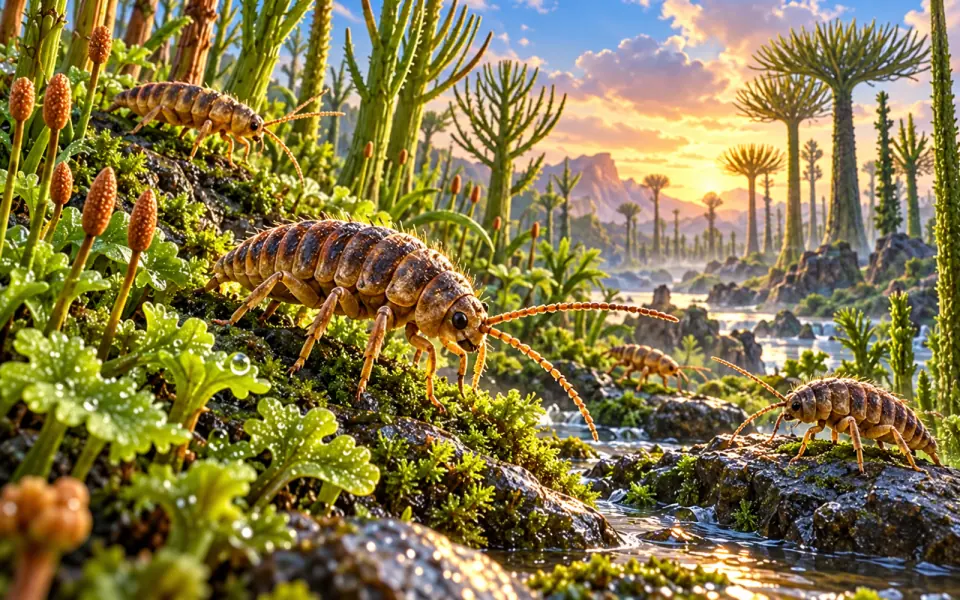 AfterThe first insectsabout 400 million years ago
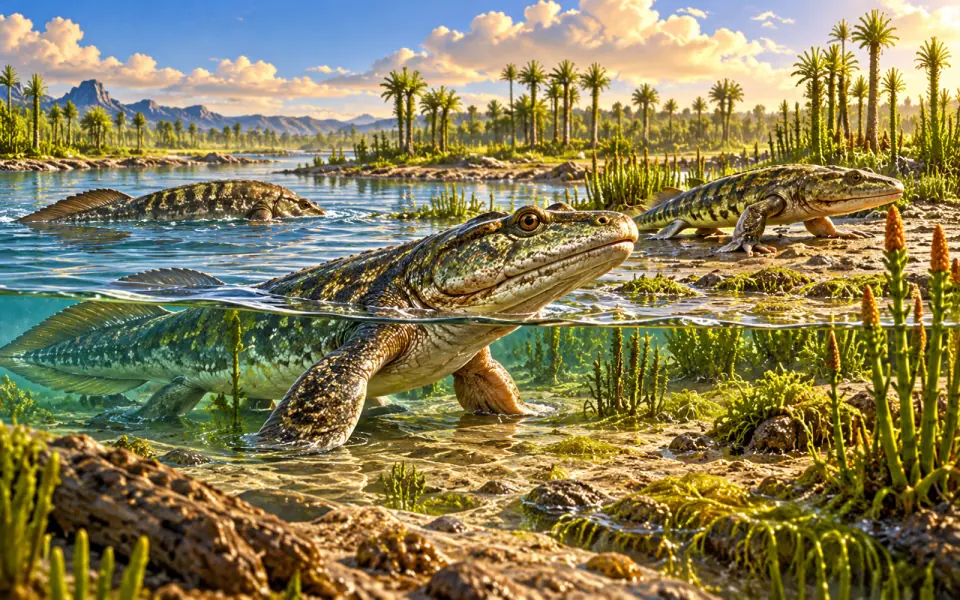 AfterThe first amphibiansabout 375 million years ago
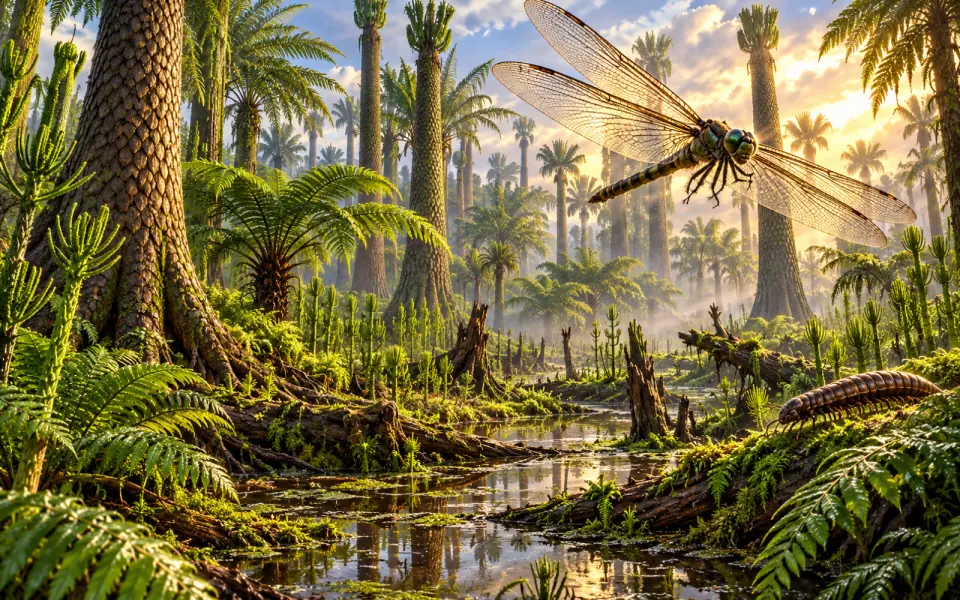 AfterCarboniferous forestsabout 320 million years ago
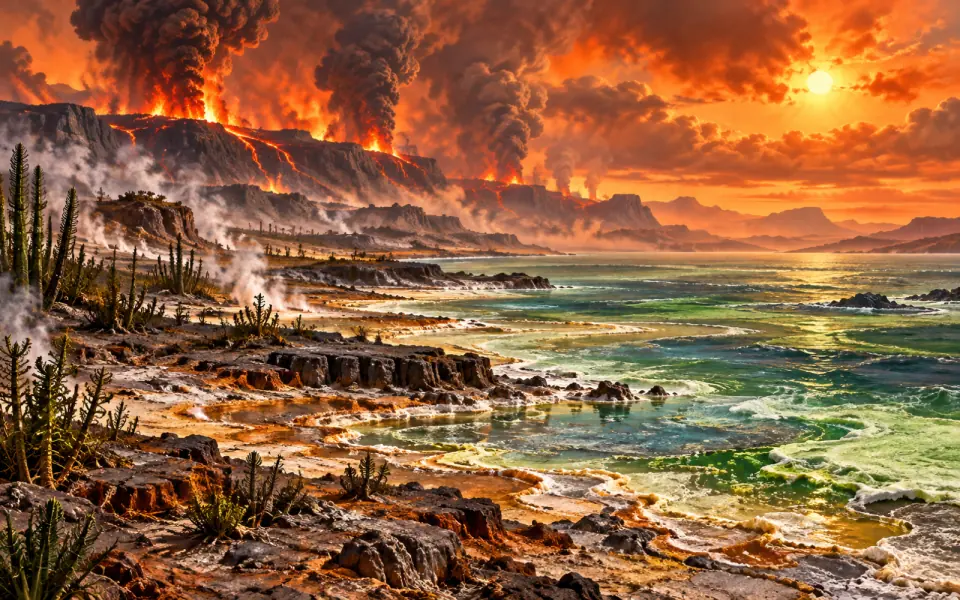 AfterThe great Permian extinctionabout 252 million years ago
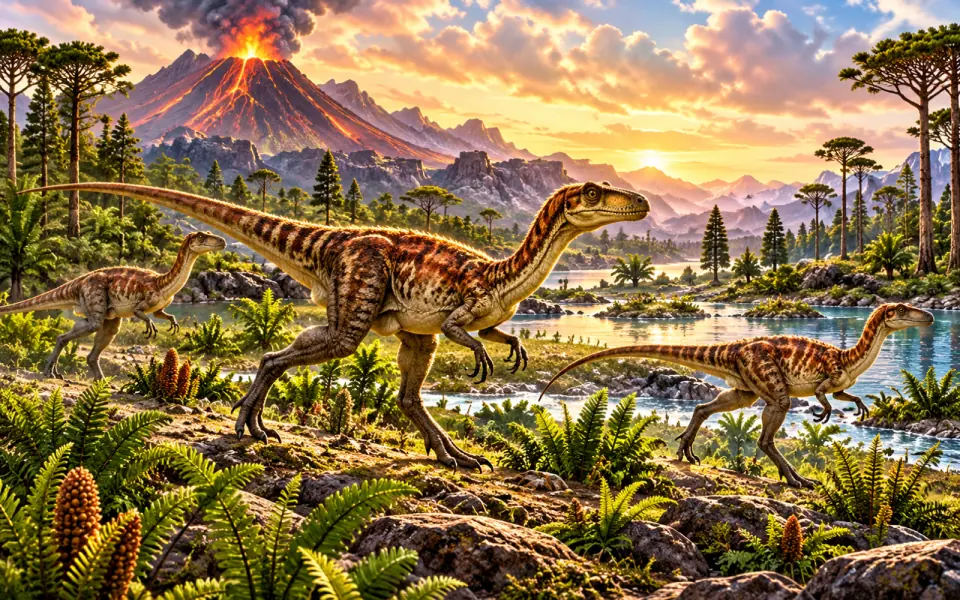 AfterThe first dinosaursabout 230 million years ago
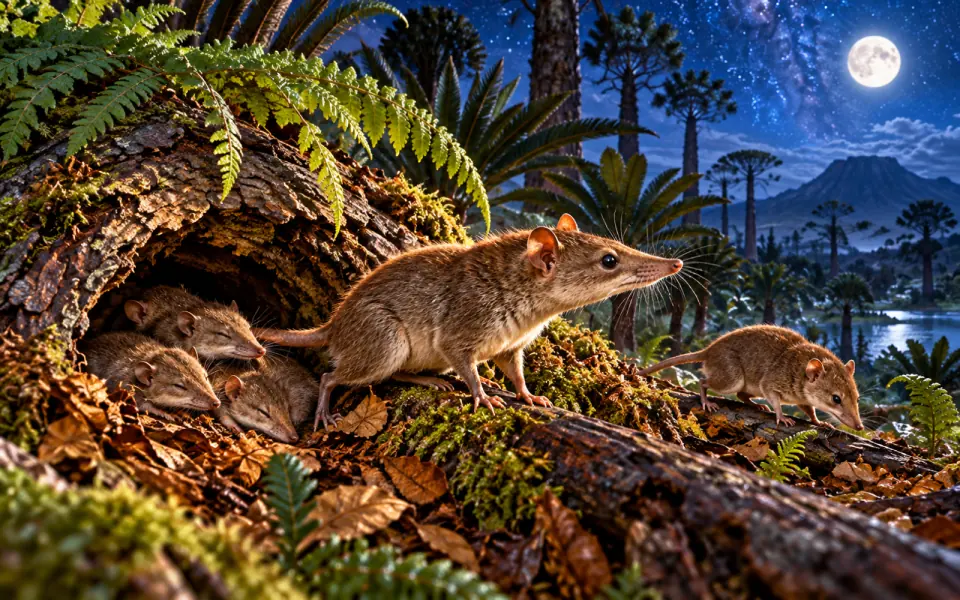 AfterThe first mammalsabout 225 million years ago
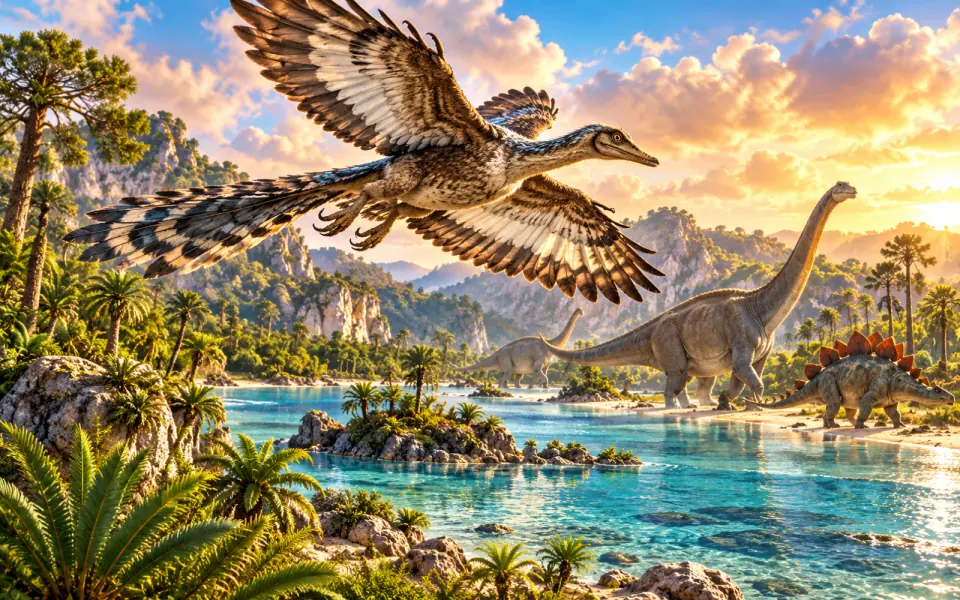 AfterThe first birdsabout 150 million years ago
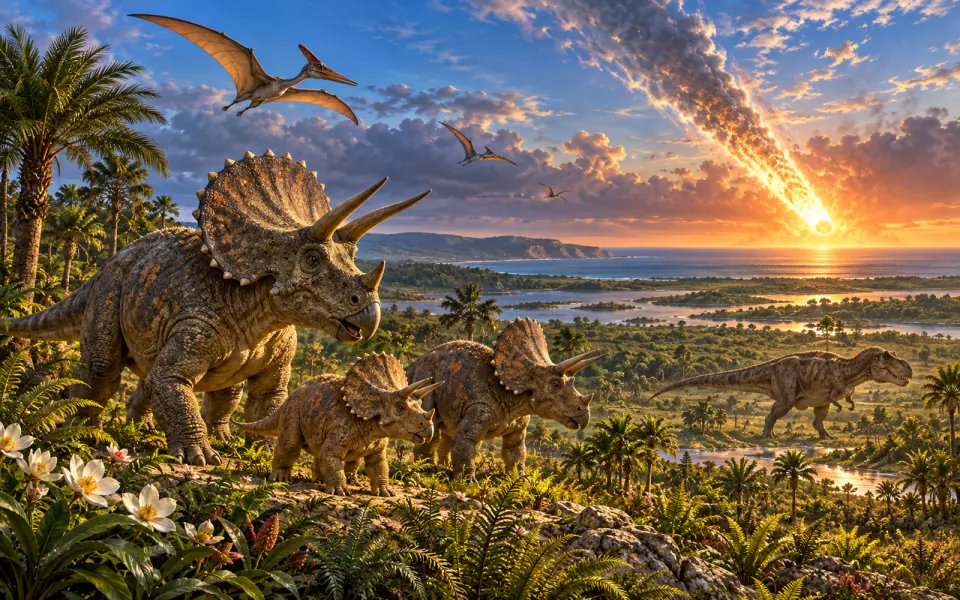 AfterExtinction of the non-avian dinosaursabout 66 million years ago
Listen / Read next
- Music to read by: Cinematic JourneyEpic film-style music, no lyrics, by Ciro Simone IrmiciSpotifyYouTube Music
Meanwhile, elsewhere in the world
Other events of the era “The Earth before us”
- The Big Bang
- The first stars
- Birth of the Milky Way
- Formation of the Solar System
- Formation of the Moon
- The oldest pieces of Earth
- The first oceans
- The first life on Earth
- Cyanobacteria and photosynthesis
- The Great Oxidation Event
- The first complex cells
- The first many-celled living things
- The Ediacaran creatures
- The Cambrian explosion
- The first plants on land
- The first fish with jaws
- The first insects
- The first amphibians
- Carboniferous forests
- The great Permian extinction
- The first dinosaurs
- The first mammals
- The first birds
- Extinction of the non-avian dinosaurs
