Euro notes and coins arrive
2002 Frankfurt (European Central Bank) and the euro countries
In short
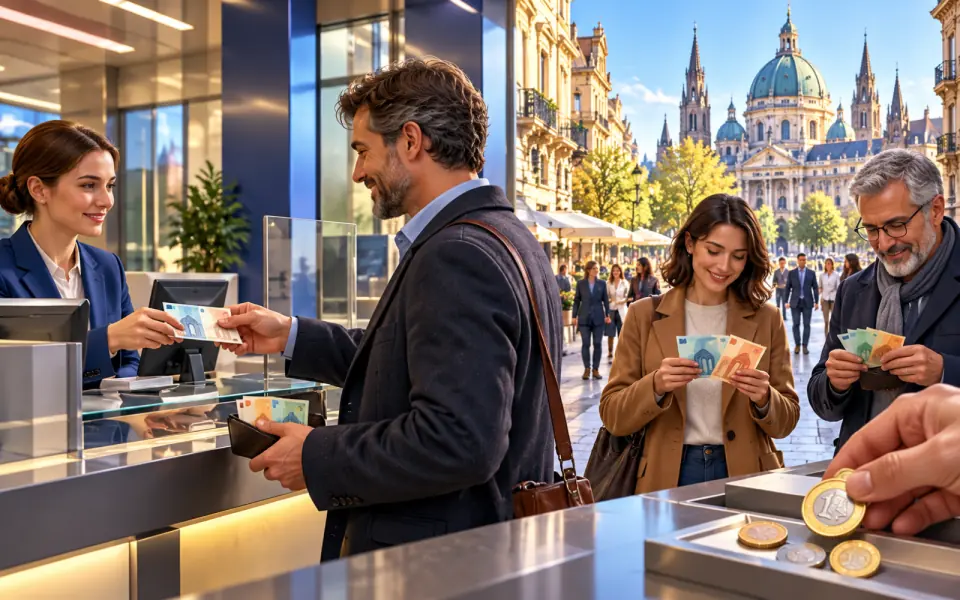
On 1 January 2002, in twelve European countries including Italy, euro coins and banknotes arrived in people's pockets. The new currency had already existed since 1999 for banks and electronic payments. In Italy one euro was worth 1,936.27 lire, and for two months people could pay with both. The banknotes are the same everywhere, while each country designs one side of its coins. Since 2026 there have been 21 euro countries.
Why it matters With a shared currency it is easier to travel and trade in Europe without changing money.
Source: European Union, Learning Corner, “Bulgaria joins euro: new chapter begins”; Banca d'Italia, “L'euro”
Study card about 5 minutes of reading
The story
Many currencies, one market
Until a few decades ago, anyone travelling in Europe had to change money at every border. In Italy people paid in lire, in France in francs, in Germany in marks, in Spain in pesetas. Each time you had to do sums and you lost something in the exchange. Trade suffered too. For businesses it was worse: the value of currencies changed every day, which made prices and profits uncertain. With the single market, goods moved around without customs duties, but the currencies still divided countries.
The idea of a common currency was old, but it became a real project in the Maastricht Treaty of 1992. Countries that wanted to adopt it first had to follow some rules about public finances, called “convergence criteria”: low inflation, and debt and deficit below certain limits. It was a time of sacrifices, particularly for Italy, which had to cut its deficit in order to be among the first to join: in 1997 the government even brought in a “tax for Europe”, partly paid back in the following years.
First in accounts, then in pockets
On 1 January 1999 eleven countries adopted the euro, at first as a “virtual” currency used in bank accounts and electronic payments, while the old currencies kept circulating. The exchange rates between the old currencies and the euro were fixed for good: for Italy, one euro was worth 1,936.27 lire. Meanwhile the European Central Bank was born in Frankfurt, Germany, which decides the monetary policy of all the euro countries, and its first president was the Dutchman Wim Duisenberg.
The decisive step came on 1 January 2002, when euro banknotes and coins really arrived in the pockets of about 300 million people in twelve countries: Austria, Belgium, Finland, France, Germany, Greece, Ireland, Italy, Luxembourg, the Netherlands, Portugal and Spain. For two months you could pay with either currency; in Italy the lira stopped being valid on 28 February 2002. In the weeks before, banks and post offices had handed out packs of euro coins to get people used to them.
What euros look like
There are seven banknotes, from 5 to 500 euros, and they show windows, doors and bridges: they were designed by the Austrian Robert Kalina so that no country is favoured, and they represent architectural styles from different periods of European history, not real buildings. There are eight coins, from one cent to two euros. They have one side that is the same for everyone and another that is different for each country. On the Italian ones you can see symbols such as the Colosseum, Castel del Monte, the Mole Antonelliana, Botticelli's Birth of Venus, the Marcus Aurelius of the Capitoline Hill, Leonardo's Vitruvian Man and Raphael's portrait of Dante. They can be used in all the euro countries, even though the design is different.
The changeover was not without controversy: many Italians had the impression that prices had gone up, especially for everyday goods such as coffee, bread and pizza, although economists estimate that the real increase was smaller than the one people felt.
The euro today
After 2002 other countries joined the euro: Slovenia in 2007, Cyprus and Malta in 2008, Slovakia in 2009, Estonia in 2011, Latvia in 2014, Lithuania in 2015, Croatia in 2023 and Bulgaria on 1 January 2026. Today there are twenty-one countries in the euro area, with about 350 million inhabitants. Some, like Denmark, chose to stay out; Sweden does not meet the conditions; the United Kingdom never adopted it and later left the Union.
Why it happened
The single currency was born to complete the single market: by removing the exchange between currencies, you avoid costs and uncertainty, and it becomes easier to compare prices between countries. It was also a political choice: to tie the economies together even more closely, so as to make a return to the conflicts of the past impossible.
Strength mattered too: the euro, used by more countries, would carry more weight in world trade and financial markets, as a counterweight to the dollar. It also took agreement between very different countries on common rules to keep inflation under control.
What changed
The euro has become one of the most important currencies in the world, used by many non-European countries too for trade and reserves. For citizens it has made travelling, shopping and comparing prices simpler, and it has lowered the cost of loans and mortgages in countries with weaker finances.
The euro has also shown its limits. With one currency but different governments, a country in difficulty can no longer devalue its own currency to help its exports. After the financial crisis of 2008, Greece, Ireland, Portugal, Spain and Italy had serious debt problems, and to save the common currency new rescue mechanisms and stricter checks on budgets were created.
Today Europeans are still debating how to complete the economic union, with a stronger common budget and more shared rules. But in little more than twenty years the euro has become a normal part of daily life for hundreds of millions of people.
Key people and places
People
- Wim Duisenberg
- Dutch banker (1935–2005): first president of the European Central Bank.
- Robert Kalina
- Austrian graphic designer (born 1955): he designed the euro banknotes.
- Jacques Delors
- French politician (1925–2023): president of the European Commission, promoter of the plan for the single currency.
- Mario Draghi
- Italian economist (born 1947): president of the ECB from 2011 to 2019; in 2012 he promised to do “whatever it takes” to save the euro.
- Christine Lagarde
- French lawyer and politician (born 1956): president of the ECB since 2019.
Places
- Frankfurt am Main, Germany
- The seat of the European Central Bank, which guides the euro's monetary policy.
- Rome
- Where the State Mint struck Italy's euro coins.
Good to know
- One euro was worth 1,936.27 lire: that was the rate fixed from 1 January 1999.
- Euro banknotes show imaginary bridges, doors and windows, not real buildings.
- Euro coins have a common side and a national side: on Italian 1-euro coins there is Leonardo's Vitruvian Man.
- In Italy the lira stopped being valid on 28 February 2002.
- Bulgaria became the twenty-first euro country on 1 January 2026.
Find out more
- European Union, Learning Corner: Bulgaria joins the euro learning-corner.learning.europa.eu
- European Central Bank, “The euro” ecb.europa.eu
- Wikipedia, “Euro” en.wikipedia.org
Related events
- The European Union1993 · TodayThe Maastricht Treaty paved the way for the single currency.
- The global financial crisis2008 · TodayThe 2008 crisis tested the single currency.
- Birth of the European Community1957 · TodayThe Treaties of Rome created the common market.
- Coins in the Mediterraneanabout 600 BC · Sea civilisationsThe first coins of the Mediterranean, almost 2,600 years ago, were born to make trade easier.
Before and after, in the era “Today”
Event 18 of 25
 BeforeThe double helix of DNA1953
 BeforeThe polio vaccine1955
 BeforeBirth of the European Community1957
 BeforeThe first artificial satellite1957
 BeforeThe first human in space1961
 BeforePop artabout 1962
 BeforeThe Beatles1963
 BeforeMartin Luther King and civil rights1963
 BeforeThe Moon landing1969
 BeforeThe internet's first ARPANET links1969
 BeforeEarth Day and the environmental movement1970
 BeforeThe personal computer1977
 BeforeThe fall of the Berlin Wall1989
 BeforeThe World Wide Web1991
 BeforeThe European Union1993
 BeforeNelson Mandela becomes president1994
 BeforeThe International Space Station1998
- You are hereEuro notes and coins arrive2002
 AfterThe modern smartphone2007
 AfterThe global financial crisis2008
 AfterMalala wins the Nobel Peace Prize2014
 AfterThe Paris Agreement on climate2015
 AfterThe first image of a black hole2019
 AfterThe COVID-19 pandemic2020
 AfterThe Webb telescope starts observing2022
Listen / Read next
- Music to read by: Cinematic JourneyEpic film-style music, no lyrics, by Ciro Simone IrmiciSpotifyYouTube Music
Meanwhile, elsewhere in the world
Other events of the era “Today”
- The double helix of DNA
- The polio vaccine
- Birth of the European Community
- The first artificial satellite
- The first human in space
- Pop art
- The Beatles
- Martin Luther King and civil rights
- The Moon landing
- The internet's first ARPANET links
- Earth Day and the environmental movement
- The personal computer
- The fall of the Berlin Wall
- The World Wide Web
- The European Union
- Nelson Mandela becomes president
- The International Space Station
- The modern smartphone
- The global financial crisis
- Malala wins the Nobel Peace Prize
- The Paris Agreement on climate
- The first image of a black hole
- The COVID-19 pandemic
- The Webb telescope starts observing
