The fall of the Berlin Wall
1989 Berlin, Germany
In short
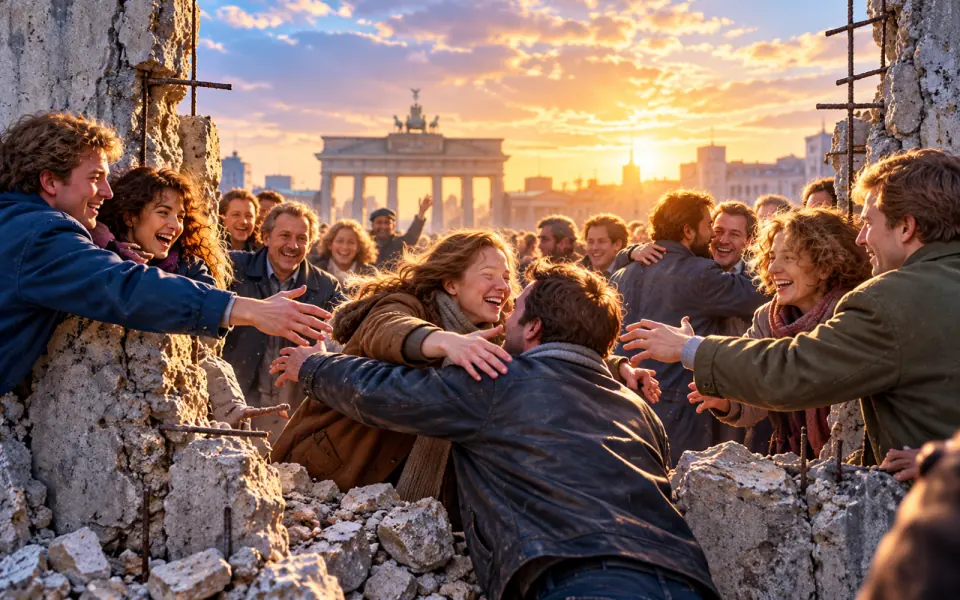
After the Second World War Germany was divided in two, and so was Berlin. In 1961 the communist government of East Germany built a wall to stop its citizens crossing into West Berlin. For 28 years it separated families and friends. On the evening of 9 November 1989, after months of protests, the crossings were opened and thousands of Berliners climbed onto the wall and began to hack at it with pickaxes, celebrating.
Why it matters Its fall led to the reunification of Germany in 1990 and to the end of the Cold War between East and West.
Source: Encyclopaedia Britannica, “Berlin Wall”
Study card about 5 minutes of reading
The story
A city cut in two
At the end of the Second World War defeated Germany was divided into four zones, occupied by the United States, the Soviet Union, the United Kingdom and France. Berlin, the capital, was divided in the same way, even though it lay in the middle of the Soviet zone. With the Cold War the three western zones became West Germany, a democracy with a market economy, while the Soviet zone became East Germany, with a one-party communist regime. Berlin stayed divided: the western part in the west, the eastern part in the east.
In the western part life improved quickly, with full shops and higher wages; in the east there were controls, little freedom and low prices but a scarcity of goods. Until 1961 it was still possible to cross from one side of the city to the other. Millions of East Germans, almost three million between 1949 and 1961, chose to move to the west, mostly young and educated people. The government of the east, which risked being left without inhabitants, decided to stop the exodus.
The Wall
In the night between 12 and 13 August 1961 Berliners woke up to find the city closed off by barbed wire and soldiers. Within a few days the wire was replaced by a concrete wall. In the end it was about 155 kilometres long around West Berlin, with watchtowers, ditches, dogs and a strip of empty ground, the “death strip”, where the guards had orders to shoot anyone trying to escape. Families were divided and streets cut off, sometimes in the middle of a neighbourhood: people waved to each other from window to window.
Many people tried to escape: they dug tunnels, hid in cars with false bottoms, crossed the Wall on ropes or in hot-air balloons. At least 140 people died in the attempt, according to researchers. The American president John Kennedy visited the city in 1963 and said, in front of a crowd: “Ich bin ein Berliner”, “I am a Berliner”, to show his closeness. In 1987 Ronald Reagan, in front of the Brandenburg Gate, called on the Soviet leader to “tear down this wall”.
The autumn of 1989
The change came from the Soviet Union. Mikhail Gorbachev, who became leader in 1985, had started reforms and had declared that the countries of the East could choose their own path without Soviet tanks stepping in. In 1989 Hungary opened its border with Austria, and thousands of East Germans began to flee that way. In Leipzig and other cities, every Monday, tens of thousands of people marched in silence with candles and shouted: “We are the people”. The government did not shoot. The party leader, Erich Honecker, resigned on 18 October.
On the evening of 9 November a government spokesman, Günter Schabowski, at a press conference shown on TV, read out the new rules on travel abroad. A journalist asked from when they applied. Schabowski, who had not read his notes properly, answered: “Immediately, without delay.” In fact the rules were due to come into force the next day, and in an orderly way, but by now the news was spreading. Thousands of people rushed to the checkpoints, especially the one at Bornholmer Straße, and demanded that they be opened. Around 23:30 the commander Harald Jäger, overwhelmed by the crowd and without orders, had the barrier raised completely. The East Berliners crossed, and on the other side were welcomed with hugs and toasts. That night many climbed on the Wall and attacked it with pickaxes.
One country
In the following months the Wall was demolished, and its pieces ended up in homes and museums all over the world. On 3 October 1990 Germany was reunified: after forty-five years there was once again one country and one capital, Berlin. Today 3 October is the German national holiday. A double row of cobblestones in the paving marks the route of the old Wall.
Why it happened
The Wall was built because East Germany was losing too many citizens. It fell because the communist system of the East was in crisis: the economy was doing badly, citizens wanted more freedom and Gorbachev's Soviet Union no longer wanted to use force to hold the empire together.
The peaceful protests, above all in Leipzig, and the pressure from people fleeing through Hungary counted for a great deal. What set off the night of 9 November, however, was a communication mistake: nobody had planned an immediate opening, and the government lost control.
What changed
With the fall of the Wall the division of Europe into two blocs came to an end. Between 1989 and 1991 the communist regimes of Eastern Europe fell one after another, almost all without violence, and in December 1991 the Soviet Union also broke up. The Cold War was over.
The reunited Germany became the most populous country in the European Union. Reunification cost a great deal, and for years the regions of the east were poorer than those of the west; even today there are differences in income and in opinions. Many countries of Eastern Europe, from Poland to the Czech Republic, joined the European Union and NATO later.
The story of the Wall reminds us how precious the freedom to move and to speak is. A piece of the Wall is also kept in many museums and squares around the world, as a warning: never build walls to divide people.
Key people and places
People
- Mikhail Gorbachev
- Soviet leader (1931–2022): his reforms allowed change in Eastern Europe; Nobel Peace Prize in 1990.
- Helmut Kohl
- German chancellor (1930–2017): he led the reunification of Germany.
- Günter Schabowski
- East German official (1929–2015): he announced the opening of the border by mistake.
- Erich Honecker
- Leader of East Germany from 1971 to 1989 (1912–1994): he resigned on 18 October 1989.
- Harald Jäger
- Border officer (1943–2024): he had the Bornholmer Straße checkpoint opened.
Places
- Brandenburg Gate, Berlin
- The monument that symbolises the divided and then reunited city.
- Bornholmer Straße, Berlin
- The first checkpoint opened on the night of 9 November 1989.
Good to know
- The Berlin Wall was about 155 kilometres long around West Berlin.
- On the night of 9 November 1989 the spokesman Schabowski said by mistake that the new travel permits applied “immediately”.
- After the fall many Berliners chipped off pieces of the Wall with pickaxes: they were nicknamed “wall woodpeckers”.
- In 1963 Kennedy said in Berlin “Ich bin ein Berliner”: “I am a Berliner”.
- 3 October, the anniversary of the 1990 reunification, is the German national holiday.
Find out more
- Wikipedia, “Berlin Wall” en.wikipedia.org
- Berlin Wall Foundation, “The Wall” stiftung-berliner-mauer.de
- Wikipedia, “Fall of the Berlin Wall” en.wikipedia.org
- Wikipedia, “Revolutions of 1989” en.wikipedia.org
Related events
- The Second World War1939–1945 · Early 20th centuryThe division of Germany came out of the Second World War.
- The European Union1993 · TodayAfter 1989 Europe came together in a single Union.
- Birth of the European Community1957 · TodayAfter the war, the European Community was born in the West.
- The Russian Revolution1917 · Early 20th centuryIn 1917 the Russian Revolution had created the system that went into crisis in 1989.
Before and after, in the era “Today”
Event 13 of 25
 BeforeThe double helix of DNA1953
 BeforeThe polio vaccine1955
 BeforeBirth of the European Community1957
 BeforeThe first artificial satellite1957
 BeforeThe first human in space1961
 BeforePop artabout 1962
 BeforeThe Beatles1963
 BeforeMartin Luther King and civil rights1963
 BeforeThe Moon landing1969
 BeforeThe internet's first ARPANET links1969
 BeforeEarth Day and the environmental movement1970
 BeforeThe personal computer1977
- You are hereThe fall of the Berlin Wall1989
 AfterThe World Wide Web1991
 AfterThe European Union1993
 AfterNelson Mandela becomes president1994
 AfterThe International Space Station1998
 AfterEuro notes and coins arrive2002
 AfterThe modern smartphone2007
 AfterThe global financial crisis2008
 AfterMalala wins the Nobel Peace Prize2014
 AfterThe Paris Agreement on climate2015
 AfterThe first image of a black hole2019
 AfterThe COVID-19 pandemic2020
 AfterThe Webb telescope starts observing2022
Listen / Read next
- Music to read by: Cinematic JourneyEpic film-style music, no lyrics, by Ciro Simone IrmiciSpotifyYouTube Music
Meanwhile, elsewhere in the world
Other events of the era “Today”
- The double helix of DNA
- The polio vaccine
- Birth of the European Community
- The first artificial satellite
- The first human in space
- Pop art
- The Beatles
- Martin Luther King and civil rights
- The Moon landing
- The internet's first ARPANET links
- Earth Day and the environmental movement
- The personal computer
- The World Wide Web
- The European Union
- Nelson Mandela becomes president
- The International Space Station
- Euro notes and coins arrive
- The modern smartphone
- The global financial crisis
- Malala wins the Nobel Peace Prize
- The Paris Agreement on climate
- The first image of a black hole
- The COVID-19 pandemic
- The Webb telescope starts observing
